hard mTLS: the Handshake & What a Certificate Proves
The one idea: a certificate is public — proof is signing with the private key
A TLS certificate is not a secret. It contains a public key and an identity (a hostname or service
name), wrapped in a signature from a Certificate Authority (CA). Anyone can obtain a copy of it — it is literally sent in
the clear at the start of a connection, and you can scrape it off any public endpoint. So presenting a
certificate proves nothing about who you are. What actually proves identity is a separate step: the peer signs
the handshake transcript with the private key that matches the certificate's public key. That message is called
CertificateVerify, and it is the beating heart of authentication. Only the holder of the private key can
produce a signature the public key will verify, so a valid CertificateVerify proves possession of the private
key — and, because the CA vouched that this key belongs to ledger-svc, it proves the peer is
ledger-svc.
What "mutual" adds
Ordinary (one-way) TLS runs this proof in one direction only: the server proves its identity to the client,
and the client stays anonymous at the transport layer (it typically proves who it is later, with a password or token).
Mutual TLS (mTLS) runs the same proof in both directions. The server additionally asks the
client for a certificate (a CertificateRequest), the client sends its own certificate and its own
CertificateVerify signature, and the server validates it the same way. When the handshake completes, each side has
cryptographic proof of the other's identity, established before a single byte of application data flows.
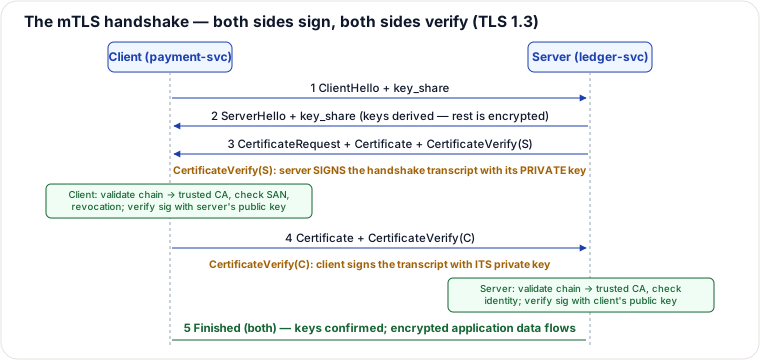
The handshake, traced (TLS 1.3)
- ClientHello — the client offers cipher suites and an ephemeral key share (its half of the Diffie-Hellman exchange).
- ServerHello — the server picks a cipher and returns its key share. Both sides now derive the handshake keys, so everything after this point is encrypted.
- Server flight —
CertificateRequest(only present in mTLS — "you must authenticate too"),Certificate(the server's cert chain), andCertificateVerify(S): the server signs a hash of the entire transcript so far with its private key, thenFinished. The client now (a) validates the chain up to a trusted CA, (b) checks the name/SAN matches who it meant to reach, (c) checks revocation, and (d) verifies the CertificateVerify signature using the public key from the cert. - Client flight — because a CertificateRequest arrived, the client sends its own
CertificateandCertificateVerify(C), signing the transcript with its private key. The server runs the same four checks against the client. - Finished (both) — a MAC over the whole transcript, keyed from the shared secret. It confirms both sides derived identical keys (so the Diffie-Hellman exchange really happened with this peer) and that no handshake message was tampered with. Encrypted application data now flows.
Why signing the transcript — not a static challenge — matters
The transcript includes both sides' fresh random values and ephemeral key shares from this connection. Signing it binds the proof to this specific handshake, so a CertificateVerify captured on the wire cannot be replayed on a new connection. Two distinct facts are being established: the CertificateVerify (an asymmetric signature) proves possession of the private key; the Finished MAC proves both peers actually share the derived session keys. Chain validation supplies the third leg — the CA's promise that this public key belongs to this identity. All three together turn "here is a certificate" into "you are provably who this certificate names."
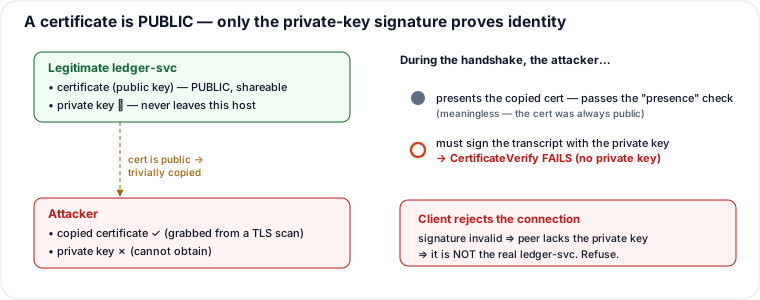
Worked example: why a copied certificate gets you nowhere
Say payment-svc connects to ledger-svc; both hold certs issued by the company's private CA.
| Step | What happens | Result |
|---|---|---|
| Server sends cert | ledger-svc cert (public key P-s, SAN ledger.internal), signed by the CA | public — anyone could hold this |
| Server sends CertificateVerify(S) | sign(privkey-s, transcript-hash) | only the real ledger-svc can make it |
| Client validates | chain → CA ok, SAN = ledger.internal ok, OCSP not-revoked ok, verify sig with P-s ok | server proven |
| Client sends cert + CertificateVerify(C) | payment-svc cert + sign(privkey-c, transcript-hash) | client's turn |
| Server validates | chain → CA ok, identity ok, verify sig with P-c ok | client proven — channel is mutually authenticated |
Now suppose an attacker scraped ledger-svc's certificate (it is public). They present it during a handshake — the
presence check passes, because it always would. But the CertificateVerify step demands a signature from
privkey-s, which never left the real host. The attacker cannot produce it, the client's
verification fails, and the connection is refused. Presence proves nothing; the signature proves everything.
Pitfalls
- Trusting cert presence instead of the proof. The classic breach: an app reads the client
cert's Subject and trusts it, while the TLS layer was configured to request but not require and verify a
client cert — or a proxy terminates TLS and forwards an
X-Client-Certheader that anything on the network can forge. If nothing verified CertificateVerify + chain, the identity is unauthenticated. - Validating the chain but not the identity. "Signed by our CA" is not "is the service I meant." If any workload the CA ever issued a cert to is accepted, one compromised service can impersonate another. You must also pin the expected SAN / SPIFFE ID.
- Skipping revocation. A leaked private key with an unexpired cert stays valid until it expires unless you check OCSP/CRL — and revocation checking is notoriously unreliable (soft-fail). The robust answer is short-lived certs so "revocation" is just "wait for expiry."
- Over-broad trust root. Trusting a public CA (or the OS trust store) for an internal service means any cert that CA issues is accepted. Internal mTLS should trust only a dedicated private CA.
Judgment: when mTLS, and when something else
mTLS vs one-way TLS + app-layer auth (JWT / API key). A bearer token (JWT, API key) is copyable — whoever holds it can replay it, so a leak in a log or a proxy is game over, and you need tight scoping, short expiry, and rotation to contain that. mTLS binds identity to a private key that never leaves the host and authenticates at the transport layer before any request is processed — ideal for service-to-service calls in a zero-trust network. But mTLS identity is coarse ("which service"), carries no fine-grained claims (user id, scopes, tenant), and the certificate lifecycle is heavy. The mature answer is usually both: mTLS for the channel and service identity, a JWT on top for the end-user's identity and authorization scopes.
Hand-rolled mTLS vs a service mesh. Doing mTLS in application code means every service embeds cert loading, trust config, rotation, and verification — duplicated and easy to get subtly wrong (see the pitfalls). A mesh (Istio, Linkerd) puts a sidecar in front of each service that originates and terminates mTLS transparently, auto-rotates identities, and centralizes policy. The cost: extra network hops and latency, sidecar resource overhead, and a new control plane to operate — plus you now trust the mesh's identity system. For a handful of services, a good TLS library may be simpler; at scale, the mesh wins on consistency.
Long-lived certs vs SPIFFE/SPIRE rotation. Long-lived certificates are a liability: a leak is valid for
months or years and revocation is unreliable. SPIFFE defines a workload identity (spiffe://trust-domain/ns/…/sa/…)
and SPIRE issues short-lived X.509 SVIDs (minutes to hours) that auto-rotate, making revocation almost moot — a
compromised cert simply expires. The trade-off is running the identity/attestation infrastructure (SPIRE) that mints and
rotates those certs.
Takeaways
- A certificate is public; possessing or presenting one proves nothing. The CertificateVerify signature over the handshake transcript proves possession of the private key — that is the actual proof of identity.
- mTLS = both peers send a cert + CertificateVerify, and both validate the other's chain to a trusted CA, check the identity/SAN, and check revocation.
- Verify all four — chain, signature, identity, revocation. Trusting mere cert presence, or "signed by our CA" without an identity check, is the recurring real-world vulnerability.
- mTLS authenticates the channel and service; pair it with a JWT for user-level authorization, and lean on a mesh + SPIFFE for automated short-lived rotation at scale.
Re-authored from-scratch for this guide. Mechanism follows RFC 8446 (TLS 1.3); operational guidance adapted from Cloudflare's mTLS docs, the SPIFFE/SPIRE project, and the Istio/Linkerd security models. Deepened for this guide.
🤖 Don't fully get this? Learn it with Claude
Stuck on mTLS: the Handshake & What a Certificate Proves? Open Claude, copy a block below, and it'll teach you this exact concept — visually and interactively.
Build the mental picture, not memorization.
I just read a lesson on **mTLS: the Handshake & What a Certificate Proves** (System Design) and want to truly understand it. Explain mTLS: the Handshake & What a Certificate Proves from first principles using ONE vivid real-world analogy and a visual mental model — draw it as ASCII art or a clear step-by-step diagram — with a concrete example using real numbers. Then ask me one question to check I got the mental picture, and wait for my reply. If you're unsure or a claim isn't standard, say so and reason from first principles instead of guessing.
Socratic — adapts to where you're stuck.
Teach me **mTLS: the Handshake & What a Certificate Proves** interactively. Ask me ONE guiding question at a time, wait for my answer, and adapt to my confusion — build the idea with me step by step instead of explaining it all at once. If you're unsure or a claim isn't standard, say so and reason from first principles instead of guessing.
Active recall exposes what you missed.
Quiz me on **mTLS: the Handshake & What a Certificate Proves** with 5 questions, easy to tricky, ONE at a time. Tell me if each answer is right; at the end, explain clearly what I got wrong and why. If you're unsure or a claim isn't standard, say so and reason from first principles instead of guessing.
Intuition + hook + flashcards for long-term memory.
Help me remember **mTLS: the Handshake & What a Certificate Proves** for the long term: give the one-sentence intuition, a memorable hook/mnemonic, a tiny worked example, and 3 active-recall flashcards (Q -> A). If you're unsure or a claim isn't standard, say so and reason from first principles instead of guessing.