What Are The Trade‑offs Between Server‑stored Sessions And JWTs for Authentication
HTTP is stateless, so both schemes solve the same problem — proving on request N that you are the same person who logged in on request 1 — but they put the proof of trust in opposite places: a server session hands the client a meaningless random ID and keeps the real state in a store the server owns, so every request costs a lookup the server can delete at will; a JWT hands the client the state itself, cryptographically signed, so every request is a local signature verification with no lookup — which is exactly why the server can no longer take it back before it expires.
The two mechanisms, precisely
Server session: on login the server generates a high-entropy random ID (e.g. 128 bits), writes session:ID → {userId, role, loginAt, expiresAt} to a store (Redis, DB, or memory), and returns it in a Set-Cookie. The cookie value carries no meaning — it is a pointer. On each later request the server reads that key back to reconstruct who you are. Trust lives in the store.
JWT: on login the server builds a token in three dot-separated base64url parts — header.payload.signature — where the signature is HMAC-SHA256(header + "." + payload, secret) (or an RSA/ECDSA signature). It returns the whole token. On each later request the server recomputes the signature over the received header and payload and checks it matches, then trusts the claims inside. Trust lives in the signing key. No store is read.
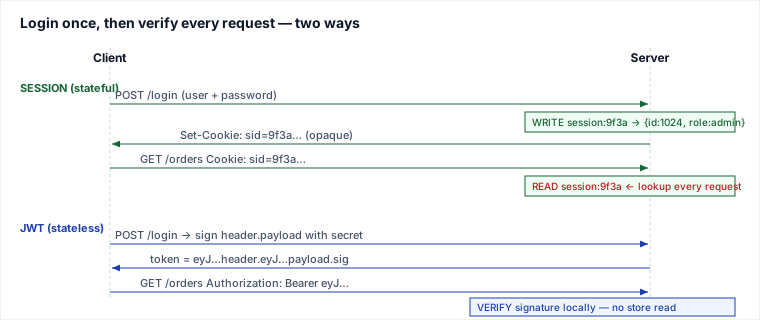
A worked example: one protected request, both ways
User 1024 (an admin) logs in, then calls GET /orders. Follow the exact bytes.
JWT built at login — three parts, base64url-encoded:
header  = {"alg":"HS256","typ":"JWT"}
        → eyJhbGciOiJIUzI1NiIsInR5cCI6IkpXVCJ9
payload = {"sub":"1024","role":"admin","iat":1751496400,"exp":1751497300}
        → eyJzdWIiOiIxMDI0Iiwicm9sZSI6ImFkbWluIiwi…
sig     = HMAC_SHA256(header + "." + payload, SECRET)
        → 3pQ8t7… (base64url)

token   = header.payload.sig   (exp is 15 min after iat)
Now the GET /orders at t = 1751496900 (8 min after login):
| Step | Server session | JWT |
|---|---|---|
| 1. Read credential from request | Cookie sid=9f3a… | Header Authorization: Bearer eyJ… |
| 2. Establish identity | GET session:9f3a from Redis → {id:1024, role:admin} (a network round-trip, ~0.5 ms) | Recompute HMAC_SHA256(header.payload, SECRET), compare to sig → match (~5 µs, no I/O) |
| 3. Check expiry | Compare store's expiresAt to now | Check exp = 1751497300 > 1751496900 → still valid |
| 4. Authorize | role from store | role from decoded payload |
| 5. Admin gets demoted to viewer at t+9min | Update the store row → next request is a viewer | Token still says role:admin until exp → stays admin for up to 15 min |
Step 5 is the whole argument in one row. The session's identity is re-read from a mutable source of truth every time, so a change takes effect on the very next request. The JWT froze role:admin at issue time; the server has no way to reach into an already-issued token, so the demotion (or a logout, or a ban) does not bite until the token expires.
Revocation is the crux
Everything else is a gradient; revocation is a wall. To make JWTs revocable you have exactly two moves, and both cost you the property you chose JWTs for:
- Short-lived access token + refresh token. Keep the access token to ~5–15 min so a stolen or stale token self-heals quickly; issue a long-lived refresh token (stored server-side) that the client trades for a fresh access token. Revocation = delete the refresh token, then wait out the short access-token window. This is the standard answer, but the refresh side is stateful — you are back to a store lookup, just less often. Make refresh tokens single-use and rotate them on every exchange; if one refresh token is ever redeemed twice (an attacker and the real client racing to redeem the stolen copy), treat the reuse as a theft signal and revoke the entire token family — not merely the request that lost the race, or whichever request wins sails through undetected while the other silently fails.
- A denylist (blocklist) of revoked token IDs. Give each token a
jtiand check it against a revoked-set on every request. This works, but now every request does the store read you adopted JWTs to avoid — you have re-created sessions with extra steps.
There is no third option that keeps statelessness and immediate revocation. Accepting a revocation window, or paying for a store, is the price of the JWT model.
The comparison, sharpened
| Aspect | Server-stored sessions | JWT (stateless tokens) |
|---|---|---|
| Where state lives | Server store; cookie is an opaque pointer | Inside the signed token on the client |
| Per-request cost | Store lookup (network/DB I/O) | Local signature verify (CPU only) |
| Immediate revocation | Yes — delete the record | No — valid until exp unless you add a denylist |
| Horizontal scaling | Needs sticky sessions or a shared store (Redis) | Any node verifies independently with the key |
| Cross-service / SSO | Shared session store or token exchange | Natural — anyone trusting the key accepts it |
| Payload visibility | Hidden; stays server-side | base64, readable by anyone (signed, not encrypted) |
| Size on the wire | Tiny (~30-byte ID) | Hundreds of bytes on every request |
| Main theft vector | CSRF (cookie auto-sent) → use SameSite + CSRF tokens | XSS if kept in localStorage → prefer HttpOnly cookie |
Pitfalls engineers actually hit
- Trusting the payload without verifying the signature. Decoding a JWT is just base64 — anyone can do it and change
roletoadmin. If your code reads claims before (or instead of) verifying the signature, you have no auth at all. Always verify first, read claims second. - The
algconfusion /alg:noneattack. Older libraries honored the token's ownalgheader. An attacker setsalg:none(no signature) or downgrades RS256→HS256 and signs with your public key as if it were the HMAC secret. Pin the expected algorithm server-side; never let the token pick. - JWT in localStorage. Convenient, but any XSS payload can read it and exfiltrate a bearer credential that works everywhere until
exp. An HttpOnly cookie can't be read by JS. If you must use headers, keep the token very short-lived. - Putting secrets in the payload. It's signed, not encrypted. Email, internal IDs, feature flags — all readable by the client and anyone who intercepts a log line.
- Clock skew on
exp. Verifier and issuer clocks drift; tokens are rejected "early" or accepted "late." Allow a small leeway (e.g. 30–60 s) and run NTP. - Rotating the JWKS signing key too fast. Verifiers fetch public keys from a JWKS endpoint and pick the one whose
kidmatches the token. If you retire the old key before every token signed under it has expired, nodes that only trust the new key set reject perfectly live tokens. Keep the previous key(s) published for at least the maximum access-token lifetime — rotation is a multi-window overlap, not a delete. - Session fixation. If you don't regenerate the session ID at the moment of login, an attacker who planted a known ID pre-login rides the authenticated session. Regenerate the ID on privilege change.
- Sticky sessions + in-memory store = lost logins on deploy. Every scale-in, restart, or rebalance drops the sessions on that node and logs those users out. Externalize to Redis before you scale horizontally.
- "Stateless" denylist creep. Teams add a revocation list "just for logout," then check it everywhere — silently turning JWT back into sessions while keeping JWT's downsides (big tokens, readable payloads).
When to use which — and a third option
Choose server sessions when the front end and back end share an origin (server-rendered app, classic web), when instant revocation is a hard requirement (banking, admin consoles, "log out all devices" on password change), or when you're small enough that one Redis is trivial. You gain a single mutable source of truth and cheap correctness; you pay a lookup per request and must run a store.
Prefer JWTs when many independent services must authenticate the same caller without sharing a session database (microservices, third-party APIs), for mobile/SPA clients on separate domains, or for SSO where a token issued once is trusted across a mesh. You gain lookup-free, share-nothing verification that scales flat; you pay with the revocation wall, bigger requests, and a client-readable payload.
Named alternative — reference (opaque) tokens with introspection. Issue a random opaque token like a session ID, but hand it around like a bearer token; resource servers validate it by calling the auth server's introspection endpoint (or a shared cache). This is the OAuth middle path: you keep JWT-style bearer ergonomics and cross-service reach and instant revocation (the auth server just stops honoring it), at the cost of a validation round-trip — essentially trading JWT's local verify for a lookup, on purpose. Pick JWT when the network hop per request is the thing you can't afford; pick reference tokens when revocation latency is the thing you can't afford.
Crisp rule: choose sessions for same-origin apps that need instant control; choose JWTs for share-nothing, cross-service scale where a short revocation window is acceptable; choose reference tokens when you want bearer-style distribution but must revoke on a dime. The common hybrid — short-lived JWT access token backed by a stateful refresh token — is popular precisely because it buys most of the JWT scaling win while bounding the revocation window to minutes.
Takeaways
- Sessions put trust in a store (lookup per request, revoke instantly); JWTs put trust in a signature (verify locally, can't revoke before
exp). That single split explains every other difference. - Revocation is the deciding axis: making JWTs revocable via a denylist or refresh tokens reintroduces the very statefulness you left sessions to escape.
- Security threat models differ: cookies invite CSRF (mitigate with SameSite/CSRF tokens); localStorage JWTs invite XSS (prefer HttpOnly cookies, short lifetimes). Never verify claims before checking the signature, and always pin the algorithm.
- It isn't binary — short JWT + stateful refresh, or opaque reference tokens with introspection, deliberately trade a little scale for bounded or instant revocation.
Re-authored and deepened for this guide. Sources: RFC 7519 (JSON Web Token) and RFC 7515 (JSON Web Signature); RFC 6749/7662 (OAuth 2.0 and token introspection) for the reference-token pattern; OWASP Session Management and JWT/authentication cheat sheets for the CSRF/XSS and alg-confusion pitfalls; Auth0 and Okta engineering docs on access/refresh-token rotation and revocation windows.
🤖 Don't fully get this? Learn it with Claude
Stuck on What Are The Trade‑offs Between Server‑stored Sessions And JWTs for Authentication? Open Claude, copy a block below, and it'll teach you this exact concept — visually and interactively.
Build the mental picture, not memorization.
I just read a lesson on **What Are The Trade‑offs Between Server‑stored Sessions And JWTs for Authentication** (System Design) and want to truly understand it. Explain What Are The Trade‑offs Between Server‑stored Sessions And JWTs for Authentication from first principles using ONE vivid real-world analogy and a visual mental model — draw it as ASCII art or a clear step-by-step diagram — with a concrete example using real numbers. Then ask me one question to check I got the mental picture, and wait for my reply. If you're unsure or a claim isn't standard, say so and reason from first principles instead of guessing.
Socratic — adapts to where you're stuck.
Teach me **What Are The Trade‑offs Between Server‑stored Sessions And JWTs for Authentication** interactively. Ask me ONE guiding question at a time, wait for my answer, and adapt to my confusion — build the idea with me step by step instead of explaining it all at once. If you're unsure or a claim isn't standard, say so and reason from first principles instead of guessing.
Active recall exposes what you missed.
Quiz me on **What Are The Trade‑offs Between Server‑stored Sessions And JWTs for Authentication** with 5 questions, easy to tricky, ONE at a time. Tell me if each answer is right; at the end, explain clearly what I got wrong and why. If you're unsure or a claim isn't standard, say so and reason from first principles instead of guessing.
Intuition + hook + flashcards for long-term memory.
Help me remember **What Are The Trade‑offs Between Server‑stored Sessions And JWTs for Authentication** for the long term: give the one-sentence intuition, a memorable hook/mnemonic, a tiny worked example, and 3 active-recall flashcards (Q -> A). If you're unsure or a claim isn't standard, say so and reason from first principles instead of guessing.