Cell-Based Architecture & Shuffle Sharding — Bounding the Blast Radius
Cell-Based Architecture & Shuffle Sharding — Bounding the Blast Radius
The scenario you must be able to answer: "A single poison tenant is browning out everyone — a runaway query pattern, a pathological request, or just 100× their fair share of load. Cap the blast radius without giving every tenant its own cluster." Per-tenant clusters would work, but the cost and operational load are absurd at thousands of tenants. The real answer is architectural fault isolation: partition the fleet so one bad actor can only hurt a bounded slice of customers. Two composable techniques do this — cells (isolate at the stack level) and shuffle sharding (isolate at the node level). Together they take blast radius from 100% of customers down to a fraction of a percent.
Mechanism 1 — the cell
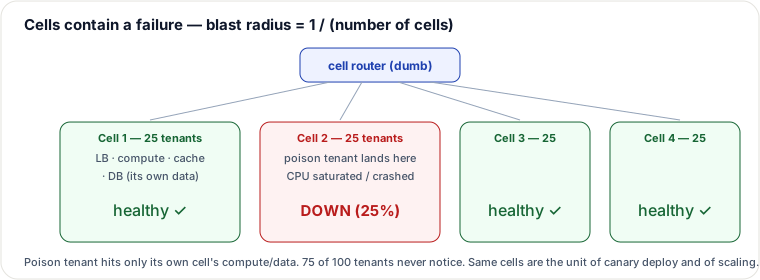
A cell is a complete, self-contained instance of your entire stack — load balancer, compute, cache, database, queues — sized to serve a subset of customers. Cells share nothing at the data or request-serving plane: a request handled in cell 3 never touches cell 1's database, threads, or connection pool. That shared-nothing boundary is the whole point. Any failure that would normally spread — a poison request that corrupts in-memory state, a hot tenant saturating CPU, a bad deploy, a cache stampede, a lock convoy — is contained to the one cell it started in. Everyone outside that cell is untouched.
A thin cell router sits in front and maps each customer to exactly one cell (by customer_id hash, tenant tier, or region). The router is deliberately dumb: it does routing and nothing else, so it holds no per-request business logic that could itself fail and take everyone down. Because cells are independent copies, they double as the unit of deploy (roll a new version cell-by-cell as waves/canaries — a bad build blasts one cell, you halt the wave) and the unit of scale (near capacity? add a cell, don't grow one giant fleet).
Cell blast-radius math
With a shared fleet, one poison tenant that exhausts a shared resource takes down 100% of customers. Split into C equal cells and the worst a single-cell failure can do is 1/C of customers:
4 cells → max blast radius 25%. 10 cells → 10%. 20 cells → 5%.
More cells means smaller blast radius but also more operational multiplicity (see pitfalls). Cell count is the tuning knob between isolation and overhead. Note the residual gap: even one cell down is 25% of customers — cells alone bound the damage but do not make it small. That is what shuffle sharding fixes.
Mechanism 2 — shuffle sharding
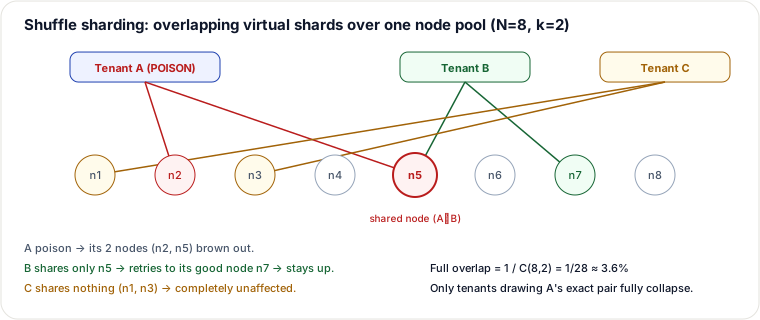
Ordinary sharding assigns each tenant to one node (or one cell). If your node is poisoned, you are 100% down, and every tenant on that node shares fate. Shuffle sharding changes the assignment: give each tenant a random subset of k nodes out of a pool of N — a "virtual shard." The tenant's traffic spreads across its k nodes (via the load balancer). The magic is combinatorial: two tenants rarely draw the same subset, so a poison tenant only degrades the handful of nodes it landed on, and almost no other tenant has all its nodes inside that set.
The number of distinct subsets is the binomial coefficient C(N, k). The chance another tenant draws your exact subset — the only way it is fully collapsed when you go poison — is 1 / C(N, k).
The combinatorics, derived (N=8, k=2)
Pool of 8 nodes, shard size 2. Distinct shards: C(8,2) = 28. Fix the poison tenant's pair, say {n2, n5}. For any other tenant drawing a random pair, there are exactly three outcomes:
- Shares both nodes (identical shard): only 1 of 28 → 1/28 ≈ 3.6%. These are the only tenants fully impacted — both their nodes are poisoned.
- Shares exactly one node: pick which of A's 2 nodes (2 ways) × the other node from the remaining 6 (6 ways) = 12 of 28 → 43%. One node bad, k−1 = 1 node still good — the load balancer / a retry routes around the bad node and the tenant survives, merely losing some headroom.
- Shares no node: C(6,2) = 15 of 28 → 54% — entirely unaffected.
Check: 1 + 12 + 15 = 28. ✓ This is why shuffle sharding pairs so naturally with retries: it engineers the common case to be "you share part of a shard with the bad actor," and a single retry to your unaffected node hides it. Only the exact-match tenants are truly down.
It scales ferociously. Because C(N,k) explodes, modest N and k give astronomical isolation. AWS's canonical figure: N=100, k=5 → C(100,5) = 75,287,520 distinct shards — the odds a second tenant fully shares your shard are ~1 in 75 million. Route 53 uses exactly this to assign each customer a shuffle shard of name servers, so one customer under DDoS cannot take out others.
Traced example — 100 tenants, 1 sends poison traffic
- (a) Shared fleet: one poison tenant exhausts the shared CPU / connection pool / lock → all 100 tenants down (100%).
- (b) 4 cells (25 tenants each): poison lands in one cell → that cell browns out → 25 tenants down (25%), the other 75 untouched.
- (c) Shuffle sharding, N=8, k=2: expected tenants that fully collapse = 99 × (1/28) ≈ 3.5 tenants (~3.5%). About 43% (~42 tenants) share one node but ride their good node via retries — assuming each node runs at under ~50% utilization, so the surviving node can absorb the failed-over traffic; ~54% never touch the poison nodes. Push to N=100, k=5 and the fully-impacted fraction drops toward zero.
The progression — 100% → 25% → ~3.5% → effectively 0% — is the entire story. Cells cap the ceiling; shuffle sharding drives the actual damage into the noise.
Pitfalls a staff interviewer will probe
- Stateful data partitioning. Cells only isolate if a customer's data lives entirely in their cell. Cross-cell data access reintroduces a shared dependency (and thus shared blast radius) and is expensive/slow. This forces a partition key (usually
customer_id) and makes cross-tenant features (global search, org-wide analytics) genuinely hard. Migrating a customer between cells means moving their data. - The router / control plane is the new SPOF. The cell router, the shard-assignment service, shared auth, a shared config/metadata store — anything all requests traverse is a shared fate-sharing component that quietly restores 100% blast radius. Keep the router dumb, statically cacheable, and itself cell-aware or partitioned; assign shards from immutable config, not a live lookup on the hot path.
- Operational multiplicity. N cells = N of everything to deploy, observe, patch, and page on. Dashboards must aggregate and drill per-cell; a per-cell metric anomaly is your early failure signal. Automation is mandatory — manual per-cell ops does not scale.
- Detection needs a response step. Identifying the poison tenant is only half the runbook. The mitigation is to re-shard the offender onto a dedicated quarantine shard (nodes serving no one else) or throttle it at the router — that ends the incident for everyone who shared a node with it, because its former nodes recover the moment its traffic moves. Quarantine is the operational complement to shuffle sharding: the combinatorics bound the damage; evacuation ends it.
- Rebalancing. Tenants grow unevenly; a cell gets hot. Rebalancing means moving tenants (and data) across cells without downtime — a hard, ongoing problem. Over-provision cell headroom and cap per-cell tenant count.
- Shuffle-shard sizing. Too small a k and a single bad node meaningfully dents a tenant with no spare; too large a k and shards overlap more (isolation drops toward plain sharding). And each node must have spare capacity to absorb its share of neighbors during a partial failure.
Selection & trade-offs vs the named alternatives
- Monolithic shared fleet — cheapest, simplest, one thing to run. Blast radius 100%: any poison tenant, bad deploy, or hot key hurts everyone. Correct choice at small scale / single-tenant / low stakes. Do not add cells here — it is pure overhead.
- Per-tenant clusters (silo model) — perfect isolation, blast radius 1 tenant, and clean for regulated/dedicated-tier customers. But cost and operational load scale linearly with tenant count — untenable for thousands of small tenants, and each cluster is under-utilized. This is the "give everyone their own cluster" the prompt explicitly rules out.
- Cell-based architecture — the middle ground: blast radius 1/C, amortized cost (25 tenants share a cell's fixed overhead), and cells double as deploy/scale units. Cost: data partitioning, router SPOF risk, N-fold ops.
- Cells + shuffle sharding — best isolation-per-dollar: cap the ceiling with cells, then shuffle-shard within the fleet so even a single-cell incident spares almost everyone in it. This is the staff-level answer to the prompt. Cost: retry logic and spare node capacity, plus the sizing/rebalancing complexity above.
When cells are overkill: small scale, few tenants, or non-critical workloads — a monolith is right and cells are premature complexity. When cells (and shuffle sharding) are mandatory: large multi-tenant SaaS where one tenant will eventually misbehave, high-availability control planes, and regulated workloads needing demonstrable isolation between customers.
Takeaways
- A cell is a shared-nothing full-stack instance serving a customer subset; a fault is contained to one cell, so blast radius = 1/(number of cells). Cells are also your deploy-wave and scale unit.
- Shuffle sharding gives each tenant a random
k-of-Nnode subset; the chance another tenant fully overlaps is 1/C(N,k) — combined with retries, a poison tenant fully impacts only its exact-match neighbors (99×1/28 ≈ 3.5 of 100). - The isolation ladder for one poison tenant: shared fleet 100% → 4 cells 25% → shuffle sharding N=8,k=2 ~3.5% → N=100,k=5 essentially 0.
- Watch the leaks: cross-cell data, a shared router/control plane, and N-fold operational cost are what quietly re-widen the blast radius you worked to shrink.
Re-authored for this guide; diagrams hand-authored as inline SVG; combinatorics verified. Sources: AWS Builders' Library — "Workload isolation using shuffle-sharding" (the N=100, k=5 → 75,287,520 figure and the Route 53 name-server shuffle shards) and "Reducing the scope of impact with cell-based architecture." See also: Bulkhead Sizing, Rate Limiting, Designing for Failure, The Consistency Spectrum.
🤖 Don't fully get this? Learn it with Claude
Stuck on Cell-Based Architecture & Shuffle Sharding — Bounding the Blast Radius? Open Claude, copy a block below, and it'll teach you this exact concept — visually and interactively.
Build the mental picture, not memorization.
I just read a lesson on **Cell-Based Architecture & Shuffle Sharding — Bounding the Blast Radius** (System Design) and want to truly understand it. Explain Cell-Based Architecture & Shuffle Sharding — Bounding the Blast Radius from first principles using ONE vivid real-world analogy and a visual mental model — draw it as ASCII art or a clear step-by-step diagram — with a concrete example using real numbers. Then ask me one question to check I got the mental picture, and wait for my reply. If you're unsure or a claim isn't standard, say so and reason from first principles instead of guessing.
Socratic — adapts to where you're stuck.
Teach me **Cell-Based Architecture & Shuffle Sharding — Bounding the Blast Radius** interactively. Ask me ONE guiding question at a time, wait for my answer, and adapt to my confusion — build the idea with me step by step instead of explaining it all at once. If you're unsure or a claim isn't standard, say so and reason from first principles instead of guessing.
Active recall exposes what you missed.
Quiz me on **Cell-Based Architecture & Shuffle Sharding — Bounding the Blast Radius** with 5 questions, easy to tricky, ONE at a time. Tell me if each answer is right; at the end, explain clearly what I got wrong and why. If you're unsure or a claim isn't standard, say so and reason from first principles instead of guessing.
Intuition + hook + flashcards for long-term memory.
Help me remember **Cell-Based Architecture & Shuffle Sharding — Bounding the Blast Radius** for the long term: give the one-sentence intuition, a memorable hook/mnemonic, a tiny worked example, and 3 active-recall flashcards (Q -> A). If you're unsure or a claim isn't standard, say so and reason from first principles instead of guessing.