What Are Idempotent Producers And Consumers, And How Do De‑duplication Keys Work
Idempotent producers and consumers in messaging systems are components that guarantee duplicate messages have no additional effect, ensuring that sending or processing the same message multiple times is equivalent to doing it once by filtering out repeats through unique de‑duplication keys.
Understanding Idempotence in Messaging Systems
In computing, idempotence refers to an operation that can be performed multiple times without changing the result beyond the initial application.
In the context of messaging systems and streaming platforms, this means if the same message is delivered or processed more than once (a common scenario in distributed systems), it will not adversely affect the system state.
Idempotent message processing is crucial for reliability in at-least-once delivery models, where a message broker may deliver a message multiple times to ensure it isn't lost.
Without idempotence, duplicate messages could lead to errors. For example, subtracting money from an account twice or sending the same notification email repeatedly.
By making producers and consumers idempotent, we ensure exactly-once effect: duplicates are detected and ignored, preserving data integrity and preventing bugs.
Idempotent Producers (Sending Messages Safely)
An idempotent producer is a message publisher designed to avoid introducing duplicate messages into a system.
In unreliable networks or broker failures, a producer might send the same message more than once (for instance, if it didn’t get an acknowledgment and retried).
Normally, this could result in the message being stored twice on the broker (causing duplicate events).
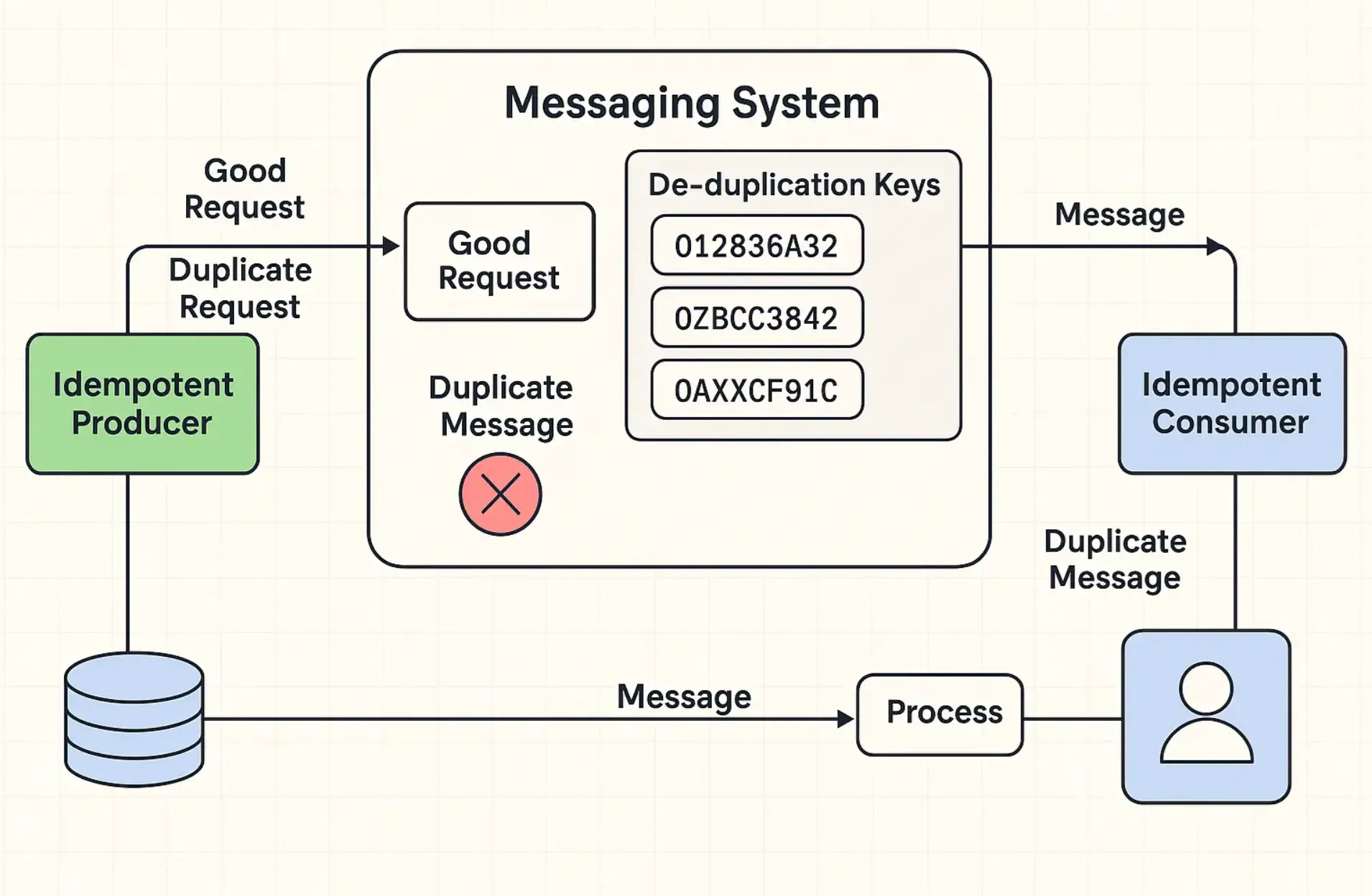
An idempotent producer solves this by attaching a unique identifier to each message and having the messaging system use it for de-duplication.
For example, Apache Kafka’s producers can be configured as idempotent: Kafka assigns a Producer ID (PID) to each producer and a sequence number to each message.
The broker tracks the last sequence number it has written for each (producer ID, partition). A retry carrying an already-written sequence number is recognized as a duplicate and dropped without a second append (the producer still gets a success). A sequence number that skips ahead of the expected next value is rejected with an out-of-order-sequence error — the two cases are handled differently, and only the first one is deduplication.
This means even if the producer retries sending the same record, Kafka will recognize the duplicate and persist it only once.
Many streaming and messaging systems implement or support idempotent producer semantics. In Kafka, enabling the enable.idempotence=true setting activates this feature (often combined with acks=all for strong delivery guarantees).
Another example is Amazon SQS FIFO queues, which use a message deduplication ID: if a producer sends a message with the same de-duplication ID as one sent in the previous 5 minutes, the queue will acknowledge the new send but not deliver a duplicate to consumers.
In general, idempotent producers ensure that no matter how many times a message is published due to retries or errors, it will be stored and seen by consumers only once.
(It’s worth noting that most broker-level idempotence is scoped to a producer’s session. If the producer restarts and gets a new identity, duplicates across sessions might still occur unless additional mechanisms like transactions are used.)
Idempotent Consumers (Processing Messages Safely)
An idempotent consumer is a message consumer (receiver) that can handle receiving the same message multiple times without adverse effects.
In systems with at-least-once delivery, a consumer may see duplicate deliveries. For example, if a consumer crashes after processing a message but before acknowledging it, the broker will resend that message when the consumer restarts, leading to a duplicate delivery.
If the consumer’s message handler simply performs the business action again, it could cause errors (e.g. double-counting, duplicate orders, charging a customer twice).
Therefore, the consumer’s processing logic must be idempotent, meaning processing the same input more than once yields the same result as processing it once.
One way to implement an idempotent consumer is by using a de-duplication data store. The consumer can assign or retrieve a unique message ID (or use a natural key in the message payload) and keep a record of IDs it has already processed.
Before processing a new message, the consumer checks if that ID has been seen before:
-
If the message’s ID is already in the processed records, the consumer knows this message is a duplicate and can safely skip it (and usually just acknowledge it without reprocessing).
-
If the ID is not in the records, process the message and record the ID in the same atomic unit as the business effect — one database transaction covering both the effect and the processed-keys insert, or record-after-success when the effect and the key store cannot share a transaction. Never commit the key before the effect: if the consumer records the key, crashes before applying the effect, and the broker redelivers, the key is found, the message is skipped as a "duplicate", and the effect is never applied — a redelivery has become a silent skip, and at-least-once has quietly degraded to at-most-once. (If you record after success without atomicity, a crash between effect and key-commit yields a duplicate on redelivery — which the idempotent effect must absorb; that is the safe failure direction.)
A common design pattern (often called the Idempotent Consumer pattern) uses a “processed messages” table in a database.
Each message’s unique key is inserted into this table exactly once.
If an insert fails because the key already exists (indicating the message was processed earlier), the consumer throws away the duplicate and does not repeat the business action.
This guarantees that even if the broker redelivers a message, the application state is updated only on the first delivery.
Frameworks and tools often provide utilities for idempotent consumption.
For instance, Apache Camel’s Idempotent Consumer EIP filter can automatically filter out duplicate messages based on a message key and a memory or persistent store.
The key point is that idempotent consumers allow at-least-once delivery systems to achieve an effectively-once outcome. You can deliver messages as many times as needed for reliability, and the consumer will ensure the effect only happens once.
This is essential for maintaining data consistency in use cases like financial transactions, inventory updates, or any cumulative calculations where double-processing would corrupt results.
How De‑duplication Keys Work
De-duplication keys (also called idempotency keys or unique message IDs) are the mechanism that enables idempotent behavior by uniquely identifying messages.
A de-duplication key is an identifier attached to each message (either by the producer, the messaging system, or derived from the message content) that remains the same for retries or duplicate instances of that message.
The system uses this key to decide whether a given message has already been processed or stored:
-
Producer-side deduplication: Some message brokers or streaming platforms accept a de-duplication key on the message. If a new message comes in with a key that was seen recently, the broker will not enqueue a duplicate. As mentioned, AWS SQS FIFO queues let you set
MessageDeduplicationIdfor each message. Within a 5-minute window, if another message arrives with the same deduplication ID, SQS will acknowledge it but not deliver it again to consumers. This ensures that transient network issues or producer retries don’t result in two consumer invocations for the same logical message. -
Consumer-side deduplication: In many cases, the broker does not automatically remove duplicates, so the consumer relies on de-dup keys to filter messages. The producer (or system) must ensure each message has a unique key (for example, a UUID, a business transaction ID, or a combination of fields). The consumer then maintains a set or database of keys it has seen. On receiving a message, the consumer checks the message’s de-duplication key against its record. If the key exists already, the message is a duplicate and will be ignored; if not, the message is processed and its key is recorded for future checks. Over time, the storage of keys might be pruned or use time-to-live strategies to avoid unbounded growth (depending on system requirements for how long duplicates might recur).
In practice, designing a good de-duplication key is important. It should be unique for each logical message or event.
Sometimes it’s a natural key (e.g. an order ID or event ID that is part of the message data).
Other times, the messaging system auto-generates a unique ID.
In stream processing frameworks or exactly-once scenarios, events might carry a combination of offsets or IDs that together act as a dedup key.
The key needs to strike a balance between uniqueness and manageability (for example, including a timestamp might not be safe if two retries have the same content but are considered the “same” event).
Many APIs and services use a similar idea; for example, payment APIs often accept an idempotency key so that if the same request is submitted twice with the same key, the server knows not to repeat the action.
Importance of Idempotent Producers/Consumers and Examples
Idempotent producers and consumers are vital for building robust, fault-tolerant messaging systems.
They allow us to combine reliable delivery with data integrity.
By using de-duplication keys and idempotent logic, we can confidently retry operations and recover from failures without risking inconsistent results or side effects.
Below are some real-world scenarios highlighting why this matters:
-
Financial Transactions: In banking or payment systems, the message for a debit or charge should only affect an account once. If an
AccountDebitedevent is published or processed twice by mistake, a non-idempotent consumer might subtract the balance two times, leading to an incorrect negative balance. An idempotent consumer would recognize the duplicate transaction ID and ignore the second message, ensuring the account is debited only once. Similarly, an idempotent producer (or a deduplication key on the message) can prevent the same payment request from being recorded twice in a ledger. -
Order Processing & Inventory: Consider an e-commerce order service that sends a message to reserve stock when an order is placed. If the producer fails to get acknowledgment and sends the “Reserve Item” message twice, two reservations might be made for the same item. Using an idempotent producer or a deduplication key (like the order ID) at the consumer ensures that the warehouse service processes the reservation only once. This prevents deducting inventory stock twice for the same order.
-
Email Notifications: A notification service might consume messages to send emails or alerts to users. Without idempotence, a duplicate message could result in a user receiving multiple identical emails. By assigning each notification a unique key (such as a notification ID or content hash) and tracking those, the consumer can skip sending an email a second time for the same event. This ensures a better user experience and avoids spam caused by duplicate events.
-
Aggregated Metrics: In streaming analytics (e.g. counting events or summing values), at-least-once delivery might feed some events twice into the computation, skewing the results. Designing the consumer aggregation function to be idempotent (for example, by keeping track of event IDs already counted) will prevent double-counting. Some systems achieve this by storing the last processed offset or event ID and using it as a checkpoint to not reapply old events. Idempotent processing thus enables accurate analytics even when the underlying data delivery might introduce duplicates.
Each of these scenarios shows that idempotent producers and consumers, together with deduplication keys, provide a safeguard against the messy realities of distributed systems (like network failures, crashes, and retries).
They ensure exactly-once effect in practice, which is especially important in messaging systems and streaming platforms where data consistency and correctness are paramount.
Overall, understanding and implementing idempotent behavior (either through broker features or at the application level with de-duplication keys) is a fundamental technique for building reliable event-driven architectures.
Where duplicates come from
At-least-once delivery is the default in most message systems. Duplicates arise from:
- Producer retry before receiving an ack.
- Consumer crash between processing and ack.
- Broker rebalancing redelivering uncommitted messages.
Kafka idempotent producer trace
With enable.idempotence=true, Kafka assigns the producer a PID and tracks sequence numbers per partition:
- Producer sends message with PID=7, seq=5 to partition 2.
- Broker acks but the ack is lost on the network.
- Producer retries PID=7, seq=5.
- Broker sees seq=5 already committed and drops the duplicate.
Important limitation: this deduplication is scoped to a single producer session. If the producer restarts and gets a new PID, duplicates across sessions can still occur.
Consumer-side idempotency by example
For a “credit wallet” event keyed by (user_id, transaction_id):
WITH ins AS (
  INSERT INTO processed_events (transaction_id)
  VALUES ('txn-123')
  ON CONFLICT (transaction_id) DO NOTHING
  RETURNING transaction_id
)
UPDATE wallets SET balance = balance + 50
WHERE user_id = 42
  AND EXISTS (SELECT 1 FROM ins);
The CTE gate is what makes this idempotent — trace both deliveries. First delivery: the INSERT writes txn-123 and returns a row, so EXISTS is true and the credit applies: balance +50. Redelivery: the INSERT hits the unique constraint, DO NOTHING returns zero rows, EXISTS is false, and the UPDATE touches nothing — the balance is unchanged.
Warning — the naive version is a real production bug. An INSERT ... ON CONFLICT DO NOTHING followed by an unconditional UPDATE double-credits on redelivery, even inside one transaction: DO NOTHING suppresses the unique-violation error instead of aborting, so the transaction continues and the duplicate credit lands. If you cannot use a CTE, check the INSERT's affected-row count in application code and skip the UPDATE when it is 0, inside the same transaction. Alternatively, drop ON CONFLICT entirely and let the unique_violation error abort the whole transaction — the duplicate then rolls back both statements, which is also safe (at the cost of handling the error).
Designing a good de-duplication key
| Source of key | Pros | Cons |
|---|---|---|
| Business ID (orderId, paymentId) | Stable, meaningful | Not always available |
| Producer-generated UUID | Always available | Requires storing every ID |
| Broker offset | Compact | Invalidates on repartitioning |
| Content hash | Derived from payload | Collisions possible; ignores retries of legitimately identical messages |
Drill ladder
- L1: Why does at-least-once delivery require idempotency?
- L2: What is the scope of Kafka’s producer idempotency?
- L3: How do you make a consumer idempotent without broker support?
- L4: What makes a good de-duplication key?
- L5: Design a payment consumer that survives duplicate delivery for 24 hours.
Sizing the dedup store, and when to skip it
The consumer-side dedup table is the part that fails silently at scale, so size it before you build it. The store must retain a key for at least as long as a duplicate can realistically arrive — the retry horizon — which is bounded by broker retention, redelivery timeouts, and how long a dead consumer can stay down. If you keep every key for that horizon:
keys retained  = ingest rate × retention window
at 100k msg/s and a 24h window: 100,000 × 86,400 = 8.64 × 10^9 keys
at ~16 bytes/key (a UUID or hash): 16 × 8.64e9 ≈ 1.38 × 10^11 B ≈ 138 GB
That 138 GB is per day, for one topic, before indexes — which is why an unbounded "processed_ids" table is a time-bomb, and why real systems attach a TTL (or log-compact) tuned to the retry horizon and shard the store. Set the TTL shorter than the horizon and late duplicates slip through as fresh operations; set it far longer and you pay for storage you never use. Name the number in a design review: unique keys/day × bytes/key × retention.
When to skip the dedup store entirely. If the operation can be made naturally idempotent — an absolute SET, a PUT, or an INSERT ... ON CONFLICT DO NOTHING keyed on a business id — you need no separate key store at all; the write itself absorbs the duplicate and the database's own unique constraint is your dedup table. Reach for an explicit dedup store only when the effect is non-idempotent (a counter increment, an external charge, an email) and cannot be reshaped into an idempotent write. Prefer a natural business key (order_id, payment_id) over a per-attempt UUID: retries of the same logical operation must carry the same key, and a UUID minted on each retry defeats dedup entirely.
🤖 Don't fully get this? Learn it with Claude
Stuck on What Are Idempotent Producers And Consumers, And How Do De‑duplication Keys Work? Open Claude, copy a block below, and it'll teach you this exact concept — visually and interactively.
Build the mental picture, not memorization.
I just read a lesson on **What Are Idempotent Producers And Consumers, And How Do De‑duplication Keys Work** (System Design) and want to truly understand it. Explain What Are Idempotent Producers And Consumers, And How Do De‑duplication Keys Work from first principles using ONE vivid real-world analogy and a visual mental model — draw it as ASCII art or a clear step-by-step diagram — with a concrete example using real numbers. Then ask me one question to check I got the mental picture, and wait for my reply. If you're unsure or a claim isn't standard, say so and reason from first principles instead of guessing.
Socratic — adapts to where you're stuck.
Teach me **What Are Idempotent Producers And Consumers, And How Do De‑duplication Keys Work** interactively. Ask me ONE guiding question at a time, wait for my answer, and adapt to my confusion — build the idea with me step by step instead of explaining it all at once. If you're unsure or a claim isn't standard, say so and reason from first principles instead of guessing.
Active recall exposes what you missed.
Quiz me on **What Are Idempotent Producers And Consumers, And How Do De‑duplication Keys Work** with 5 questions, easy to tricky, ONE at a time. Tell me if each answer is right; at the end, explain clearly what I got wrong and why. If you're unsure or a claim isn't standard, say so and reason from first principles instead of guessing.
Intuition + hook + flashcards for long-term memory.
Help me remember **What Are Idempotent Producers And Consumers, And How Do De‑duplication Keys Work** for the long term: give the one-sentence intuition, a memorable hook/mnemonic, a tiny worked example, and 3 active-recall flashcards (Q -> A). If you're unsure or a claim isn't standard, say so and reason from first principles instead of guessing.