What Is Quorum N, R, W, And Why Does R W N Give Strongly Consistent Reads
Quorum replication stores every key on N nodes and forces each write to be acknowledged by W of them and each read to consult R of them; when you pick R + W > N, the set of nodes that stored the last write and the set of nodes a read touches are mathematically forced to share at least one node, so the read is guaranteed to see a copy of the latest write and can serve it.
That single overlap guarantee is the whole idea. The three knobs:
- N — replication factor: how many copies of each key exist. Fixed per keyspace/table (e.g. N = 3).
- W — write quorum: how many replicas must ACK before the coordinator tells the client “written.” Tunable per request.
- R — read quorum: how many replicas must respond before the coordinator answers the read, reconciling versions and returning the newest.
There is no leader here. Any node can coordinate; correctness comes purely from the counting rule, not from a single authority.
Why R + W > N forces an overlap
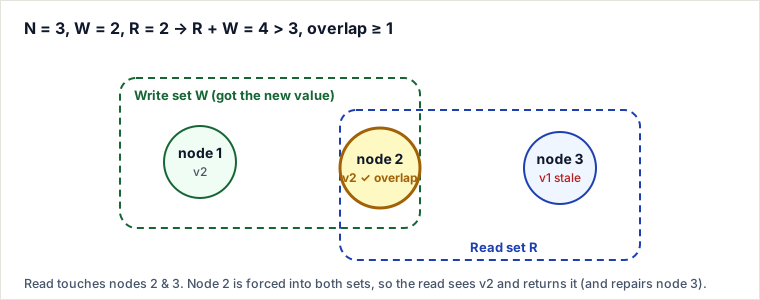
This is the pigeonhole principle, not a heuristic. A successful write leaves the newest version on some set of W replicas (the write set). A read gathers responses from some set of R replicas (the read set). Both sets are drawn from the same pool of N replicas.
If the two sets were disjoint (shared no node), they would together contain W + R distinct nodes. But you only have N nodes, so W + R distinct nodes is impossible once W + R > N. Therefore any read set and any write set must intersect in at least:
overlap ≥ (W + R) − NWith N = 3, W = 2, R = 2 that is at least 4 − 3 = 1 shared node — which holds the latest value and its version stamp. The coordinator compares versions across the R responses, returns the newest, and (in Dynamo-style systems) issues a read repair to push that value back onto any stale replica it saw. Drop below the line — R + W ≤ N — and the read set can dodge the write set entirely, so a read right after a write can legally return the old value: eventual, not strong, consistency.
Worked trace: the same key, three configurations
Key user:42, N = 3 replicas. A client writes version v2, then immediately reads. Follow what each configuration guarantees.
Setup A — N=3, W=2, R=2 (strong: R+W=4 > 3)
- Write v2: coordinator sends to all 3; node 3 is slow/down. Nodes 1 and 2 ACK → W=2 met → client told “OK.” State: n1=v2, n2=v2, n3=v1.
- Read: coordinator queries any 2. Worst case it picks nodes 2 and 3 → sees {v2, v1}.
- Reconcile: v2 > v1 by version stamp → returns v2. Read repair updates node 3 to v2.
No matter which 2 nodes the read hits, one of them is in {n1, n2}. Strong read holds.
Setup B — N=3, W=1, R=1 (unsafe: R+W=2 ≤ 3)
- Write v2: only node 1 ACKs → W=1 met → “OK.” State: n1=v2, n2=v1, n3=v1.
- Read: coordinator picks node 3 → sees only {v1}.
- Result: returns v1 — a stale read of data that was already acknowledged as written. No overlap was guaranteed, so this is legal behavior, not a bug.
Setup C — N=5, W=3, R=3 (strong + fault tolerant: R+W=6 > 5)
- Write v2: needs 3 ACKs. Even with 2 nodes down, 3 remain → write succeeds.
- Read: needs 3 responses; overlap ≥ 6 − 5 = 1 → at least one responder has v2.
- Result: strong read and the cluster survives 2 simultaneous node failures on both paths.
| Setup | N | W | R | R+W vs N | Guaranteed overlap | Read result | Failures tolerated |
|---|---|---|---|---|---|---|---|
| A | 3 | 2 | 2 | 4 > 3 | ≥ 1 | fresh (v2) | write:1, read:1 |
| B | 3 | 1 | 1 | 2 ≤ 3 | 0 possible | can be stale (v1) | write:2, read:2 |
| C | 5 | 3 | 3 | 6 > 5 | ≥ 1 | fresh (v2) | write:2, read:2 |
Note the tension in the last column: Setup B tolerates more failures precisely because it demands less agreement — that is the same slack that lets it return stale data.
The majority rule, stated correctly
Cassandra’s QUORUM level and the majority quorums in Raft/Paxos both use the same threshold:
quorum = floor(N / 2) + 1This is the integer floor of N/2, plus one — not ordinary rounding of N/2 + 1. Work it out:
- N = 3 → floor(3/2) + 1 = 1 + 1 = 2
- N = 4 → floor(4/2) + 1 = 2 + 1 = 3
- N = 5 → floor(5/2) + 1 = 2 + 1 = 3
- N = 6 → floor(6/2) + 1 = 3 + 1 = 4
Setting W = R = floor(N/2)+1 always gives R + W = 2·(floor(N/2)+1) > N, so a symmetric majority quorum is always strongly consistent. It also guarantees any two write quorums overlap — which is exactly why leader-election protocols like Raft use a majority: two candidates can never both collect a majority of votes, so there is never a split-brain leader. Same counting trick, different payload (a vote instead of a value).
A quorum config tolerates N − W failures on the write path and N − R on the read path before an operation can no longer be satisfied. With N=5, W=R=3 that is 2 on each side.
Pitfalls
- R+W>N is not linearizability. It guarantees a read observes the latest completed write, but with concurrent writers and no coordination you get conflicting versions (siblings). Overlap tells you what’s newest by version; it does not order concurrent writes. Dynamo/Riak surface siblings for the app to merge; that’s why they lean on vector clocks / CRDTs, not just quorum counting.
- Sloppy quorums silently break the math. Cassandra/Dynamo can write to any live N nodes (hinted handoff) when the preferred replicas are down. Those hint-holders aren’t in the read’s replica set, so R+W>N no longer implies overlap. You can read stale data even at QUORUM during a partition. Know whether your DB uses a strict or sloppy quorum.
- W=N kills write availability. Requiring all replicas to ACK means one slow or dead node blocks every write. Quorums exist to avoid exactly this — don’t reintroduce it by cranking W to N “for safety.”
- Per-request tuning that doesn’t add up. If different clients use different R/W on the same data (one writes at W=1, another reads at R=2, N=3 → 3 ≤ 3), you’ve lost the guarantee even though each request “looks fine.” The invariant is R+W>N across the write that happened and the read that follows, not per call in isolation.
- Read repair is best-effort, not a fix for under-provisioned quorums. It converges replicas over time but does not make an R+W≤N read fresh.
When to use quorum replication — and when not
Reach for tunable quorums when: you run a leaderless, multi-datacenter store (Cassandra, DynamoDB, Riak, ScyllaDB); you need to keep serving writes during node/AZ failures; and different data on the same cluster has different consistency needs (billing rows at QUORUM, activity feed at ONE). The killer feature is that consistency is a per-request dial, not a cluster-wide setting.
Trade-offs vs named alternatives:
- vs. a single leader with synchronous replicas (Raft/Paxos, e.g. etcd, Spanner, ZooKeeper): Leader-based consensus gives you linearizable reads/writes and a total order for free — no sibling reconciliation. You pay with a leader bottleneck, leader-election stalls on failover, and harder multi-region writes (every write crosses to the leader). Quorum replication has no leader to lose and writes anywhere, but you inherit conflict resolution and only get “read-your-writes-ish” strength, not a global order. Choose leader-based when you need linearizability, config data, locks, or leader election; choose leaderless quorums when write availability and geo-distribution matter more than a strict global order.
- vs. pure eventual consistency (R+W≤N, e.g. W=1/R=1): You gain the lowest possible latency and the highest availability — a single reachable replica serves any op. You lose the freshness guarantee entirely. Choose R+W>N when a stale read is a correctness bug (inventory, balances, auth); prefer R+W≤N when staleness is cosmetic and tail latency is the product (feeds, view counts, recommendations).
- Asymmetric tuning within quorums: write-heavy + read-your-writes → lean W low, R high isn’t the move; instead keep R+W>N but shift cost to the rarer op. Read-heavy system → R=1, W=N pushes overlap onto writes so reads are cheap (but writes fragile). Write-heavy → W=1, R=N. The sum is the constraint; where you put the cost is the design choice.
Takeaways
- R + W > N is the pigeonhole principle: two sets drawn from N nodes with sizes summing above N must intersect, so a read always touches a node holding the latest write.
- The guaranteed overlap is exactly (R + W) − N nodes; the failure budget is N−W on writes and N−R on reads — more agreement means fresher reads but less fault tolerance.
- A symmetric majority quorum W = R = floor(N/2)+1 is always strongly consistent and is the same threshold Raft/Paxos use to prevent split-brain.
- Overlap gives freshness, not linearizability or write ordering — concurrent writes still need versioning/CRDTs, and sloppy quorums void the guarantee during partitions.
L0 · R + W > N forces the read set and write set to share a node, so the read sees the latest write.
L1 · ① Concurrency — “Two clients write the same key concurrently, both hit W=2. The next R=2 read — what comes back?”
Trap: “R+W>N guarantees the read returns the latest write.”
Bar: Concurrent writes have no order between them, so quorum’s version-stamp comparison can’t declare one “newest” — the read set legally returns two siblings. Detecting that requires vector clocks to flag them as concurrent; LWW just picks a timestamp and silently discards the other write's data — see conflict resolution.
L2 · ② Failure — “Node 3 is down during a write; Dynamo hints the write onto node 4 instead. You read at QUORUM right after — safe?”
Trap: “Yes — W was still satisfied, so R+W>N still holds.”
Bar: The hint sits on node 4, which is outside the N preferred replicas the read's R set is drawn from, so the pigeonhole argument — both sets carved from the *same* N — no longer applies and overlap isn't guaranteed. The read can legally return stale data until the hint is handed back to node 3. See sloppy quorum / hinted handoff and quorum is not linearizability.
L3 · ③ Scale — “N=3, one replica per region (US/EU/APAC), 500K QPS, strict QUORUM on every call. What breaks first at scale?”
Trap: “Nothing — QUORUM is QUORUM, the math doesn't care about topology.”
Bar: Every write and read now blocks on 2-of-3 ACKs, and one of those two must cross an ocean (80–150ms RTT), so p99 floors at a cross-region round trip instead of local disk. Production fix is LOCAL_QUORUM — overlap guaranteed only within one region — which means a LOCAL_QUORUM read in EU can miss a LOCAL_QUORUM write just acked in US; "QUORUM" stops being one global guarantee and becomes per-region.
L4 · ④ Time/Lifecycle — “A replica is down for 6 hours; the hint window (say 3h) expires before it rejoins, then it serves a read. What do you see?”
Trap: “Read repair will have already fixed it by then.”
Bar: Once the hint window expires the coordinator drops the hint, so the rejoined replica never got the write and stays stale until anti-entropy (Merkle-tree diffing) runs. Read repair is opportunistic — it only heals a replica that happens to land inside some later read's R set — so a QUORUM read can unluckily sample the stale node and return old data for hours. See read repair & anti-entropy.
L5 · ⑤ Adversary/Edge — “You're resizing N=3→N=4 mid-flight. Can R+W>N, satisfied at the old N, silently stop holding during the resize?”
Trap: “No — it's just arithmetic; it holds at any N as long as R+W>N for that N.”
Bar: The invariant assumes one atomically-agreed N everyone computes against; mid-resize some nodes still route against old-N=3 while others already route against new-N=4, so a write quorum computed under old-N and a read quorum computed under new-N can fail to overlap even though each individually passes its own R+W>N check. Real systems require quorums to overlap in *both* the old and new membership during the transition — the same joint-consensus trick Raft uses for membership changes. See Raft leader election & log replication.
The floor keeps dropping: add Byzantine replicas that lie about their version stamp — quorum counting assumed honest ACKs; now you need 2f+1 of 3f+1 to outvote f liars, not a plain majority.
Self-locate: died at L1 → mid-level; L4+ → staff signal.
Sources: DeCandia et al., “Dynamo: Amazon’s Highly Available Key-value Store” (SOSP 2007), which introduced the (N, R, W) notation and the R+W>N rule; Ongaro & Ousterhout, “In Search of an Understandable Consensus Algorithm (Raft)” (2014) on majority quorums; Lamport, “The Part-Time Parliament / Paxos”; DataStax / Apache Cassandra documentation on consistency levels (ONE, QUORUM, ALL), read repair, and hinted handoff; Kleppmann, Designing Data-Intensive Applications (Ch. 5, “Quorums for reading and writing” and “Limitations of quorum consistency”). Re-authored and deepened for this guide, with the floor(N/2)+1 majority rule corrected.
🤖 Don't fully get this? Learn it with Claude
Stuck on What Is Quorum N, R, W, And Why Does R W N Give Strongly Consistent Reads? Open Claude, copy a block below, and it'll teach you this exact concept — visually and interactively.
Build the mental picture, not memorization.
I just read a lesson on **What Is Quorum N, R, W, And Why Does R W N Give Strongly Consistent Reads** (System Design) and want to truly understand it. Explain What Is Quorum N, R, W, And Why Does R W N Give Strongly Consistent Reads from first principles using ONE vivid real-world analogy and a visual mental model — draw it as ASCII art or a clear step-by-step diagram — with a concrete example using real numbers. Then ask me one question to check I got the mental picture, and wait for my reply. If you're unsure or a claim isn't standard, say so and reason from first principles instead of guessing.
Socratic — adapts to where you're stuck.
Teach me **What Is Quorum N, R, W, And Why Does R W N Give Strongly Consistent Reads** interactively. Ask me ONE guiding question at a time, wait for my answer, and adapt to my confusion — build the idea with me step by step instead of explaining it all at once. If you're unsure or a claim isn't standard, say so and reason from first principles instead of guessing.
Active recall exposes what you missed.
Quiz me on **What Is Quorum N, R, W, And Why Does R W N Give Strongly Consistent Reads** with 5 questions, easy to tricky, ONE at a time. Tell me if each answer is right; at the end, explain clearly what I got wrong and why. If you're unsure or a claim isn't standard, say so and reason from first principles instead of guessing.
Intuition + hook + flashcards for long-term memory.
Help me remember **What Is Quorum N, R, W, And Why Does R W N Give Strongly Consistent Reads** for the long term: give the one-sentence intuition, a memorable hook/mnemonic, a tiny worked example, and 3 active-recall flashcards (Q -> A). If you're unsure or a claim isn't standard, say so and reason from first principles instead of guessing.