The Purpose of a Resume vs a Portfolio
The Purpose of a Resume vs a Portfolio
1. Intuition — the problem it solves
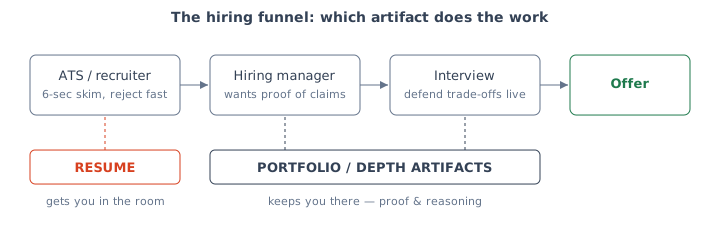
A hiring pipeline is a funnel with brutal filters. For a senior backend role, a single opening can attract hundreds of applicants, and the people at the top of the funnel — a recruiter, an ATS (Applicant Tracking System), sometimes a hiring manager skimming between meetings — have seconds, not hours. They are not trying to understand you; they are trying to reject fast and keep a small, safe shortlist.
The resume exists for this stage. It is a lossy compression of your career optimized for a fast no-or-maybe decision. Its job is not to prove you are great; its job is to survive the filter and buy you a conversation. The portfolio solves the opposite problem: once someone is already interested, they want depth and proof — they want to see that the impressive line on the resume is real. Confusing the two is the classic mistake. Engineers pour effort into a beautiful project site and send a flat resume, so nobody ever clicks the link; or they cram architecture diagrams into the resume and it gets discarded for being unreadable in six seconds.
So the mental model is: the resume gets you in the room; the portfolio (and the interview) keep you there. They are sequential stages of a funnel, not competing formats.
2. Precise definition / how each works
A resume is a 1–2 page, scannable, keyword-dense summary of outcomes: roles, scope, and quantified impact. Its consumer is often a machine first (ATS parses it into fields and scores keyword overlap with the job description) and a skimmer second. Optimizations that follow directly:
- Reverse-chronological, most recent first — recency dominates for senior hires.
- Impact-first bullets, not responsibility lists. Prefer the shape
Action → mechanism → quantified result. - Keyword honesty: the real technologies you used, phrased to match how the JD phrases them (so both the ATS and the human find them).
- Ruthless subtraction: every line that does not raise your probability of an interview is noise that dilutes the lines that do.
A portfolio is the depth layer: a personal site, a curated GitHub, design docs, a technical blog, or system diagrams. Its consumer has already decided you might be worth their time and now wants evidence and reasoning — not "shipped a payments service" but how you handled idempotency, retries, and reconciliation. It rewards narrative, code you are proud of, and trade-off discussion. Length and depth are features here, not liabilities.
3. Concrete example — the same win, two artifacts
Suppose you cut checkout latency on a payments service. On the resume, this is one dense, quantified line built to survive a skim:
Cut p99 checkout latency 820ms -> 210ms (74%) by replacing
synchronous fraud checks with an async queue + read-through
cache; sustained through Black Friday at 12k req/s.
Notice it is self-contained: numbers, mechanism, and scale in one line, with keywords (p99, cache, queue) an ATS and a human both catch. It makes a claim.
The portfolio version is the proof behind that claim — a short write-up or design doc the interested reader can open:
Why async: fraud scoring is 90% of tail latency but only
advisory pre-auth, so I moved it off the hot path and
reconciled post-auth. Trade-off: a ~0.3% window of
accepted-then-flagged orders, bounded by a 5-min sweep +
auto-refund. Alternatives rejected: bigger DB (didn't fix
the scoring call); sync timeout (dropped legit orders).
In the interview you then say the resume line, and let them pull the thread: "Happy to walk through the reconciliation trade-off" — the portfolio doc is your safety net so the deep-dive is a story you have already rehearsed.
4. When to lean on which — the judgment layer
- Cold applications / high-volume top-of-funnel: the resume is nearly everything. A portfolio link helps only if it is one click and instantly credible. Optimize the resume first — it is the binding constraint.
- Referrals / warm intros: the filter is already partly bypassed, so the portfolio and a crisp narrative carry more weight; the resume becomes a formality for the ATS.
- Staff/principal or specialist roles (distributed systems, infra): depth artifacts — design docs, talks, deep OSS contributions — differentiate you, because everyone at that level already has a clean resume. The portfolio is the tiebreaker.
- Alternatives to a built portfolio: a strong GitHub, a conference talk, or a technical blog all serve the same "proof" function — pick whichever you can make genuinely deep. Do not substitute a portfolio for a resume: recruiters and ATS pipelines still require the resume, and a link-only application usually never gets opened.
- Don't over-invest in a fancy portfolio site if your resume can't pass the six-second skim — you'd be optimizing stage 2 while dying at stage 1.
5. Pitfalls / what interviewers probe
- Responsibility-speak instead of impact: "Responsible for the payments service" says nothing. Interviewers immediately ask "what did you change, and what moved?" Lead with the outcome.
- Unbacked numbers: a resume metric with no story behind it is a trap. If you write
74%, expect "measured how, over what window, versus what baseline?" Your portfolio/notes must survive that. - "We" that hides your contribution: senior interviews probe for individual ownership. Be precise about the boundary between team work and your decisions.
- Resume ≠ portfolio depth: cramming architecture detail into the resume makes it unscannable; putting only vague one-liners in the portfolio wastes the one place depth is welcome. Match altitude to audience.
- Stale or broken portfolio links: a 404 or a dead demo actively hurts — it signals you don't maintain what you ship. Only link things you'd defend live.
- Keyword stuffing / dishonest matching: gaming the ATS with tech you can't discuss collapses the moment an engineer asks a follow-up.
Key takeaways
- A resume is a lossy, scannable summary built to survive a fast filter; a portfolio is the depth layer that proves the claims. They are sequential funnel stages, not rivals.
- Resume gets you in the room; portfolio and interview keep you there. Optimize the resume first — it is the binding constraint in cold applications.
- Write resume bullets as
action → mechanism → quantified result; keep them honest and keyword-aligned so both ATS and humans find them. - Let the portfolio carry trade-offs, alternatives-rejected, and narrative — the material senior interviewers actually probe.
- Match the artifact to the channel: cold apply favors the resume, referrals and staff-level roles reward depth artifacts.
- Every number is a promise you must defend live; never link a portfolio you wouldn't walk an interviewer through.
🤖 Don't fully get this? Learn it with Claude
Stuck on The Purpose of a Resume vs a Portfolio? Open Claude, copy a block below, and it'll teach you this exact concept — visually and interactively.
Build the mental picture, not memorization.
I just read a lesson on **The Purpose of a Resume vs a Portfolio** (Career & Job Search) and want to truly understand it. Explain The Purpose of a Resume vs a Portfolio from first principles using ONE vivid real-world analogy and a visual mental model — draw it as ASCII art or a clear step-by-step diagram — with a concrete example using real numbers. Then ask me one question to check I got the mental picture, and wait for my reply. If you're unsure or a claim isn't standard, say so and reason from first principles instead of guessing.
Socratic — adapts to where you're stuck.
Teach me **The Purpose of a Resume vs a Portfolio** interactively. Ask me ONE guiding question at a time, wait for my answer, and adapt to my confusion — build the idea with me step by step instead of explaining it all at once. If you're unsure or a claim isn't standard, say so and reason from first principles instead of guessing.
Active recall exposes what you missed.
Quiz me on **The Purpose of a Resume vs a Portfolio** with 5 questions, easy to tricky, ONE at a time. Tell me if each answer is right; at the end, explain clearly what I got wrong and why. If you're unsure or a claim isn't standard, say so and reason from first principles instead of guessing.
Intuition + hook + flashcards for long-term memory.
Help me remember **The Purpose of a Resume vs a Portfolio** for the long term: give the one-sentence intuition, a memorable hook/mnemonic, a tiny worked example, and 3 active-recall flashcards (Q -> A). If you're unsure or a claim isn't standard, say so and reason from first principles instead of guessing.