Tailoring Resumes to Specific Jobs
Tailoring Resumes to Specific Jobs
A tailored resume is a resume rewritten to match one specific job description, rather than a single generic document blasted to every opening. For a senior backend engineer, tailoring is the difference between a resume that reads like a person who happens to have skills, and one that reads like the exact person the hiring manager wrote the requisition for.
1. Intuition — the problem it solves
Your resume passes through three filters before a human decides to interview you: an Applicant Tracking System (ATS) that indexes and keyword-scores it, a recruiter who spends 6–8 seconds skimming, and a hiring manager who asks "can this person do the specific thing I'm hurting for?" A generic resume optimizes for none of them. It buries the one project that matches the role under four that don't, uses your vocabulary instead of theirs (you wrote message queue, the JD says Kafka), and forces every reader to do the translation work themselves. Most won't — they'll move to the next candidate. Tailoring shifts that translation cost from the reader to you, where it belongs. It is not lying or reformatting; it is relevance ranking: surfacing the true parts of your history that this particular team cares about, and demoting the rest.
2. Precise definition / how it works
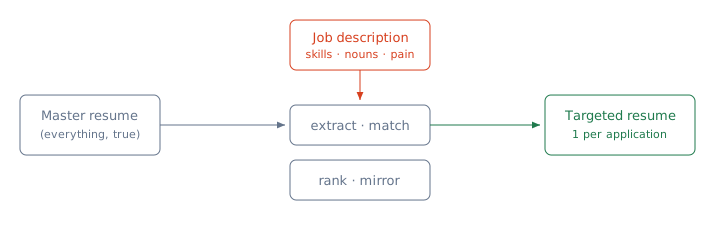
Tailoring is a per-application transform: tailor(master_resume, job_description) → targeted_resume. You maintain one exhaustive master resume (every project, metric, and technology, kept long and ugly) and derive a lean one- to two-page targeted version per role. The transform has four moves:
- Extract the JD's signal: required skills, the exact nouns (
gRPC,PostgreSQL,event-driven), the seniority verbs (own,lead,mentor), and the implied pain (a JD heavy on "reliability" and "on-call" is hiring to stop getting paged). - Match each requirement to true evidence in your master resume.
- Rank: reorder bullets and projects so the most JD-relevant evidence is top of each section — recruiters read top-down and stop early.
- Mirror the JD's terminology exactly where it's honest to do so, so both the ATS keyword match and the human's pattern-match fire.
The ATS matters but is often overstated: modern systems (Greenhouse, Lever) rank rather than hard-reject, and a referral bypasses them entirely. Optimize keywords enough to not get filtered, then spend your real effort on the human's 8-second scan.
3. Concrete example — the transform on one bullet
Suppose the JD says: "Own a high-throughput payments service; experience with Kafka, idempotency, and reducing p99 latency." Here is one master-resume bullet, generic, then tailored:
GENERIC (master):
  "Worked on backend services and improved performance
   of the checkout system using a messaging system."

TAILORED (to this JD):
  "Owned the payments settlement service (Java, Kafka)
   processing 12k events/sec; added idempotency keys to
   eliminate double-charges, and cut p99 latency 340ms→90ms
   by batching DB writes."
The tailored bullet mirrors the JD's nouns (Kafka, idempotency, p99), leads with the ownership verb Owned, and quantifies impact. Same underlying truth — but now the reader does zero translation. A line you could say in the recruiter screen: "I saw the role centers on payment reliability, so I put my settlement-service work up top — that's where I owned idempotency and the p99 cut you mention." This signals you read the JD and can map your experience to their need, which is itself the senior skill under test.
4. When to use / when NOT — the judgment layer
Tailoring costs 20–40 minutes per application. Spend it where the expected return justifies it; skip it where it doesn't. Compare against the two alternatives:
- vs. one generic resume (spray-and-pray): Generic wins only on raw volume — early-career mass applications, or fully interchangeable roles. For senior/staff roles, where a handful of targeted applications convert far better than fifty generic ones, tailor. The generic approach's hidden cost is a low reply rate that you misread as "a bad market" rather than a bad-fit signal.
- vs. per-JD from scratch: Never write each resume fresh — it doesn't scale and you lose your best proven bullets. The master-resume-plus-transform model gives you tailoring's relevance at spray-and-pray's marginal cost after the first setup.
- Don't over-tailor: If matching the JD requires inventing experience, stretching "used once in a hackathon" into "expert," or dropping so much that the resume misrepresents your trajectory, stop — you'll fail the interview that the resume wins. Tailor emphasis, never facts. Also skip deep tailoring for a strong referral: a referral already clears the ATS and recruiter filters, so a clean generic resume plus the referrer's context often suffices.
5. Pitfalls / what interviewers probe
- Keyword stuffing. A hidden white-text skills wall or a 30-item tech list fools nobody senior and reads as desperate. Interviewers probe every noun on your resume — if
Kafkais there because you mirrored the JD, expect "walk me through a Kafka partitioning decision you made." Only mirror terms you can defend under follow-up. - Emphasis drifting into fabrication. "Led the migration" when you contributed one service invites "what was your specific role, and who else was involved?" Inflation collapses the moment they ask for the decision you personally owned.
- Metrics with no baseline or method. "Improved latency by 70%" draws "70% of what, measured how, over what window?" Keep the before→after and the mechanism (as in the p99 example) so the number survives scrutiny.
- Obvious copy-paste tells. The JD's product name left in your summary, or a bullet phrased in their marketing voice, signals a careless template. Mirror vocabulary, not sentences.
- Losing the narrative. Aggressive reordering can produce a resume with no coherent story — a senior reviewer wants to see a deliberate arc (growing scope, ownership, depth), not a bag of keyword-matched fragments.
Key takeaways
- Tailoring is relevance ranking, not rewriting: surface the true parts of your history this role cares about, demote the rest.
- Keep one exhaustive master resume and derive a lean targeted version per application — that's tailoring's payoff at near spray-and-pray cost.
- Optimize for three readers in order: pass the ATS on keywords, win the recruiter's 8-second top-down scan, answer the hiring manager's "can they do this?"
- The four moves: extract the JD's signal, match to real evidence, rank best-fit first, mirror exact terminology.
- Tailor emphasis, never facts — every mirrored noun and metric must survive interview follow-up.
- Reserve the effort for senior/high-fit roles; skip deep tailoring behind a strong referral, and never write each resume from scratch.
🤖 Don't fully get this? Learn it with Claude
Stuck on Tailoring Resumes to Specific Jobs? Open Claude, copy a block below, and it'll teach you this exact concept — visually and interactively.
Build the mental picture, not memorization.
I just read a lesson on **Tailoring Resumes to Specific Jobs** (Career & Job Search) and want to truly understand it. Explain Tailoring Resumes to Specific Jobs from first principles using ONE vivid real-world analogy and a visual mental model — draw it as ASCII art or a clear step-by-step diagram — with a concrete example using real numbers. Then ask me one question to check I got the mental picture, and wait for my reply. If you're unsure or a claim isn't standard, say so and reason from first principles instead of guessing.
Socratic — adapts to where you're stuck.
Teach me **Tailoring Resumes to Specific Jobs** interactively. Ask me ONE guiding question at a time, wait for my answer, and adapt to my confusion — build the idea with me step by step instead of explaining it all at once. If you're unsure or a claim isn't standard, say so and reason from first principles instead of guessing.
Active recall exposes what you missed.
Quiz me on **Tailoring Resumes to Specific Jobs** with 5 questions, easy to tricky, ONE at a time. Tell me if each answer is right; at the end, explain clearly what I got wrong and why. If you're unsure or a claim isn't standard, say so and reason from first principles instead of guessing.
Intuition + hook + flashcards for long-term memory.
Help me remember **Tailoring Resumes to Specific Jobs** for the long term: give the one-sentence intuition, a memorable hook/mnemonic, a tiny worked example, and 3 active-recall flashcards (Q -> A). If you're unsure or a claim isn't standard, say so and reason from first principles instead of guessing.