ForkJoin Approach to Concurrency
Fork/Join gets parallel speedup by recursively splitting one big task into halves until each piece is small enough to run sequentially, then combining the partial results back up the tree — and it runs all those pieces on a small fixed pool of worker threads (one per CPU core) where idle workers steal queued subtasks from busy ones, so the cost of "forking" is a cheap object push onto a queue, not the creation of an OS thread.
The mechanism, precisely
The naive mental model is "fork = spawn a thread, join = wait for it." That is wrong at scale, and the correction is the whole point of this design:
- A real OS thread costs roughly 0.5–1 MB of stack plus a kernel-side scheduling entry. Creating one per subtask in a recursive split (which generates thousands of tasks) would exhaust memory and drown the CPU in context switches.
- So
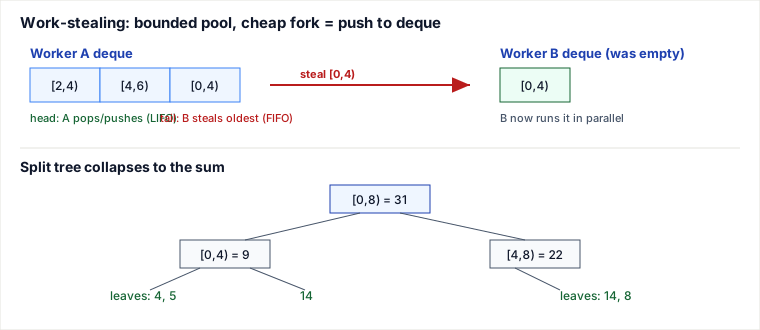
ForkJoinPoolcreates a bounded set of worker threads — by defaultRuntime.getRuntime().availableProcessors()of them — and keeps them alive for the program's life. fork()does not start a thread. It pushes the subtask onto the calling worker's own double-ended queue (deque) and returns immediately. That push is a few instructions.- Each worker pops its own tasks from the head (LIFO — good cache locality, the most-recently-forked task is usually the one whose data is still hot). When a worker's deque is empty, it steals a task from the tail of a random other worker's deque (FIFO from the victim's side — it grabs the oldest, biggest, least-likely-to-conflict task). This is work-stealing, and it is what keeps all cores busy without a central lock.
join()on a forked subtask does not block the worker idly. If the result isn't ready, the worker helps — it runs other queued tasks (including the one it's waiting on) until the result is available. A blocked worker is a wasted core, so the pool refuses to waste it.
Worked example: sum an array of 8 elements, threshold 2
Take [3, 1, 4, 1, 5, 9, 2, 6] (sum = 31). The task splits any range longer than the threshold (2) in half and forks; ranges of length ≤ 2 are summed directly. Watch the tree build and collapse:
| Step | Action | Range | What happens | Returns |
|---|---|---|---|---|
| 1 | compute | [0,8) | len 8 > 2 → split. fork() left [0,4) onto deque; recurse into right [4,8) | — |
| 2 | compute | [4,8) | len 4 > 2 → split. fork left [4,6); recurse right [6,8) | — |
| 3 | compute | [6,8) | len 2 ≤ 2 → sum 2+6 | 8 |
| 4 | join | [4,6) | was forked; sum 5+9 (run here or stolen by idle worker) | 14 |
| 5 | combine | [4,8) | 14 + 8 | 22 |
| 6 | join | [0,4) | forked at step 1; splits into [0,2)=3+1=4 and [2,4)=4+1=5 | 9 |
| 7 | combine | [0,8) | 9 + 22 | 31 |
The leaves (8, 14, 4, 5) sit on worker deques. If a second core is free during step 3, it steals [4,6) from the tail of the first worker's deque and computes 14 in parallel — that is where the speedup comes from. With one core, the same tree runs sequentially and still produces 31, just without the overlap.
Java: RecursiveTask<Long>
This is the canonical Fork/Join shape. Note the order: fork the left, compute the right on the current thread, then join — never fork both and join both, because that wastes the current worker.
import java.util.concurrent.RecursiveTask;
import java.util.concurrent.ForkJoinPool;

class SumTask extends RecursiveTask<Long> {
    private static final int THRESHOLD = 2;
    private final int[] a;
    private final int lo, hi;

    SumTask(int[] a, int lo, int hi) { this.a = a; this.lo = lo; this.hi = hi; }

    @Override
    protected Long compute() {
        if (hi - lo <= THRESHOLD) {          // small enough: do it directly
            long sum = 0;
            for (int i = lo; i < hi; i++) sum += a[i];
            return sum;
        }
        int mid = (lo + hi) >>> 1;
        SumTask left = new SumTask(a, lo, mid);
        left.fork();                          // push left onto THIS worker's deque
        long right = new SumTask(a, mid, hi).compute(); // run right here, no waiting
        long leftResult = left.join();        // help/steal until left is done
        return leftResult + right;
    }
}

// usage
int[] data = {3, 1, 4, 1, 5, 9, 2, 6};
long total = ForkJoinPool.commonPool().invoke(new SumTask(data, 0, data.length));
// total == 31
Why the naive version is wrong
A version that does left.fork(); right.fork(); return left.join() + right.join(); forks both halves and then sits in join() — the current worker has nothing to compute itself and the second forked task often just gets stolen, adding overhead. Worse, calling left.join() before right.fork() serializes the whole thing. And a version that spawns new Thread(...) per split — the old "forking = new thread" idea — creates thousands of OS threads for a deep tree and collapses. The fixed pool + deque + steal is exactly the fix for that cost.
Go: the same divide-and-conquer with goroutines + a WaitGroup
Go has no ForkJoinPool in its standard library because it doesn't need a user-space work-stealing pool — the runtime scheduler itself is a work-stealing scheduler over goroutines. A goroutine is a few KB of growable stack multiplexed onto a small set of OS threads (the M:N model, bounded by GOMAXPROCS), so spawning one really is cheap. You express the split directly:
package main

import (
    "fmt"
    "sync"
)

const threshold = 2

func sum(a []int) int {
    if len(a) <= threshold {
        s := 0
        for _, v := range a { s += v }
        return s
    }
    mid := len(a) / 2
    var left int
    var wg sync.WaitGroup
    wg.Add(1)
    go func() {              // "fork" the left half — a goroutine, not an OS thread
        defer wg.Done()
        left = sum(a[:mid])
    }()
    right := sum(a[mid:])    // compute the right half on this goroutine
    wg.Wait()                // "join": wait for the left half
    return left + right
}

func main() {
    fmt.Println(sum([]int{3, 1, 4, 1, 5, 9, 2, 6})) // 31
}
Where the two runtimes differ
- Unit of work. Java forks
ForkJoinTaskobjects onto a deque you wait on withjoin(); Go forks goroutines and you wait with async.WaitGroupor a channel. Go's work-stealing is hidden inside the runtime; Java's is the explicitForkJoinPoolyou call into. - Cost & bounding. Both bound the OS-thread count (Java pool size ≈ cores; Go
GOMAXPROCS≈ cores). The Java version above with a real-thread-per-split would die; the Go version is fine because a goroutine ≈ a few KB and the runtime, not the kernel, schedules it. Still, an unbounded recursive goroutine fan-out can pile up scheduling pressure, so for huge fan-outs you'd add a worker-pool / semaphore. - Blocking semantics. Java's
join()keeps the worker useful by running other tasks while it waits. Go'swg.Wait()parks the goroutine and the scheduler immediately runs another goroutine on that OS thread — same net effect (no wasted core), different mechanism (channel/parking vs. task helping).
Pitfalls
- Threshold too small. A threshold of 1 forks a task per element. For summing an int array the split/steal bookkeeping costs more than the addition, so the parallel version is slower than a plain loop. Pick a threshold where a leaf does enough real work (often thousands of elements, or a few microseconds) to dwarf the fork cost.
- Blocking inside a Fork/Join task. If a task does I/O, sleeps, or grabs a lock, it parks a pool worker and there are only ~N workers. A few blocked tasks can stall the entire common pool — including everything else in the JVM that shares it (parallel streams,
CompletableFuture.supplyAsyncdefaults). Use a separateForkJoinPoolfor blocking work, or wrap it inManagedBlockerso the pool spins up a compensating thread. - Wrong fork/join order. Forking both halves and joining both, or joining before forking the sibling, kills the speedup (see "Why the naive version is wrong"). Always: fork left, compute right inline, join left.
- Shared mutable state in subtasks. Fork/Join only parallelizes cleanly when subtasks are independent. If two leaves write the same field you reintroduce the race conditions the next lessons cover — the model gives you parallelism, not safety.
- In Go: capturing the loop variable / racing on a shared result. Writing partial results into a shared slice from many goroutines without distinct indices, or capturing a mutating variable in the closure, is a data race — run with
go test -race.
Takeaways
- Fork/Join = recursive split until small, run leaves on a bounded pool, combine results up the tree.
fork()is a cheap push, not a thread spawn — that's the whole reason it scales. - Work-stealing keeps every core busy without a central queue lock: workers run their own tasks LIFO and steal others' oldest tasks FIFO.
- In Java you write
RecursiveTask/RecursiveActionand call into aForkJoinPool; in Go you write goroutines and the runtime is the work-stealing scheduler. Both bound OS threads to ≈ core count. - The model gives parallelism, not correctness — tune the threshold, never block a pool worker, and keep subtasks independent.
Re-authored and deepened for this guide. Sources: Doug Lea, "A Java Fork/Join Framework" (2000), the original design paper for java.util.concurrent; the OpenJDK ForkJoinPool / RecursiveTask Javadoc and source; Brian Goetz et al., Java Concurrency in Practice; the Go runtime scheduler design (Dmitry Vyukov's work-stealing scheduler) and The Go Programming Language (Donovan & Kernighan), ch. 8–9. The earlier version's claim that "spawning new threads is not resource-intensive" was corrected — real Fork/Join uses a bounded pool with work-stealing precisely because OS-thread creation is expensive.
ForkJoin vs parallel streams vs virtual threads
| Tool | Mechanism | Best when | When not |
|---|---|---|---|
| ForkJoinPool + RecursiveTask | Explicit split/join, work-stealing deques, you control threshold | Custom divide-and-conquer, non-trivial combine, need ManagedBlocker | Simple map over a collection — streams are enough |
| parallelStream() | Uses common ForkJoinPool under the hood | Stateless map/filter/reduce on in-memory data, quick wins | Blocking I/O in the lambda (starves common pool); need isolation from other FJ users |
| Virtual thread per task (Java 21+) | M:N carrier threads; cheap blocking | Massive concurrent I/O (100k connections), sequential-looking code | Tight CPU-bound numeric loops — prefer FJ/parallel streams so work-stealing + threshold apply |
Worked decision
Sum 100M doubles: use FJ or Arrays.parallelPrefix/parallelStream with threshold-sized chunks — CPU-bound, pure. Fetch 100k URLs: virtual threads (or Go goroutines), not ForkJoin — each task blocks on network and would park FJ workers.
Failure / ops
All app latency spikes when one feature calls parallelStream() that does JDBC — common pool workers stuck in I/O; other parallel streams starve. Fix: dedicated pool, or virtual threads, never block the common FJ pool.
Drill ladder
- L1: What does
fork()put on the deque — a thread or a task? - L2: Why fork-left / compute-right?
- L3: When is parallelStream a production footgun?
- L4: Defend virtual-thread-per-task vs ForkJoin for a CPU matrix multiply.
🤖 Don't fully get this? Learn it with Claude
Stuck on ForkJoin Approach to Concurrency? Open Claude, copy a block below, and it'll teach you this exact concept — visually and interactively.
Build the mental picture, not memorization.
I just read a lesson on **ForkJoin Approach to Concurrency** (Concurrency) and want to truly understand it. Explain ForkJoin Approach to Concurrency from first principles using ONE vivid real-world analogy and a visual mental model — draw it as ASCII art or a clear step-by-step diagram — with a concrete example using real numbers. Then ask me one question to check I got the mental picture, and wait for my reply. If you're unsure or a claim isn't standard, say so and reason from first principles instead of guessing.
Socratic — adapts to where you're stuck.
Teach me **ForkJoin Approach to Concurrency** interactively. Ask me ONE guiding question at a time, wait for my answer, and adapt to my confusion — build the idea with me step by step instead of explaining it all at once. If you're unsure or a claim isn't standard, say so and reason from first principles instead of guessing.
Active recall exposes what you missed.
Quiz me on **ForkJoin Approach to Concurrency** with 5 questions, easy to tricky, ONE at a time. Tell me if each answer is right; at the end, explain clearly what I got wrong and why. If you're unsure or a claim isn't standard, say so and reason from first principles instead of guessing.
Intuition + hook + flashcards for long-term memory.
Help me remember **ForkJoin Approach to Concurrency** for the long term: give the one-sentence intuition, a memorable hook/mnemonic, a tiny worked example, and 3 active-recall flashcards (Q -> A). If you're unsure or a claim isn't standard, say so and reason from first principles instead of guessing.