Why Multithreading and Concurrency Are Essential Today
Concurrency wins because a modern CPU has stopped getting faster per-core and instead grew wider — it ships 8, 16, 64 physical cores that can each retire instructions in the same nanosecond — so the only way to convert that hardware into wall-clock speed is to split one job into pieces that run on separate cores at once. The catch the optimistic "100 threads = 100x" story hides: you only ever speed up the part of the work that is actually parallelizable, and every thread you add also adds coordination (splitting input, merging results, contending for shared state). Those two forces — the serial fraction and the per-thread overhead — are what decide whether 100 threads give you 90x or 6x.
The naive pitch, and why it lies
The original version of this page used a clean example: scan 10 billion entries at 1 microsecond each.
- 1 thread: 10,000,000,000 × 1 µs = 10,000 s ≈ 2.78 hours.
- 100 threads, perfectly split: 100,000,000 entries each × 1 µs = 100 s ≈ 1.67 minutes.
The arithmetic is correct. The conclusion — "100 threads always means 100x" — is not, because it silently assumes 100% of the work parallelizes and that merging 100 partial results is free. Neither is true. Real scans have a serial spine: you read the input bounds, hand each thread its slice, and then combine 100 partial answers into one. Call that serial fraction s.
Amdahl's law: the ceiling you cannot cross
If a fraction s of the work is inherently serial and the remaining (1−s) parallelizes across N threads, total speedup is:
Speedup(N) = 1 / ( s + (1 - s)/N )As N grows, the (1−s)/N term vanishes and you slam into a hard ceiling of 1/s. Even infinite threads cannot beat it. This single formula is why "just add more threads" stops paying off.
The same example, traced honestly
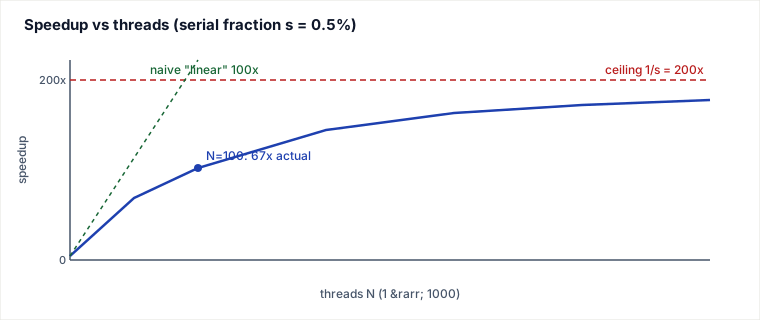
Reuse the 10B-entry scan (10,000 s on one thread), but admit a 0.5% serial spine: s = 0.005 (50 s of unavoidable setup + merge), leaving 9,950 s parallelizable. Now watch what actually happens as we add threads:
| Threads N | Parallel part 9950/N | + Serial 50 s | Wall time | Real speedup | Naive claim |
|---|---|---|---|---|---|
| 1 | 9950 s | 50 s | 10,000 s | 1.0x | 1x |
| 10 | 995 s | 50 s | 1,045 s | 9.6x | 10x |
| 100 | 99.5 s | 50 s | 149.5 s | 66.9x | 100x |
| 1000 | 9.95 s | 50 s | 59.95 s | 166.8x | 1000x |
| ∞ | 0 s | 50 s | 50 s | 200x (ceiling) | ∞ |
At 100 threads the honest number is ~67x, not 100x — and you can never beat 200x no matter how many cores you buy, because 50 s of serial work is irreducible. That gap between 67x and 100x is the lesson the bullet-list version erased.
The mechanism in code: scatter, work, gather
The same three-phase shape appears in every parallel job. Below, sum a large array. The serial spine is the split and the final merge; the parallel body is the per-slice loop.
Java — threads + Future
import java.util.concurrent.*;
import java.util.stream.IntStream;

long parallelSum(long[] data, int nThreads) throws Exception {
    ExecutorService pool = Executors.newFixedThreadPool(nThreads);
    int chunk = (data.length + nThreads - 1) / nThreads;   // serial: split
    Future<Long>[] parts = new Future[nThreads];
    for (int t = 0; t < nThreads; t++) {
        final int lo = t * chunk;
        final int hi = Math.min(lo + chunk, data.length);
        parts[t] = pool.submit(() -> {                     // parallel body
            long s = 0;
            for (int i = lo; i < hi; i++) s += data[i];
            return s;
        });
    }
    long total = 0;
    for (Future<Long> f : parts) total += f.get();          // serial: gather
    pool.shutdown();
    return total;
}
Go — goroutines + channel
func parallelSum(data []int64, nWorkers int) int64 {
    chunk := (len(data) + nWorkers - 1) / nWorkers   // serial: split
    results := make(chan int64, nWorkers)
    for t := 0; t < nWorkers; t++ {
        lo := t * chunk
        hi := lo + chunk
        if hi > len(data) {
            hi = len(data)
        }
        go func(lo, hi int) {                        // parallel body
            var s int64
            for i := lo; i < hi; i++ {
                s += data[i]
            }
            results <- s
        }(lo, hi)
    }
    var total int64
    for t := 0; t < nWorkers; t++ {
        total += <-results                           // serial: gather
    }
    return total
}
Each goroutine writes its partial sum to its own variable, so there is no shared-write race; the only shared object is the channel, which is safe for concurrent send/receive. Both versions give the same answer because the split is disjoint and the merge is the only place results combine.
Where Java and Go differ underneath
| Aspect | Java | Go |
|---|---|---|
| Unit of execution | A Thread maps 1:1 to an OS thread (~1 MB stack each); you pool them via an ExecutorService because spawning thousands is expensive. | A goroutine is a user-space task (~2 KB growable stack) multiplexed onto a small pool of OS threads by the runtime scheduler; millions are routine. |
| Handing back results | Future.get() blocks the caller, or you use wait/notify / BlockingQueue. | Channels: results <- s and <-results both transfer the value and synchronize, replacing wait/notify. |
| Parallelism control | Bounded by the pool size you choose. | Bounded by GOMAXPROCS (OS threads running Go code at once), independent of how many goroutines exist. |
The Amdahl ceiling applies identically to both: cheap goroutines let you launch a million workers, but if your serial fraction is 0.5% you still cannot beat 200x.
Pitfalls
- Assuming linear speedup. 100 threads almost never gives 100x. Measure the serial fraction first; if setup+merge is 1% of runtime, your ceiling is 100x before overhead, and realistic gains at 100 threads are well under that.
- Coordination overhead grows with N. Splitting input, scheduling tasks, and merging results all cost time. Past some point each added thread slows you down — the curve turns over (the Universal Scalability Law captures this; Amdahl is the optimistic case that ignores it).
- Shared mutable state silently destroys correctness. If two threads do
total += xon one shared variable without a lock or atomic, you lose updates — a race condition, not a slowdown. The code above avoids it by giving each worker a private accumulator. - Concurrency ≠ parallelism. On a single core, threads interleave (concurrency) and help latency-bound work (I/O) but not CPU-bound work. The 67x figure assumes ≥100 real cores; on 8 cores, 100 threads of pure CPU work give roughly 8x, not 67x.
- False sharing. Threads writing to adjacent memory in the same cache line force constant cache-coherence traffic, so "independent" work mysteriously fails to scale.
Takeaways
- Concurrency converts wider hardware (more cores) into faster wall-clock time, since single-core speed plateaued years ago.
- Speedup is governed by Amdahl's law:
1 / (s + (1-s)/N), capped at 1/s. Find your serial fraction before promising a number. - Every job is scatter → parallel work → gather; the scatter and gather are your serial spine, and coordination overhead only grows with thread count.
- Java pays for OS threads (pool them); Go's goroutines + channels are cheap and many — but neither escapes the serial ceiling.
Sources: Gene Amdahl, "Validity of the single processor approach to achieving large scale computing capabilities" (AFIPS, 1967); Brian Goetz et al., Java Concurrency in Practice (2006); the Go Blog, "Share Memory By Communicating" and the sync/goroutine scheduler docs; Neil Gunther, Guerrilla Capacity Planning (Universal Scalability Law). Re-authored and deepened for this guide: replaced the misleadingly linear 100x claim with an Amdahl-correct traced example, added a speedup-vs-threads diagram, side-by-side Java/Go code, and a pitfalls section.
Universal Scalability Law with a worked β
Amdahl's law is the optimistic ceiling that assumes zero coherence cost. Neil Gunther's Universal Scalability Law (USL) adds two penalties:
C(N) = N / (1 + α(N−1) + β N (N−1))
- α — contention (serialization fraction; Amdahl-like).
- β — coherency / crosstalk (cache-line bouncing, lock queues, shared bus). The
N(N−1)term grows super-linearly, so capacity can peak and then fall.
Worked example (β drives the turnover)
Take a service where serial work is 1% (α ≈ 0.01) and coherence is small but real (β = 0.001). Relative capacity C(N) vs ideal linear N:
| N threads/cores | Amdahl only (β=0) | USL C(N) | Notes |
|---|---|---|---|
| 1 | 1.00 | 1.00 | baseline |
| 10 | ≈9.2 | ≈8.5 | contention + mild crosstalk |
| 50 | ≈33.6 | ≈12.7 | β term bites — already past the peak |
| 100 | ≈50.3 | ≈8.4 | retrograde — more threads now hurt |
| ∞ (Amdahl) | 100 | →0 | USL has no ceiling — capacity collapses once β>0 |
Rough peak near N* ≈ √((1−α)/β) = √(0.99/0.001) ≈ 31 — beyond that, each added thread reduces throughput (the β·N(N−1) crosstalk term overtakes the parallel gain). Interview one-liner: Amdahl says "ceiling"; USL says "ceiling then retrogression from coherency."
How to estimate α, β from a load test
- Measure throughput X(N) at N = 1, 2, 4, … up past the knee.
- Fit C(N)=X(N)/X(1) to USL (nonlinear regression or Gunther's method).
- If β≈0 and α large → fix serial critical sections. If β large → fix false sharing, hot locks, global atomics.
When not
- Don't quote USL for I/O wait without queueing models — Little's Law + service time dominate.
- Don't fit three parameters on two data points; you need a curve through the peak.
Failure / ops
Latency rises and throughput drops as you scale pods 2× with CPU still <70% → look for shared Redis lock, single partition leader, or false-sharing counters (β symptoms), not "need more cores."
Drill ladder
- L1: Write Amdahl S(N) for s=0.01, N=100.
- L2: What does a non-zero β do to the shape of the scalability curve?
- L3: Given peak throughput at N=32 and collapse at N=128, is that α or β dominated? Why?
- L4: Name one code change that reduces α and one that reduces β.
🤖 Don't fully get this? Learn it with Claude
Stuck on Why Multithreading and Concurrency Are Essential Today? Open Claude, copy a block below, and it'll teach you this exact concept — visually and interactively.
Build the mental picture, not memorization.
I just read a lesson on **Why Multithreading and Concurrency Are Essential Today** (Concurrency) and want to truly understand it. Explain Why Multithreading and Concurrency Are Essential Today from first principles using ONE vivid real-world analogy and a visual mental model — draw it as ASCII art or a clear step-by-step diagram — with a concrete example using real numbers. Then ask me one question to check I got the mental picture, and wait for my reply. If you're unsure or a claim isn't standard, say so and reason from first principles instead of guessing.
Socratic — adapts to where you're stuck.
Teach me **Why Multithreading and Concurrency Are Essential Today** interactively. Ask me ONE guiding question at a time, wait for my answer, and adapt to my confusion — build the idea with me step by step instead of explaining it all at once. If you're unsure or a claim isn't standard, say so and reason from first principles instead of guessing.
Active recall exposes what you missed.
Quiz me on **Why Multithreading and Concurrency Are Essential Today** with 5 questions, easy to tricky, ONE at a time. Tell me if each answer is right; at the end, explain clearly what I got wrong and why. If you're unsure or a claim isn't standard, say so and reason from first principles instead of guessing.
Intuition + hook + flashcards for long-term memory.
Help me remember **Why Multithreading and Concurrency Are Essential Today** for the long term: give the one-sentence intuition, a memorable hook/mnemonic, a tiny worked example, and 3 active-recall flashcards (Q -> A). If you're unsure or a claim isn't standard, say so and reason from first principles instead of guessing.