Atomics & Compare-And-Swap (CAS)
Locking without locks
A lock fixes the counter race, but blocking threads is expensive and risks deadlock. For a single shared
variable there is a faster tool: atomic types backed by Compare-And-Swap (CAS),
a hardware instruction (CMPXCHG on x86) that does a read-check-write as one indivisible step.
What CAS actually does
compareAndSet(expected, newValue): atomically — if the current value still equalsexpected, set it tonewValueand returntrue; otherwise change nothing and returnfalse.
That boolean is the whole trick. If CAS returns false, another thread changed the value in between,
so you re-read and try again. Compare this to the race condition: a plain count++
blindly overwrites; CAS detects the conflict and retries, so no update is lost.
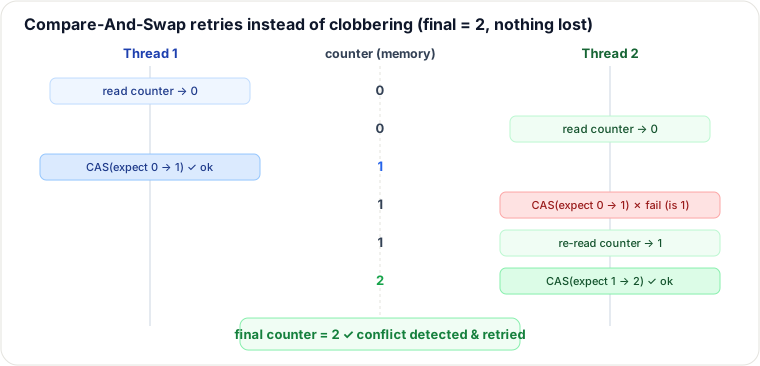
The retry loop, traced
| # | Thread | Action | counter |
|---|---|---|---|
| 1 | T1 | read → 0 | 0 |
| 2 | T2 | read → 0 | 0 |
| 3 | T1 | CAS(0→1) ✓ | 1 |
| 4 | T2 | CAS(0→1) ✗ (value is 1, not 0) | 1 |
| 5 | T2 | re-read → 1 | 1 |
| 6 | T2 | CAS(1→2) ✓ | 2 |
incrementAndGet() is exactly this loop, hidden:
// what AtomicInteger.incrementAndGet() does internally
int v;
do {
    v = get();                  // read current
} while (!compareAndSet(v, v + 1));   // retry until our read was still valid
return v + 1;
Lock-free vs locked — when to use which
| Atomic / CAS | Lock | |
|---|---|---|
| Scope | One variable | Any multi-step critical section |
| Blocking | No — spins & retries | Yes — threads park |
| Best when | Counter, flag, single reference; low–moderate contention | Multiple fields must change together; high contention |
| Risk | Wasted CPU on retries under heavy contention | Deadlock, lock convoy |
The classic gotcha: the ABA problem
CAS only checks the value, not whether it changed and changed back. If a value goes
A→B→A, a CAS expecting A succeeds — even though the world moved underneath it (common with reused
nodes in lock-free stacks). Fix with a version stamp: AtomicStampedReference compares (value, stamp).
Takeaways
- CAS = atomic "set to new only if still equal to expected"; the failure path is a retry.
- Unlike
count++, CAS detects a concurrent change instead of clobbering it. - Atomics shine for single-variable, low-contention updates; locks for compound critical sections.
- Beware ABA — use a stamped/versioned reference when identity matters.
Re-authored for this guide; CAS retry diagram hand-authored as SVG. Follows Java Concurrency in Practice (ch. 15) and Jenkov's non-blocking-algorithms tutorial. See also: Race Conditions, and Memory Model & Visibility.
🤖 Don't fully get this? Learn it with Claude
Stuck on Atomics & Compare-And-Swap (CAS)? Open Claude, copy a block below, and it'll teach you this exact concept — visually and interactively.
Build the mental picture, not memorization.
I just read a lesson on **Atomics & Compare-And-Swap (CAS)** (Concurrency) and want to truly understand it. Explain Atomics & Compare-And-Swap (CAS) from first principles using ONE vivid real-world analogy and a visual mental model — draw it as ASCII art or a clear step-by-step diagram — with a concrete example using real numbers. Then ask me one question to check I got the mental picture, and wait for my reply. If you're unsure or a claim isn't standard, say so and reason from first principles instead of guessing.
Socratic — adapts to where you're stuck.
Teach me **Atomics & Compare-And-Swap (CAS)** interactively. Ask me ONE guiding question at a time, wait for my answer, and adapt to my confusion — build the idea with me step by step instead of explaining it all at once. If you're unsure or a claim isn't standard, say so and reason from first principles instead of guessing.
Active recall exposes what you missed.
Quiz me on **Atomics & Compare-And-Swap (CAS)** with 5 questions, easy to tricky, ONE at a time. Tell me if each answer is right; at the end, explain clearly what I got wrong and why. If you're unsure or a claim isn't standard, say so and reason from first principles instead of guessing.
Intuition + hook + flashcards for long-term memory.
Help me remember **Atomics & Compare-And-Swap (CAS)** for the long term: give the one-sentence intuition, a memorable hook/mnemonic, a tiny worked example, and 3 active-recall flashcards (Q -> A). If you're unsure or a claim isn't standard, say so and reason from first principles instead of guessing.