Priority Inversion — the Bug That Nearly Killed Mars Pathfinder
Priority Inversion — the Bug That Nearly Killed Mars Pathfinder
Priority inversion is a scheduling failure that appears the moment two things are true at once: your system schedules by priority (the highest-priority runnable task always runs), and tasks of different priorities share a lock. It is not a bug in any one task’s code — each task is individually correct. It is an emergent interaction between the scheduler and the mutex, and in its dangerous form it makes a high-priority task’s worst-case latency unbounded. That is exactly the property a real-time system exists to prevent, which is why this bug reset a spacecraft on the surface of Mars in 1997.
The mechanism, first
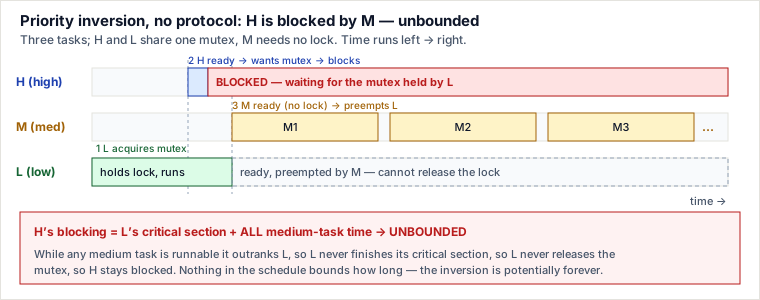
Take three tasks, ranked H (high) > M (medium) > L (low). H and L both touch a shared data structure guarded by one mutex; M touches neither and needs no lock. The failing interleaving:
- L acquires the mutex and starts its critical section.
- H becomes runnable, preempts L (it outranks it), and tries to acquire the same mutex. The mutex is held, so H blocks. This much is normal and expected — H must wait for L’s critical section.
- With H blocked, the scheduler runs the next-highest runnable task. If only L were runnable, L would finish and release — fine. But now M becomes runnable. M outranks L, so M preempts L. M does not need the lock, so it just runs.
- L is now stuck: it holds the lock but cannot run, because M keeps outranking it. So L never reaches the
unlock. H, which is only waiting for that unlock, stays blocked.
The result is the inversion: H, the highest-priority task, is effectively blocked by M, a lower-priority task that it has no lock relationship with at all. M is winning the CPU over H, indirectly, by starving the lock-holder L. The priority order has been inverted through the lock.
Bounded vs. unbounded inversion — the distinction that matters
Some blocking is unavoidable and acceptable. When H waits for L to finish a critical section, that is bounded priority inversion: H’s extra delay is at most the length of L’s critical section, which you can measure and budget for. Real-time schedulability analysis assumes some bounded blocking and accounts for it. There is nothing to fear here as long as critical sections are short and their worst case is known.
The dangerous case is unbounded priority inversion. Once a medium task can preempt the lock-holder, the blocking is no longer bounded by L’s critical section — it is extended by however long M runs. And there may be many medium-priority tasks (M1, M2, M3, …), each becoming runnable in turn, each preempting L again. There is no term in the schedule that caps the total. H’s delay becomes:
delay(H) = L's critical section + SUM(all medium-priority work that becomes runnable)The second term is not bounded by anything in your control. That is what “unbounded” means, and why the standard mistake — “my critical sections are only a few microseconds, so inversion can’t hurt me” — is wrong. The length of your critical section is the bounded part. The unbounded part comes entirely from the medium tasks, which have nothing to do with the lock.
Mars Pathfinder, 1997
Mars Pathfinder landed on 4 July 1997 and began returning data. Within days the lander began experiencing total system resets — a watchdog would fire, the spacecraft would reboot, and a day’s data would be lost. The flight software ran on the VxWorks real-time OS with strict priority-preemptive scheduling. The cause was textbook priority inversion:
- An information bus — a shared memory area coordinating instruments — was managed by a high-priority bus-management task, which accessed the bus under a mutex.
- A low-priority meteorological (ASI/MET) data-gathering task also published to that bus, taking the same mutex.
- Occasionally an interrupt would make the low-priority MET task hold the mutex just as the high-priority bus task needed it, so the bus task blocked — normal so far.
- But a long-running medium-priority communications task would then become runnable, preempt the low-priority MET task, and run. The MET task never got the CPU back to release the mutex, so the high-priority bus task stayed blocked.
- A watchdog timer checked that the bus task completed its work within a deadline. When it did not, the watchdog concluded the system had hung and triggered a full reset.
The fix was priority inheritance, and it was applied after landing, from Earth. The VxWorks mutex (semMCreate) supported an inversion-safe option (SEM_INVERSION_SAFE, i.e. priority inheritance) that had not been enabled on that mutex. JPL engineers, having reproduced the hang on a ground replica, used VxWorks’ on-board C interpreter to flip the initialization flag that enabled priority inheritance on the offending mutex, uploaded the change, and the resets stopped. The definitive first-hand account is Glenn Reeves’ (JPL flight-software lead) “What Really Happened on Mars,” written to correct the widely circulated retelling by Mike Jones, which was itself based on a keynote by Wind River’s David Wilner. The priority-inheritance diagnosis and fix are accurate in both.
The two fixes: priority inheritance vs. priority ceiling
Both protocols attack the same weak point — the lock-holder being preemptable by an unrelated medium task — but they do it differently. Both come from Sha, Rajkumar & Lehoczky’s 1990 paper on real-time synchronization.
Priority inheritance (basic PIP)
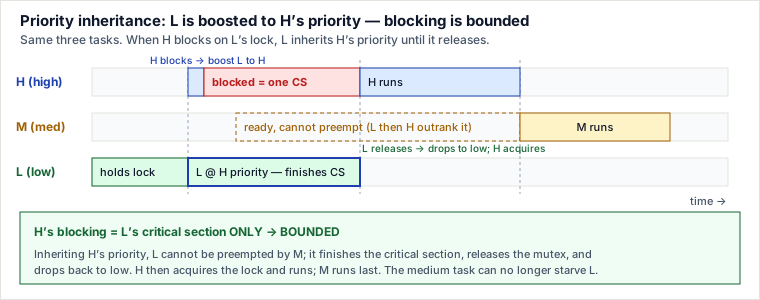
Rule: while a low-priority task holds a lock that a higher-priority task is blocked on, temporarily raise the holder to the highest priority among the tasks waiting for that lock. Drop it back the instant it releases the lock. In the trace above, the moment H blocks on L’s mutex, L is boosted to H’s priority. Now M — which is below H — can no longer preempt L. L runs its critical section to completion at H’s priority, releases the lock, and drops back to low; H immediately acquires and runs. The medium task is powerless to extend the blocking.
Inheritance is dynamic (it only changes priorities when a block actually happens), transitive (if H blocks on L, and L is itself blocked on an even-lower task, the boost chains down the whole chain), and needs no per-lock configuration. Its downsides: bookkeeping on every block/unblock, the possibility of a task being boosted and de-boosted many times (chained inheritance), and — critically — it does not by itself prevent deadlock.
Priority ceiling (PCP / immediate ceiling, ICPP)
Rule: each lock is assigned a static ceiling equal to the highest priority of any task that can ever acquire it. In the immediate ceiling variant (the one most RTOSes implement and what POSIX calls priority protection), a task is raised to the lock’s ceiling the moment it acquires the lock — before any contention even occurs. Because the holder already runs at the ceiling, no task that could ever want the lock can preempt it, so the inversion window never opens.
Ceiling protocols give a stronger guarantee than inheritance: a task can be blocked at most once, for the duration of a single critical section, and in the classic formulation the protocol also prevents deadlock and chained blocking (a task can only start a critical section if its priority is strictly higher than the ceilings of all locks currently held by other tasks). The price is that ceilings must be computed statically from the full set of tasks and locks — you need to know every task that touches every lock up front — and the holder is boosted even when there is no contention at all, which adds priority-change overhead to the uncontended path.
Contrast in one line: inheritance reacts to contention and needs no analysis but only bounds blocking; ceiling acts pre-emptively, needs static analysis, and additionally buys you deadlock freedom and single-block bounds.
The traced resolution, step by step
Reading the second timeline against the first, with priority inheritance enabled on the mutex:
- L acquires the mutex at low priority and runs its critical section.
- H becomes runnable, preempts L, tries the mutex, and blocks — identical to before.
- Priority inheritance triggers on the block: the OS raises L to H’s priority, because H is now waiting on a lock L holds.
- M becomes runnable — but M is below H, and L is now at H’s priority. M cannot preempt L. It sits ready.
- L finishes its critical section and releases the mutex. Its priority drops back to low.
- H unblocks, acquires the mutex, and runs. When H finishes, M finally runs.
H’s blocking was reduced from “L’s critical section + all medium work” to just “L’s critical section” — bounded and analyzable. That single change is what stopped the Pathfinder resets.
How to get it in practice
- POSIX threads. Set the mutex protocol on the attribute before creating the mutex:
pthread_mutexattr_setprotocol(&attr, PTHREAD_PRIO_INHERIT)for priority inheritance, orPTHREAD_PRIO_PROTECTpluspthread_mutexattr_setprioceiling(&attr, ceil)for the ceiling (priority-protect) protocol. The default isPTHREAD_PRIO_NONE— no protection at all. - Linux real-time. The
PREEMPT_RTkernel builds most in-kernel locks on rt-mutexes, which implement priority inheritance; userspace gets it through PI futexes (FUTEX_LOCK_PI) under the RT scheduling classes (SCHED_FIFO/SCHED_RR). - Where you do NOT get it. The general-purpose Linux scheduler (
SCHED_OTHER/ CFS) does not do priority inheritance for ordinary mutexes, and mainstream language runtimes — Javasynchronized/ReentrantLock, Gosync.Mutex, Python’s GIL and locks — do not implement PI. So this bug bites specifically in RT, embedded, and kernel code, and in lock-heavy, latency-sensitive services where a “priority” effectively exists (e.g. a latency-critical request thread starved behind a background thread holding a shared lock while medium-weight threads hog cores).
Selection & trade-offs
Four strategies sit on a spectrum from “do nothing” to “remove the shared lock entirely.” Pick by how much you know statically and whether you can afford to redesign the data sharing.
| Strategy | How it works | Cost | Right when |
|---|---|---|---|
| No protocol | Nothing; plain mutex | Cheapest; inversion possible and unbounded | No two priority bands ever share a lock (or you are not priority-scheduled) |
| Priority inheritance | Boost holder to highest waiter’s priority on block; drop on release; transitive along chains | Per-block bookkeeping; possible repeated boosts; does not prevent deadlock | Dynamic or unknown task set; you want a drop-in fix with no static analysis (the pragmatic default, and the Pathfinder fix) |
| Priority ceiling (immediate) | Static per-lock ceiling; holder runs at ceiling from acquire time | Requires knowing all tasks/locks up front; boosts even when uncontended | Hard real-time with a fixed, analyzable task set (avionics, safety-critical); you also want deadlock freedom and single-block bounds |
| Avoid the shared lock | Lock-free structures, message passing, or per-priority data with no cross-band sharing | Design effort; harder algorithms or copy/queue overhead | Feasible to eliminate cross-band sharing — then no protocol is needed and the failure mode does not exist |
The last row is worth taking seriously: the cleanest fix for priority inversion is often architectural. If H and L never share a lock — because they communicate through a lock-free queue or a message channel instead — there is no critical section for M to interfere with, and no protocol to tune. Inheritance and ceiling are the tools when shared locking across priority bands is unavoidable.
Pitfalls
- “My critical sections are short, so I’m safe.” The bounded part of the delay is your critical section; the unbounded part is the medium tasks. Short critical sections do not cap the medium-task time, so they do not prevent unbounded inversion.
- Assuming your runtime does PI. Enabling
PTHREAD_PRIO_INHERITin C does nothing for your Java or Go service — those runtimes have no PI. If you depend on it, verify it exists on your exact platform and scheduling class. - PI overhead and chains. Priority inheritance is not free: every block/unblock adjusts priorities, and transitive chains (H waits on L, L waits on an even-lower task) can cause cascades of boosts. In deep chains this bookkeeping is itself a latency source.
- Wrong ceilings. A priority ceiling set too low reopens the inversion window; too high needlessly delays unrelated tasks. Ceilings must be re-derived whenever the task set changes — a maintenance hazard.
- PI is not a deadlock fix. Basic priority inheritance bounds blocking but does nothing about lock-ordering deadlocks; only the ceiling protocol (in its classic form) also gives deadlock freedom.
Takeaways
- Priority inversion is an interaction between priority scheduling and shared locks, not a bug in any single task; its dangerous form makes a high-priority task’s latency unbounded, driven by unrelated medium tasks — not by your critical-section length.
- Priority inheritance is the pragmatic default: dynamic, transitive, no static analysis, bounds blocking to the critical section. It is what saved Mars Pathfinder in flight.
- Priority ceiling gives stronger guarantees (single-block bound plus deadlock freedom) at the cost of static analysis and uncontended overhead — choose it for fixed, safety-critical task sets.
- PI only helps if your platform provides it (RTOS, POSIX RT mutexes,
PREEMPT_RT) — CFS and mainstream language runtimes do not. When you can, the strongest fix is to not share a lock across priority bands at all.
References
- L. Sha, R. Rajkumar, J. P. Lehoczky, “Priority Inheritance Protocols: An Approach to Real-Time Synchronization,” IEEE Transactions on Computers, 39(9), 1990.
- Glenn E. Reeves, “What Really Happened on Mars?” (JPL, 1997/1998); and Mike Jones’ account of David Wilner’s keynote on the Pathfinder priority-inversion incident.
- POSIX / IEEE Std 1003.1:
pthread_mutexattr_setprotocol,pthread_mutexattr_setprioceiling(PTHREAD_PRIO_INHERIT/PTHREAD_PRIO_PROTECT). - Linux kernel documentation:
PREEMPT_RTandDocumentation/locking/rt-mutex.rst(rt-mutex priority inheritance; PI futexes).
🤖 Don't fully get this? Learn it with Claude
Stuck on Priority Inversion — the Bug That Nearly Killed Mars Pathfinder? Open Claude, copy a block below, and it'll teach you this exact concept — visually and interactively.
Build the mental picture, not memorization.
I just read a lesson on **Priority Inversion — the Bug That Nearly Killed Mars Pathfinder** (Concurrency) and want to truly understand it. Explain Priority Inversion — the Bug That Nearly Killed Mars Pathfinder from first principles using ONE vivid real-world analogy and a visual mental model — draw it as ASCII art or a clear step-by-step diagram — with a concrete example using real numbers. Then ask me one question to check I got the mental picture, and wait for my reply. If you're unsure or a claim isn't standard, say so and reason from first principles instead of guessing.
Socratic — adapts to where you're stuck.
Teach me **Priority Inversion — the Bug That Nearly Killed Mars Pathfinder** interactively. Ask me ONE guiding question at a time, wait for my answer, and adapt to my confusion — build the idea with me step by step instead of explaining it all at once. If you're unsure or a claim isn't standard, say so and reason from first principles instead of guessing.
Active recall exposes what you missed.
Quiz me on **Priority Inversion — the Bug That Nearly Killed Mars Pathfinder** with 5 questions, easy to tricky, ONE at a time. Tell me if each answer is right; at the end, explain clearly what I got wrong and why. If you're unsure or a claim isn't standard, say so and reason from first principles instead of guessing.
Intuition + hook + flashcards for long-term memory.
Help me remember **Priority Inversion — the Bug That Nearly Killed Mars Pathfinder** for the long term: give the one-sentence intuition, a memorable hook/mnemonic, a tiny worked example, and 3 active-recall flashcards (Q -> A). If you're unsure or a claim isn't standard, say so and reason from first principles instead of guessing.