How a Lock Is Built — From Test-and-Set to Futex to Spin-then-Park
A lock feels like an abstraction — lock(), do work, unlock() — but underneath there is no magic keeper of order. There is a single word of memory and a promise from the CPU that one instruction can read-modify-write that word without any other core interleaving. Everything else — spinning, queueing, parking, fairness, the near-zero cost of an uncontended acquire — is engineering built on top of that one atomic instruction plus a way to wait.
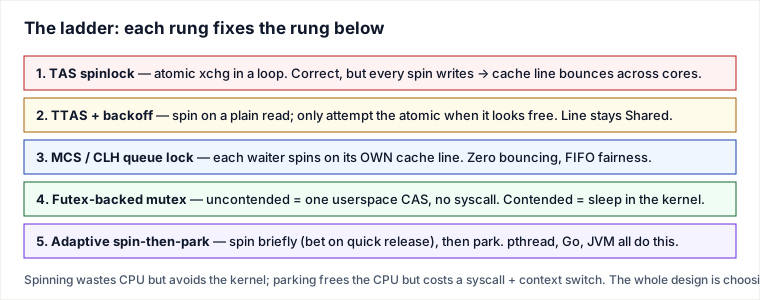
This page builds the ladder rung by rung. We start at the silicon (test-and-set, compare-and-swap), watch the naive spinlock melt a multicore machine, fix it with test-and-test-and-set and backoff, remove the cache traffic entirely with queue locks, then confront the real problem: pure spinning burns a CPU while the lock holder is asleep. The answer — the futex — is the reason an uncontended std::mutex, pthread_mutex, or Go sync.Mutex costs a handful of nanoseconds and touches the kernel exactly zero times.
The two questions we are answering
- Why is an uncontended lock nearly free? Because acquiring it is a single atomic compare-and-swap on a userspace word. No syscall, no scheduler, no context switch — just one instruction that the cache coherence protocol already knows how to make atomic. The kernel only appears when a thread actually has to wait.
- How is a mutex actually implemented? As a small state machine over that word: a fast path that CASes the word from "free" to "held", and a slow path that, only on contention, asks the OS to put the thread to sleep and wake it later. Real mutexes spin for a short while first, betting the holder will release before a park is worth its cost.
Rung 0 — The hardware primitive: an atomic read-modify-write
The problem a lock solves is that if (free) { free = false; } is three separate operations — read, test, write — and two cores can both read "free" before either writes "false". Both think they won. The CPU fixes this by offering instructions that fuse read-modify-write into one indivisible step that the cache coherence protocol serializes.
Two matter for locks. Test-and-set (TAS): atomically write 1 to a word and return its old value. On x86 this is LOCK XCHG (exchange register with memory; the LOCK prefix makes it atomic). Compare-and-swap (CAS): atomically, "if the word equals expected, store new and report success; else report the actual value." On x86 this is LOCK CMPXCHG. CAS is strictly more expressive — it lets you build lock-free stacks, counters, and the futex fast path — but for a plain mutual-exclusion lock, TAS is enough.
// The primitives, as the CPU exposes them (C11 atomics over the hardware op).

// test-and-set: atomically set *p = 1, return the OLD value.
// Compiles to LOCK XCHG on x86-64.
int test_and_set(atomic_int *p) {
    return atomic_exchange(p, 1);   // returns previous value: 0 = we got it, 1 = someone held it
}

// compare-and-swap: if *p == expected, set *p = desired and return true;
// else write the actual value back into *expected and return false.
// Compiles to LOCK CMPXCHG on x86-64.
bool compare_and_swap(atomic_int *p, int *expected, int desired) {
    return atomic_compare_exchange_strong(p, expected, desired);
}
Why is this atomic and not merely fast? Because of cache coherence (MESI). To write a line, a core must own it Exclusive/Modified — it broadcasts a Read-For-Ownership (RFO) that invalidates every other core's copy. The LOCK prefix guarantees that for the duration of the read-modify-write, no other core can touch that line. That guarantee is the entire foundation of every lock below. It is also the source of every scaling problem we are about to hit: writes force cache lines to move between cores, and moving a cache line between cores is expensive.
Rung 1 — The naive spinlock (TAS): correct, then it melts
The simplest lock: loop calling test-and-set until it returns 0 (the word was free and is now ours).
// TAS spinlock — CORRECT but pathological under contention.
typedef struct { atomic_int locked; } spinlock;   // 0 = free, 1 = held

void spin_lock(spinlock *L) {
    while (atomic_exchange(&L->locked, 1) == 1) {
        // returned 1 → someone else holds it → keep hammering
        // NOTE: every iteration is a WRITE (xchg), even while we fail
    }
}

void spin_unlock(spinlock *L) {
    atomic_store_explicit(&L->locked, 0, memory_order_release);
}
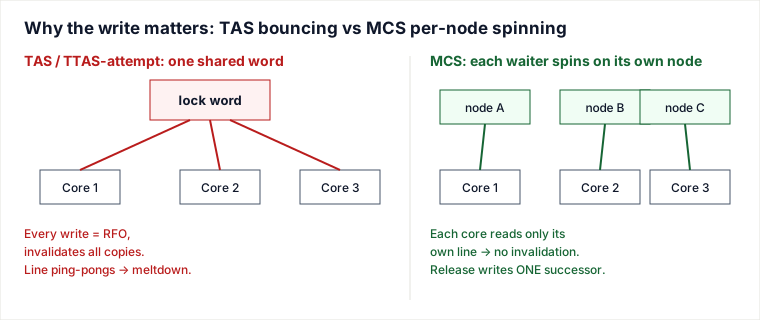
Correctness is fine. Scaling is a disaster. Every iteration of the loop executes xchg, which is a write, which demands the cache line in Exclusive state, which issues an RFO that invalidates the line in every other core's cache. With N cores spinning, the single lock word ping-pongs between caches continuously — the "cache line bouncing" storm. Worse, the core actually holding the lock now has to fight the spinners just to write the word to release it. Throughput doesn't plateau under contention; it collapses. This is the contention meltdown, and it is entirely caused by spinning with a write.
Rung 2 — Test-and-test-and-set (TTAS) + exponential backoff
The fix is to stop writing while you wait. In TTAS the spin loop is a plain read; you only fire the atomic when the read says the lock looks free. A read only needs the cache line in Shared state — many cores can hold a Shared copy simultaneously, so spinning generates no coherence traffic at all once every spinner has cached the line. The RFO storm only happens at the moment of an actual attempt.
// TTAS: test (cheap read) then test-and-set (the atomic), plus exponential backoff.
void ttas_lock(spinlock *L) {
    int backoff = 1;
    for (;;) {
        // TEST: spin on a plain load — line stays Shared, no bus traffic.
        while (atomic_load_explicit(&L->locked, memory_order_relaxed) == 1)
            cpu_relax();                 // x86 PAUSE: hint to the pipeline, cheap

        // Looks free — now TEST-AND-SET (the only write).
        if (atomic_exchange(&L->locked, 1) == 0)
            return;                      // acquired

        // Lost the race; back off to spread out the retries and cut collisions.
        for (int i = 0; i < backoff; i++) cpu_relax();
        if (backoff < 1024) backoff *= 2;
    }
}
The improvement is dramatic: instead of N cores each issuing writes every iteration, they issue writes only when the lock is released and they contend for it. The PAUSE instruction (cpu_relax()) tells the CPU this is a spin-wait, reducing power and easing memory-order speculation. Exponential backoff addresses the residual thundering herd — when the lock frees, all spinners attempt at once; backoff staggers the retries so they don't all collide again. TTAS is still not fair (whoever's cache is warmest tends to win), and a released lock still causes one invalidation burst, but it turns "meltdown" into "acceptable under moderate contention."
Rung 3 — Queue locks (MCS / CLH): everyone spins locally
TTAS still shares one word, so a release still invalidates every spinner's cached copy at once. Queue locks eliminate even that. The idea (Mellor-Crummey & Scott, 1991): form an explicit FIFO queue of waiters, where each waiter allocates its own node and spins on a flag inside its own node. Because no two waiters spin on the same memory, there is zero coherence traffic during the wait, and release touches exactly one cache line — the successor's.
// MCS lock. Each thread supplies its own node (usually stack-local).
typedef struct mcs_node {
    _Atomic(struct mcs_node *) next;
    atomic_int                 locked;   // 1 = must wait, 0 = go
} mcs_node;

typedef struct { _Atomic(mcs_node *) tail; } mcs_lock;   // tail = last in line

void mcs_lock_acquire(mcs_lock *L, mcs_node *self) {
    self->next = NULL;
    self->locked = 1;
    // Atomically append self to the queue; get the previous tail.
    mcs_node *pred = atomic_exchange(&L->tail, self);   // one XCHG
    if (pred != NULL) {                 // someone is ahead of us
        atomic_store(&pred->next, self); // tell predecessor to hand off to us
        while (atomic_load(&self->locked) == 1)   // SPIN ON OUR OWN NODE
            cpu_relax();                //   → line stays local, no bouncing
    }
    // pred == NULL → we are the head, lock is ours immediately.
}

void mcs_lock_release(mcs_lock *L, mcs_node *self) {
    mcs_node *succ = atomic_load(&self->next);
    if (succ == NULL) {                 // no known successor
        mcs_node *expected = self;      // try to close the queue
        if (atomic_compare_exchange_strong(&L->tail, &expected, NULL))
            return;                     // we were last; done
        while ((succ = atomic_load(&self->next)) == NULL)  // successor mid-enqueue
            cpu_relax();                //   wait for it to link itself
    }
    atomic_store(&succ->locked, 0);     // release: touch ONLY successor's line
}
MCS gives strict FIFO fairness (no starvation, no lucky-cache winner) and near-constant traffic regardless of core count — the property that made it the basis for the Linux kernel's qspinlock. CLH is a close cousin where each waiter spins on its predecessor's node instead of its own, which is simpler and works better on cache-coherent-only (non-NUMA-local) machines but spins on remote memory. The cost of queue locks: you must supply a node, release has that awkward mid-enqueue race to handle, and — like all spin locks — they still burn CPU while waiting. Which brings us to the real problem.
Rung 4 — The blocking problem, and the futex
Every lock so far spins. Spinning is a bet: "the holder will release so soon that burning cycles is cheaper than going to sleep." On a multicore box with a two-instruction critical section, that bet wins. But if the lock holder gets descheduled by the OS — its timeslice ends, or it's preempted — the spinners now burn entire timeslices waiting for a thread that isn't even running. On a single core it's catastrophic: the spinner can't yield to the holder, so it spins uselessly until preempted. Spinning must eventually give way to blocking: tell the OS "put me to sleep until this word changes."
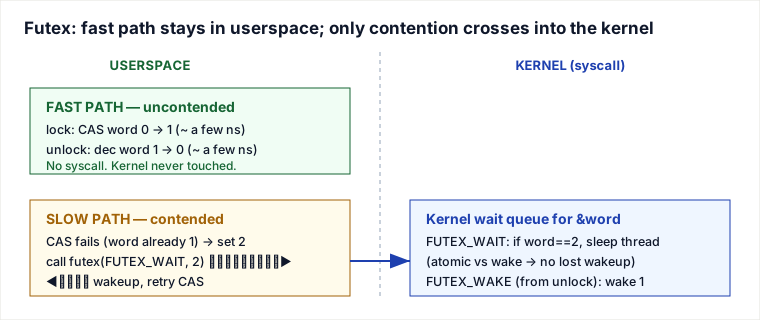
Naively, blocking means a syscall on every acquire and release to register/wake a waiter in the kernel — even when there's no contention and no one to wait for. That syscall (hundreds of nanoseconds) would dominate the lock cost. The futex (fast userspace mutex, Linux 2.6) is the insight that makes blocking cheap: keep the lock word in userspace, and only enter the kernel when a thread actually has to wait or has to wake someone.
The kernel provides two operations on a userspace address:
futex(&word, FUTEX_WAIT, expected)— "atomically: ifword == expected, put me to sleep on this address; otherwise return immediately." The compare-and-sleep is atomic against wakeups, closing the lost-wakeup race.futex(&word, FUTEX_WAKE, n)— "wake up tonthreads sleeping on this address."
The crucial part: the kernel knows nothing about the lock when it is uncontended. No kernel object is allocated, no syscall is made. The kernel only materializes a wait-queue for that address when some thread calls FUTEX_WAIT.
// Futex-backed mutex — the classic 3-state design (Drepper, "Futexes Are Tricky").
// State: 0 = unlocked, 1 = locked no waiters, 2 = locked WITH waiters.
atomic_int m;   // the whole lock is one int

void mutex_lock(atomic_int *m) {
    int c = 0;
    // FAST PATH: try to CAS 0 → 1. Uncontended → done, NO SYSCALL.
    if (atomic_compare_exchange_strong(m, &c, 1))
        return;                         // c was 0; we own it. This is the common case.

    // SLOW PATH: contended.
    if (c != 2)                         // if state was 1, mark it 2 (waiters present)
        c = atomic_exchange(m, 2);
    while (c != 0) {                    // while still held by someone...
        futex(m, FUTEX_WAIT, 2);        //   sleep until it's not 2 (SYSCALL, only here)
        c = atomic_exchange(m, 2);      //   woke up: try to grab, re-marking "waiters"
    }
}

void mutex_unlock(atomic_int *m) {
    // FAST PATH: if state was 1 (no waiters), just drop to 0. NO SYSCALL.
    if (atomic_fetch_sub(m, 1) != 1) {  // returns old value; if it was 2 there are waiters
        atomic_store(m, 0);
        futex(m, FUTEX_WAKE, 1);        //   wake ONE waiter (SYSCALL, only when waiters exist)
    }
}
Trace the two worlds. Uncontended lock: one CAS 0→1, done — a few nanoseconds, entirely in userspace. Uncontended unlock: one atomic decrement 1→0, done. Zero syscalls on the entire critical section. This is why an uncontended lock is nearly free: the fast path is literally one atomic instruction, and the kernel is never involved. The syscall only appears on the branch where a thread genuinely could not proceed and had to sleep — exactly where paying for it is unavoidable anyway. The "3" state (waiters bit) exists so unlock can skip the FUTEX_WAKE syscall when it can prove no one is waiting.
Rung 5 — Adaptive spin-then-park: what real mutexes do
Pure blocking has its own waste: if the holder releases 50 nanoseconds after you failed the CAS, going through FUTEX_WAIT (syscall + context switch out, then a wakeup syscall + context switch back in — easily 1-2 microseconds) is far more expensive than just spinning for those 50 ns. So production mutexes are adaptive: on the slow path, spin a bounded number of times first (betting the holder releases soon), and only park (futex_wait) if the spin budget runs out. This captures the best of both: near-zero latency for short critical sections, and no CPU waste for long ones.
// Adaptive slow path (conceptual — glibc/pthreads and others do a version of this).
void mutex_lock_adaptive(atomic_int *m) {
    int c = 0;
    if (atomic_compare_exchange_strong(m, &c, 1)) return;   // fast path

    for (int spins = 0; spins < SPIN_LIMIT; spins++) {      // BET: holder releases soon
        if (atomic_load(m) == 0) {
            c = 0;
            if (atomic_compare_exchange_strong(m, &c, 1)) return;   // grabbed during spin
        }
        cpu_relax();
    }
    // Spin budget exhausted → holder is likely descheduled → PARK.
    slow_path_park(m);   // the futex_wait loop from Rung 4
}
JVM lock inflation is the same ladder wearing object-oriented clothes. Every Java object has a lock, but paying full weight for locks that are rarely contended is wasteful, so HotSpot escalates lazily: biased locking (the object is tagged with one thread's ID; that thread reacquires with no atomic at all — now largely removed/deprecated as multicore made the rebias cost dominate) → thin lock (an uncontended CAS on the object header's mark word, exactly Rung 4's fast path) → fat lock (on real contention, the JVM "inflates" the lock, allocating a heavyweight OS-monitor / ObjectMonitor that parks threads via the OS). Biased → thin → fat is JVM-speak for "no-atomic → CAS → OS-park."
Go's sync.Mutex runs the same play in the runtime. The fast path is a single CAS on the mutex's state word (goroutine-level, no OS thread involved). On contention it spins a few times (runtime_canSpin, only when it makes sense — multicore, holder running), then parks the goroutine on a runtime semaphore (runtime_SemacquireMutex), which is itself futex-backed at the OS-thread layer. Go adds a starvation mode: if a goroutine waits more than 1 ms, the mutex flips from "normal" (barging — a newly arriving goroutine can steal the lock, which is throughput-optimal but can starve the queue) to "starvation" (strict FIFO handoff directly to the head waiter), then flips back once the backlog clears. It's the fairness-vs-throughput knob made explicit.
A traced two-thread contention
Two threads, T1 and T2, a futex-backed mutex, one shared word m.
UNCONTENDED (T1 alone):
  T1  mutex_lock:   CAS m 0→1  ✓            cost: 1 atomic, ~10-20 ns, NO syscall
  T1  <critical section>
  T1  mutex_unlock: dec m 1→0, old==1 ✓      cost: 1 atomic, no waiters → NO syscall
  Total kernel crossings: 0

CONTENDED (T2 arrives while T1 holds it):
  T1  holds m (m==1)
  T2  mutex_lock:   CAS m 0→1  ✗ (got 1)     cost: 1 atomic (failed)
  T2  (adaptive)    spin SPIN_LIMIT times... T1 still in CS → budget exhausted
  T2  set m→2 (mark waiters)                 cost: 1 atomic
  T2  futex(m, WAIT, 2)  → sleeps            cost: SYSCALL + context switch OUT (~1 µs)
  ---- T1 finishes ----
  T1  mutex_unlock: dec m 2→1, old==2 → waiters! store m=0; futex(m, WAKE, 1)
                                             cost: 1 atomic + SYSCALL (wake)
  T2  wakes, CAS/exchange m→2, sees free, proceeds
                                             cost: context switch IN (~1 µs) + 1 atomic
  Kernel crossings: exactly 2 (one WAIT, one WAKE) — paid only because a thread truly slept.
The asymmetry is the whole point. The uncontended path is a couple of cache-local atomic instructions. The kernel — with its microsecond-scale syscalls and context switches — shows up only on the branch where a thread had nothing to do but sleep, which is exactly when that cost is amortized against real idle time rather than wasted.
Pitfalls
- Hand-rolling a spinlock in userspace. A userspace spinlock has no relationship with the scheduler. It has no fairness (barging, possible starvation), it burns 100% CPU while waiting, and it is vulnerable to priority inversion: a low-priority thread holding the lock can be preempted by the very medium-priority threads that a high-priority spinner is starving, so the high-priority thread spins forever waiting for a holder that never gets to run. Kernels solve this with priority inheritance on real mutexes; your spinlock cannot. Use a real mutex unless you have measured that the critical section is nanoseconds long and you are pinned/realtime.
- Assuming a lock always syscalls. A very common mental model bug. It leads people to avoid locks and reach for lock-free structures prematurely "to avoid the syscall" — but the uncontended mutex never syscalls. Contention, not locking, is what costs. Measure contention before you optimize it away.
- Spinning on a hyperthread starves the sibling. Two logical cores (SMT/hyperthreads) share one physical core's execution units. A tight spin loop on one hyperthread consumes issue slots the sibling needs — so your spinner can slow down the very thread holding the lock if they share a core.
PAUSEexists partly to mitigate this by yielding pipeline resources, but it is not a cure. This is a core reason spin budgets are kept small and adaptive. - Forgetting release semantics. The unlock store must be a release (and lock, an acquire) so the critical section's writes are visible to the next holder. A plain relaxed store lets the compiler/CPU reorder work out of the critical section.
Selection & trade-offs
- TAS spinlock — never ship it. Only pedagogically useful, or on a strictly single-writer path. It melts under any real multicore contention.
- TTAS + exponential backoff — good when the critical section is very short (tens of ns), contention is moderate, you're on multicore, and you can guarantee the holder won't be descheduled (e.g. interrupts off, or pinned realtime threads). Wins over a futex mutex by avoiding syscalls entirely. Loses when contention is high (still one shared line) or holders can sleep.
- MCS / CLH queue lock — the choice when you need spinning and scalability to many cores and FIFO fairness. Constant coherence traffic regardless of core count; no starvation. This is why the Linux kernel uses MCS-based
qspinlockinternally. Costs: per-waiter node, trickier release, and it still spins (so still a bad fit if holders can be preempted — which is why it lives in the kernel where the holder isn't preempted while holding). - Futex-backed mutex (optionally adaptive) — the correct default for essentially all userspace application code. Uncontended cost is a single atomic; contended waiters sleep instead of burning CPU, so it tolerates long critical sections, descheduled holders, oversubscription, and single-core machines gracefully. The adaptive spin recovers most of the spinlock's low latency for short sections. You give up strict fairness (barging) unless the implementation adds a starvation mode (as Go does). Choose this unless you have a measured reason not to.
The through-line: spinning trades CPU to avoid the kernel; parking trades a syscall to free the CPU. TAS→TTAS→MCS optimize the spinning side (less coherence traffic, more fairness); the futex optimizes the crossing between the two (stay in userspace until you genuinely must sleep); adaptive spin-then-park picks the crossover point dynamically. Every real mutex you use is some tuning of exactly these axes.
Takeaways
- A lock is nothing but an atomic read-modify-write on a memory word plus a way to wait. The atomicity comes free from cache coherence; all the sophistication is in how you wait.
- An uncontended lock is nearly free because a futex-backed mutex's fast path is a single userspace CAS with zero kernel involvement. The kernel appears only when a thread must actually sleep — and only then do you pay a syscall.
- Writing while spinning is the enemy: it forces cache lines to bounce (RFO storms). TTAS spins on reads; MCS/CLH spin on per-thread lines. Both attack the same coherence-traffic problem.
- Real mutexes (pthread, Go
sync.Mutex, the JVM's biased→thin→fat inflation) all implement the same adaptive spin-then-park ladder — spin briefly for short critical sections, park to avoid burning CPU on long ones.
Citations
- T. E. Anderson, "The Performance of Spin Lock Alternatives for Shared-Memory Multiprocessors," IEEE TPDS, 1990 — TAS meltdown, backoff, array/queue locks.
- J. Mellor-Crummey & M. Scott, "Algorithms for Scalable Synchronization on Shared-Memory Multiprocessors," ACM TOCS, 1991 — the MCS lock (and CLH lineage).
- U. Drepper, "Futexes Are Tricky," 2011 — the 3-state futex mutex and its lost-wakeup pitfalls;
man 2 futex,man 7 futex. - Herlihy & Shavit, "The Art of Multiprocessor Programming," ch. 7 (Spin Locks and Contention) — TTAS, backoff, MCS/CLH, and the spin-vs-block analysis.
- HotSpot JVM lock inflation (biased → thin → fat /
ObjectMonitor); Go runtimesync.Mutexsource (normal vs starvation mode,runtime_canSpin,runtime_SemacquireMutex).
🤖 Don't fully get this? Learn it with Claude
Stuck on How a Lock Is Built — From Test-and-Set to Futex to Spin-then-Park? Open Claude, copy a block below, and it'll teach you this exact concept — visually and interactively.
Build the mental picture, not memorization.
I just read a lesson on **How a Lock Is Built — From Test-and-Set to Futex to Spin-then-Park** (Concurrency) and want to truly understand it. Explain How a Lock Is Built — From Test-and-Set to Futex to Spin-then-Park from first principles using ONE vivid real-world analogy and a visual mental model — draw it as ASCII art or a clear step-by-step diagram — with a concrete example using real numbers. Then ask me one question to check I got the mental picture, and wait for my reply. If you're unsure or a claim isn't standard, say so and reason from first principles instead of guessing.
Socratic — adapts to where you're stuck.
Teach me **How a Lock Is Built — From Test-and-Set to Futex to Spin-then-Park** interactively. Ask me ONE guiding question at a time, wait for my answer, and adapt to my confusion — build the idea with me step by step instead of explaining it all at once. If you're unsure or a claim isn't standard, say so and reason from first principles instead of guessing.
Active recall exposes what you missed.
Quiz me on **How a Lock Is Built — From Test-and-Set to Futex to Spin-then-Park** with 5 questions, easy to tricky, ONE at a time. Tell me if each answer is right; at the end, explain clearly what I got wrong and why. If you're unsure or a claim isn't standard, say so and reason from first principles instead of guessing.
Intuition + hook + flashcards for long-term memory.
Help me remember **How a Lock Is Built — From Test-and-Set to Futex to Spin-then-Park** for the long term: give the one-sentence intuition, a memorable hook/mnemonic, a tiny worked example, and 3 active-recall flashcards (Q -> A). If you're unsure or a claim isn't standard, say so and reason from first principles instead of guessing.