Relations, Tuples, and Attributes
A relation is a set of tuples drawn from the Cartesian product of its attribute domains, and that single definition — “a set, not a list” — is the mechanism that forces every property you will rely on for the next twenty years of SQL: rows have no order, columns have no order, and no two rows can be identical. Everything below (arity, cardinality, schema vs. instance, why a key is mandatory) is a consequence of that one set-theoretic fact, not an arbitrary rule a vendor invented.
The mechanism: a relation is a subset of a Cartesian product
Fix three domains — the universes of legal values for each attribute:
dom(RollNo)= the positive integersdom(Name)= strings up to 60 charsdom(CGPA)= the reals in[0.0, 10.0], plus the special markerNULL(“unknown / not applicable”)
The Cartesian product dom(RollNo) × dom(Name) × dom(CGPA) is the set of every conceivable 3-tuple — billions of them, almost all nonsense. A relation is simply a chosen subset of that product: the handful of tuples that are true facts right now. A tuple is one element of that subset (one row, one fact). An attribute is a named position in the tuple, and its name — not its left-to-right index — is how you address it. Because the container is a mathematical set, two structural guarantees come for free:
- No duplicate tuples. Sets cannot contain the same element twice, so two byte-identical rows are the same row.
- No inherent order of rows or of columns.
{a, b} = {b, a}; the relation is unchanged by reordering.
Hold onto guarantee #1 — it is the reason a relation needs a key, and the reason the SQL tables you actually use quietly break this model.
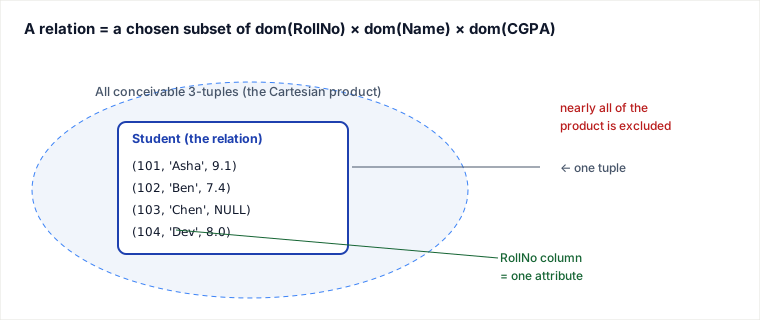
Worked example: watch the set semantics bite
Start with the four true facts above. Schema and instance are different things, so name them precisely:
- Schema (the blueprint, fixed):
Student(RollNo: int, Name: varchar(60), CGPA: decimal(3,1) NULL). Its arity / degree is 3 — a property of the schema, so it never changes as rows come and go. - Instance (the data right now, changes every write): the set of four tuples. Its cardinality is 4 — a property of the instance.
Now run three operations and track what the set rules do at each step:
- Insert a fact that is already present. Attempt to add
(102, 'Ben', 7.4)again. In the pure model this is a no-op: the element is already in the set, so cardinality stays 4. The information content did not increase, because asserting a true fact twice tells you nothing new. - Reorder the rows. List Dev first, then Asha, Chen, Ben. The relation is identical — same set, same cardinality 4. Any query result that depended on this physical order would be reading something the model does not promise.
- Reason about the NULL. Ask “how many students have CGPA < 8.0?” Ben (7.4) qualifies. Chen is
NULL— unknown — soNULL < 8.0evaluates to unknown, not true, and Chen is excluded. Answer: 1, not 2. The NULL is not zero and not a low value; it is the absence of a value, and comparisons against it produce a third truth value.
Three operations, three model-level facts: duplicates collapse, order is meaningless, and NULL infects comparisons. None of these were taught as rules — they fell out of “a relation is a set.”
Why the textbook model and your real table disagree
Here is the trap that bites working engineers: a SQL table is a bag (multiset), not a relation. The standard relational model forbids duplicate rows; SQL permits them. If you create a table with no primary key and no unique constraint, this is legal and the second row survives:
CREATE TABLE student (
  roll_no INT,
  name    VARCHAR(60),
  cgpa    DECIMAL(3,1)      -- NULL allowed by default
);
INSERT INTO student VALUES (102, 'Ben', 7.4);
INSERT INTO student VALUES (102, 'Ben', 7.4);   -- succeeds. Two identical rows.
SELECT COUNT(*) FROM student;                   -- 2, not 1
Why the naive version is wrong: “A relation can’t have duplicates, so my table can’t either” is false. Nothing in SQL enforces set semantics for you — the engine only enforces what you declare. The fix is to add the constraint that makes the table behave like a true relation:
CREATE TABLE student (
  roll_no INT PRIMARY KEY,            -- now the engine rejects duplicate roll_no
  name    VARCHAR(60) NOT NULL,
  cgpa    DECIMAL(3,1)               -- still NULL-able, on purpose
);
The primary key is what closes the gap between “a set of unique tuples” (the model) and “a heap of rows” (an unconstrained table). A relation is a set by definition; a table is a set only by discipline.
Pitfalls
- Assuming rows come back in insert order.
SELECT * FROM studentwith noORDER BYmay return any order, and the order can change after a vacuum, an index rebuild, or a parallel scan. Code that pages or compares results withoutORDER BYis relying on a property the model explicitly denies — it works in dev and breaks in prod. - Treating NULL as a value.
WHERE cgpa = NULLreturns nothing (it evaluates to unknown, never true); you must writeWHERE cgpa IS NULL. Likewisecgpa <> 8.0silently drops the NULL rows. Aggregates compound this:AVG(cgpa)skips NULLs entirely, so the denominator is the count of non-null rows, not the row count. - Counting NULL with COUNT.
COUNT(*)counts rows;COUNT(cgpa)counts non-null cgpa values. On the four-row instance these give 4 and 3 — a classic off-by-one in reports. - Forgetting the key, then deduping by hand. A table with no unique constraint silently accumulates duplicate facts; engineers then write
SELECT DISTINCTeverywhere to paper over it.DISTINCTis a query-time band-aid; the real fix is a constraint at write time, which also lets the planner reason about uniqueness. - Confusing arity with cardinality. Arity (column count) is a schema property and is stable; cardinality (row count) is an instance property and changes on every write. Saying “the relation grew to degree 5” when you added rows is a vocabulary error that signals a shaky mental model.
Takeaways
- A relation is a set of tuples over a Cartesian product of domains; “set” is the engine behind unique rows, unordered rows, and unordered columns — they are consequences, not rules.
- Schema vs. instance maps onto arity vs. cardinality: arity (columns) is fixed by the schema, cardinality (rows) changes with the data.
- SQL tables are bags, not relations — duplicates and arbitrary order are allowed until a primary key / UNIQUE constraint pulls the table back to true set semantics.
- NULL is a third truth value, not a value: compare it with
IS NULL, and remember it quietly drops out of=,<>, ordinary aggregates, andCOUNT(col).
Sources: E. F. Codd, “A Relational Model of Data for Large Shared Data Banks,” Communications of the ACM (1970), for the set-theoretic definition of a relation; Silberschatz, Korth & Sudarshan, Database System Concepts (7th ed.), ch. 2, on schema vs. instance, arity, cardinality, and domains; Date, An Introduction to Database Systems, on the relation-vs-table (set vs. bag) distinction; the ISO/IEC 9075 SQL standard and the PostgreSQL documentation for NULL three-valued logic and the COUNT(*) vs COUNT(col) behavior. Re-authored and deepened for this guide: replaced three auto-imported placeholder figures with one hand-authored diagram of the Cartesian-product mechanism, added a traced worked example, the bag-vs-relation pitfall with a runnable fix, and an engineering pitfalls section.
🎯 STRICT STANDOUT: Why / worked / when-not / failure / drills — Relations, Tuples, and Attributes
Why this concept exists (judgment chain)
The relational model won because set semantics give identity, uniqueness, and order-independence for free — you do not invent them per app. A relation is a subset of a Cartesian product of domains; SQL tables are bags until PRIMARY KEY/UNIQUE reimpose set rules. Without that mental model, engineers treat heap order as a contract and treat NULL as zero.
Worked example with numbers or traced steps
Schema Student(roll_no PK, name, cgpa NULL); instance 4 rows including Chen with cgpa NULL.
Insert (102,'Ben',7.4) twice without PK → bag cardinality 2; with PK → second insert rejected.
WHERE cgpa < 8.0: Ben only (NULL < 8 is UNKNOWN → Chen dropped).
COUNT(*) = 4; COUNT(cgpa) = 3; AVG(cgpa) skips NULL in the denominator.
Arity = 3 (schema); cardinality = 4 (instance).
When NOT to use / named alternative
Do not force set semantics with SELECT DISTINCT at every read when the fix is a write-time UNIQUE constraint. Do not assume heap scan order when ORDER BY is omitted. Prefer a surrogate/natural key only after naming the uniqueness rule you actually need.
Failure / ops fingerprint
Symptom: intermittent pagination skip/dupe after vacuum/index rebuild because code relied on physical order. Symptom: reports off-by-one because COUNT(col) vs COUNT(*). Ops: alert on tables missing PK in production schemas; fail CI if CREATE TABLE has no uniqueness constraint.
Hostile-panel Q&As (model answers)
Q1. Why does SQL allow duplicate rows if Codd's model forbids them?
Model answer: SQL tables are multisets by design for implementation pragmatism; uniqueness is opt-in via constraints. The model is recovered only when you declare PK/UNIQUE.
Q2. Is NULL a value in the domain?
Model answer: No — it is a marker of unknown/not-applicable producing three-valued logic. Comparisons yield UNKNOWN; use IS NULL / IS NOT NULL.
Q3. Defend PRIMARY KEY vs SELECT DISTINCT for dedupe.
Model answer: PK rejects bad writes once; DISTINCT is a read-time band-aid that costs sorts/hashes and never stops bad data from landing.
🤖 Don't fully get this? Learn it with Claude
Stuck on Relations, Tuples, and Attributes? Open Claude, copy a block below, and it'll teach you this exact concept — visually and interactively.
Build the mental picture, not memorization.
I just read a lesson on **Relations, Tuples, and Attributes** (Databases) and want to truly understand it. Explain Relations, Tuples, and Attributes from first principles using ONE vivid real-world analogy and a visual mental model — draw it as ASCII art or a clear step-by-step diagram — with a concrete example using real numbers. Then ask me one question to check I got the mental picture, and wait for my reply. If you're unsure or a claim isn't standard, say so and reason from first principles instead of guessing.
Socratic — adapts to where you're stuck.
Teach me **Relations, Tuples, and Attributes** interactively. Ask me ONE guiding question at a time, wait for my answer, and adapt to my confusion — build the idea with me step by step instead of explaining it all at once. If you're unsure or a claim isn't standard, say so and reason from first principles instead of guessing.
Active recall exposes what you missed.
Quiz me on **Relations, Tuples, and Attributes** with 5 questions, easy to tricky, ONE at a time. Tell me if each answer is right; at the end, explain clearly what I got wrong and why. If you're unsure or a claim isn't standard, say so and reason from first principles instead of guessing.
Intuition + hook + flashcards for long-term memory.
Help me remember **Relations, Tuples, and Attributes** for the long term: give the one-sentence intuition, a memorable hook/mnemonic, a tiny worked example, and 3 active-recall flashcards (Q -> A). If you're unsure or a claim isn't standard, say so and reason from first principles instead of guessing.