Keys in Relational Databases
One idea, layered: every key is a superkey with a constraint added
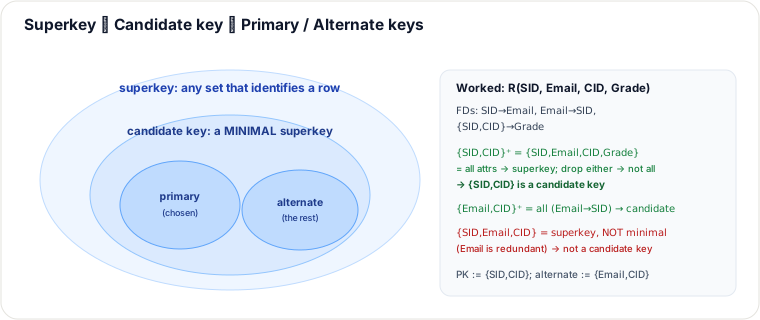
"Key" is overloaded, but the terms nest cleanly. Build them up:
- Superkey — any set of attributes whose values are unique across rows, so it identifies a
row.
{StudentID},{StudentID, Email}, even{StudentID, Email, Name}are all superkeys if StudentID is unique. Most superkeys carry dead weight. - Candidate key — a minimal superkey: remove any attribute and it stops being unique. This is the real notion of "a key"; a table can have several.
- Primary key — the one candidate key you choose to identify rows (NOT NULL, unique, one per table). The others become alternate keys (still enforced UNIQUE).
- Composite key — a key with more than one attribute. Foreign key — attribute(s) in one table whose values must match a candidate/primary key in another (covered next, in integrity constraints).
Finding candidate keys mechanically — attribute closure
You don't eyeball candidate keys; you derive them from the functional dependencies. The tool is the closure X⁺: the set of all attributes determined by X. If X⁺ = every attribute, X is a superkey; if no proper subset of X is also a superkey, X is a candidate key.
Take R(StudentID, Email, CourseID, Grade) with FDs:
StudentID→Email, Email→StudentID (email is unique per student),
{StudentID, CourseID}→Grade.
{StudentID, CourseID}⁺
   start: {StudentID, CourseID}
   + StudentID→Email           → add Email
   + {StudentID,CourseID}→Grade → add Grade
   = {StudentID, Email, CourseID, Grade}  = ALL attributes  → superkey
   drop StudentID or CourseID → closure no longer covers all  → MINIMAL
   → {StudentID, CourseID} is a CANDIDATE KEY
Because Email→StudentID too, {Email, CourseID} has the same closure → it's a
second candidate key. But {StudentID, Email, CourseID} is only a superkey: Email is redundant
(StudentID already implies it), so it isn't minimal and isn't a candidate key. Pick one candidate as
primary (say {StudentID, CourseID}); the other is an alternate key you
still declare UNIQUE.
Why it matters beyond vocabulary
- Candidate keys are the inputs to normalization — 2NF/3NF/BCNF are defined relative to "prime" attributes (those in some candidate key). You can't check a normal form without first finding the candidate keys.
- Choosing the primary key drives physical layout: in InnoDB the PK is the clustered index (rows stored in PK order), so a wide or random PK (e.g. a UUID) has real write-amplification costs.
Takeaways
- superkey ⊇ candidate key (minimal) ⊇ {primary (chosen), alternate (the rest)}.
- Derive candidate keys by computing attribute closures from the FDs, not by guessing.
- A relation can have several candidate keys; exactly one becomes the primary key.
Deepened for this guide (the prior version only listed definitions). Closure algorithm per Silberschatz, "Database System Concepts". See also: Functional Dependency & Closure, Normalization, Indexing & Storage.
🤖 Don't fully get this? Learn it with Claude
Stuck on Keys in Relational Databases? Open Claude, copy a block below, and it'll teach you this exact concept — visually and interactively.
Build the mental picture, not memorization.
I just read a lesson on **Keys in Relational Databases** (Databases) and want to truly understand it. Explain Keys in Relational Databases from first principles using ONE vivid real-world analogy and a visual mental model — draw it as ASCII art or a clear step-by-step diagram — with a concrete example using real numbers. Then ask me one question to check I got the mental picture, and wait for my reply. If you're unsure or a claim isn't standard, say so and reason from first principles instead of guessing.
Socratic — adapts to where you're stuck.
Teach me **Keys in Relational Databases** interactively. Ask me ONE guiding question at a time, wait for my answer, and adapt to my confusion — build the idea with me step by step instead of explaining it all at once. If you're unsure or a claim isn't standard, say so and reason from first principles instead of guessing.
Active recall exposes what you missed.
Quiz me on **Keys in Relational Databases** with 5 questions, easy to tricky, ONE at a time. Tell me if each answer is right; at the end, explain clearly what I got wrong and why. If you're unsure or a claim isn't standard, say so and reason from first principles instead of guessing.
Intuition + hook + flashcards for long-term memory.
Help me remember **Keys in Relational Databases** for the long term: give the one-sentence intuition, a memorable hook/mnemonic, a tiny worked example, and 3 active-recall flashcards (Q -> A). If you're unsure or a claim isn't standard, say so and reason from first principles instead of guessing.