Introduction to HashSets
A HashSet stores each element by computing its hash code, mapping that hash to one of a fixed number of buckets (index = hash mod capacity), and short-circuiting insert/lookup/delete to that single bucket instead of scanning the whole collection — uniqueness and O(1) average operations are both side effects of this addressing scheme, not separate features bolted on.
Recognize the pattern
- The problem asks "has this been seen before?", "does this exist?", or "remove duplicates" — with no need to preserve insertion order or associate extra data.
- You need membership testing repeated many times inside a loop (classic tell: nested loop doing
containsthat you want to collapse to O(1)). - You only care about presence, not a value attached to a key (if you need a value too, that's a HashMap, not a HashSet).
Brute force vs. optimal
Brute force: keep elements in an array/list; to check membership or insert-if-absent, linearly scan every existing element. Insert-if-absent costs O(n) per call because you must scan before you know it's new; n insertions cost O(n²) total.
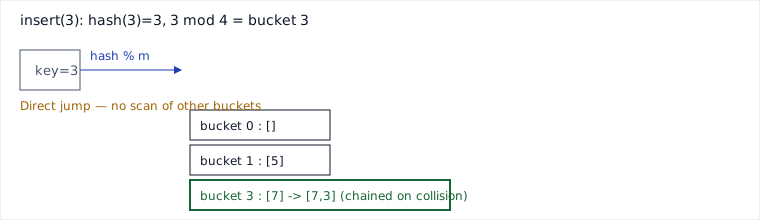
Optimal (HashSet): compute hash(x), jump directly to bucket hash(x) % capacity, and compare only against the few elements colliding in that bucket. Insert-if-absent becomes O(1) average; n insertions cost O(n) total.
Complexity, derived
Let n = number of elements, m = number of buckets (capacity). The load factor α = n/m. Java's HashSet (backed by HashMap) resizes (doubles m) whenever α would exceed 0.75, keeping α bounded.
Assume a good hash function distributes keys uniformly. Expected chain length in any bucket = α, a constant once α is bounded (≤0.75). So:
- add / contains / remove: O(1) hash computation + O(α) = O(1) amortized average. Worst case (all keys collide into one bucket, e.g. adversarial hashing or a broken
hashCode()) degrades to O(n) — Java 8+ HashMap converts a long chain (≥8 entries) to a red-black tree, capping worst case at O(log n) per bucket op — but only once the table itself has ≥64 buckets (MIN_TREEIFY_CAPACITY); below that, a long chain triggers a resize instead of treeification. - resize: doubling and rehashing m→2m costs O(n), but happens O(log n) times total across n inserts, so amortized cost per insert stays O(1) (same argument as dynamic array doubling).
- space: O(n) for elements + O(m) for the bucket array, m = O(n) since α is bounded — so O(n) overall, with a constant-factor overhead (~1.33x due to 0.75 load factor, plus per-entry object/pointer overhead in Java).
Traced example — dedup a stream
Insert [7, 3, 7, 5, 3] into a HashSet with capacity m = 4 (indices 0-3), hash = value % 4:
| Insert | hash % 4 | Bucket contents after | Result |
|---|---|---|---|
| 7 | 3 | bucket3: [7] | added |
| 3 | 3 | bucket3: [7,3] | added (collision, chained) |
| 7 | 3 | bucket3: [7,3] | rejected — 7 already in chain |
| 5 | 1 | bucket1: [5] | added |
| 3 | 3 | bucket3: [7,3] | rejected — 3 already in chain |
Final set: {7, 3, 5} — order not guaranteed to match insertion order.
Reference implementation
import java.util.ArrayList;
import java.util.HashSet;
import java.util.List;
import java.util.Set;

public class DedupExample {
    public static List<Integer> firstOccurrences(int[] nums) {
        Set<Integer> seen = new HashSet<>();
        List<Integer> result = new ArrayList<>();
        for (int n : nums) {
            if (seen.add(n)) {
                // add() returns true only the first time n is seen
                result.add(n); // keep first occurrences, in input order
            }
        }
        return result;
    }
}
Pitfalls
- Mutable elements: mutating an object after inserting it into a HashSet changes its hash code, so it becomes unfindable (lookup hashes the new state and lands in the wrong bucket) — never mutate fields used in
hashCode()/equals()while the object lives in a set. - Broken hashCode()/equals() contract: if two equal objects return different hash codes, duplicates slip through; if hashCode() always returns the same value, every element collides and performance degrades to O(n).
- Assuming order: iterating a HashSet gives no guarantee of insertion or sorted order — use LinkedHashSet or TreeSet if you need that.
- Autoboxing pitfalls in Java: Integer caching only covers -128..127; comparing boxed types with == instead of relying on equals()/hashCode() inside custom logic causes subtle bugs.
When to use / when not — trade-offs
| Need | Structure | Why |
|---|---|---|
| Fast membership check, no ordering, no values | HashSet | O(1) avg add/contains/remove |
| Key→value association | HashMap | HashSet is literally backed by HashMap with a dummy value |
| Need sorted iteration / range queries | TreeSet | O(log n) ops via balanced BST, but gives ordering HashSet can't |
| Need insertion-order iteration | LinkedHashSet | slightly more memory (extra linked list), same O(1) avg ops |
| Elements are small dense integers, memory-critical | BitSet | O(1) ops with far less memory, but only for integer domains |
| One-shot sorted, unique output from a batch | sort + unique pass | O(n log n) but low constants, no hash worst case, and the result comes out ordered |
Takeaways
- Uniqueness and O(1) average lookup both come from the same mechanism: hash → bucket index → localized comparison.
- Load factor is the knob that trades memory (lower α, more buckets, less collision) for time; Java resizes at α > 0.75.
- Worst case is O(n) per op under hash collisions unless the underlying map treeifies long chains (Java 8+ caps it at O(log n), once chain ≥8 and table capacity ≥64).
- A HashSet's power collapses if hashCode()/equals() is wrong or if stored objects mutate in place.
Recall: Why does resizing a HashSet (doubling capacity and rehashing all elements) still keep amortized insertion at O(1), even though a single resize costs O(n)?
Synthesized from standard HashSet/HashMap internals (Java Collections Framework docs and algorithm literature on hashing with chaining) and the original page's HashSet vs. HashTable framing.
🤖 Don't fully get this? Learn it with Claude
Stuck on Introduction to HashSets? Open Claude, copy a block below, and it'll teach you this exact concept — visually and interactively.
Build the mental picture, not memorization.
I just read a lesson on **Introduction to HashSets** (DSA) and want to truly understand it. Explain Introduction to HashSets from first principles using ONE vivid real-world analogy and a visual mental model — draw it as ASCII art or a clear step-by-step diagram — with a concrete example using real numbers. Then ask me one question to check I got the mental picture, and wait for my reply. If you're unsure or a claim isn't standard, say so and reason from first principles instead of guessing.
Socratic — adapts to where you're stuck.
Teach me **Introduction to HashSets** interactively. Ask me ONE guiding question at a time, wait for my answer, and adapt to my confusion — build the idea with me step by step instead of explaining it all at once. If you're unsure or a claim isn't standard, say so and reason from first principles instead of guessing.
Active recall exposes what you missed.
Quiz me on **Introduction to HashSets** with 5 questions, easy to tricky, ONE at a time. Tell me if each answer is right; at the end, explain clearly what I got wrong and why. If you're unsure or a claim isn't standard, say so and reason from first principles instead of guessing.
Intuition + hook + flashcards for long-term memory.
Help me remember **Introduction to HashSets** for the long term: give the one-sentence intuition, a memorable hook/mnemonic, a tiny worked example, and 3 active-recall flashcards (Q -> A). If you're unsure or a claim isn't standard, say so and reason from first principles instead of guessing.