Using Hashtable in Different Programming Languages
Mechanism
A hashtable achieves near O(1) average lookup/insert/delete by converting a key into an integer via a hash function, reducing that integer modulo the table's bucket count to pick a slot, and storing the key-value pair there; collisions (two keys mapping to the same slot) are resolved either by chaining (each slot holds a linked list/tree of entries) or open addressing (probe to the next free slot). Every mainstream language ships this same idea under a different name and with different collision strategy defaults — the interview skill is recognizing that a `Map`/`dict`/`HashMap`/`unordered_map` call is the same data structure regardless of syntax, and knowing its guarantees and failure modes well enough to reason about complexity and pick the right variant.
Recognize the pattern
- Problem needs "have I seen this before?", "count occurrences", or "find complement/pair" in better than O(n²) or O(n log n).
- Need O(1) membership/lookup by key, and order does not matter (or you'll layer ordering on top with a `LinkedHashMap`/`TreeMap`).
- Keys are used as-is for equality (strings, numbers, tuples of immutables) — not floating point keys, not mutable objects whose hash could change after insertion.
Brute force → optimal
Brute force: keep entries in an unsorted array/list; lookup means scanning every element and comparing keys — O(n) per lookup, O(n²) total for n operations (e.g. two-sum by nested loop).
Optimal: hash the key once (O(k) for a key of length k, treated as O(1) for fixed-size keys), jump straight to the bucket, and compare against only the few entries that collided there — O(1) average per lookup, O(n) total for n operations.
Complexity, derived
Let n = number of entries, m = number of buckets, α = n/m the load factor. With a good hash function, keys distribute roughly uniformly, so each bucket holds about α entries on average. A lookup costs: 1 hash computation (O(1)) + O(α) comparisons to scan that bucket's chain. So average lookup/insert/delete is O(1 + α). Java's HashMap and Python's dict keep α bounded (Java resizes at α>0.75; Python resizes at ⅔ full) by doubling the table and rehashing every entry when the threshold is crossed — that rehash is O(m), but amortized over the m/2 insertions since the last resize it adds only O(1) per insertion (same doubling argument as dynamic arrays). Worst case (all keys collide, e.g. an adversarial or degenerate hash) degrades a chained table to O(n) per op, since every entry lands in one bucket's list. Space is O(n + m) — the entries themselves plus the (mostly empty) bucket array; open-addressing tables need extra tombstone slots after deletion.
Worked example: two-sum with target 9
Array [2, 7, 11, 4], build a hash map of value→index while scanning once.
| i | num | need = 9 - num | map before | found? | map after |
|---|---|---|---|---|---|
| 0 | 2 | 7 | {} | no | {2:0} |
| 1 | 7 | 2 | {2:0} | yes → hash(2) hits bucket, compares key 2, match at index 0 | – |
Result: indices (0,1). One pass, O(n) time instead of the brute-force O(n²) nested loop.
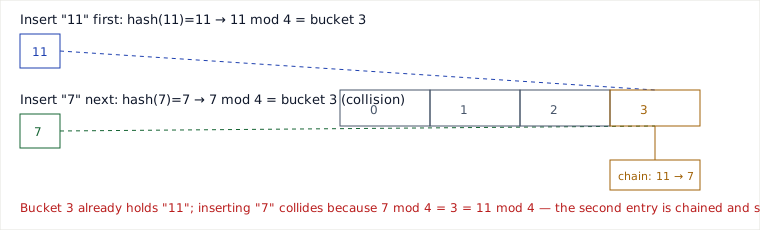
The figure above is a standalone collision illustration, not a step of the two-sum trace (which stops at i = 1 and never inserts 11): inserting 11 and then 7 into an m = 4 table sends both to bucket 3, because 11 mod 4 = 7 mod 4 = 3, so 7 is chained behind 11 and found by a linear scan of that one chain.
Across languages
| Language | API | Default collision handling | Ordering |
|---|---|---|---|
| Java | java.util.HashMap | chaining (treeified to a red-black tree per bucket once a bucket exceeds 8 entries and the table has ≥64 buckets — smaller tables resize instead — for O(log n) worst case) | none (use LinkedHashMap/TreeMap) |
| Python | dict | open addressing | insertion order (guaranteed since 3.7) |
| C++ | std::unordered_map | chaining (buckets are linked lists) | none |
| JavaScript | Map / Object | not spec-mandated; in V8, Map/Set are backed by an OrderedHashTable that resolves collisions by chaining (each entry stores the index of the next colliding entry in a dense, insertion-ordered data array); the open-addressing structure in V8 is the NameDictionary behind dictionary-mode Objects | Map: insertion order |
| C# | Dictionary<TKey,TValue> | chaining, implemented as a bucket-index array pointing into a parallel entries array linked via each entry's internal 'next' field (not open addressing) | none (practically insertion-ish, not guaranteed) |
| Go | map[K]V | chaining within buckets of 8 slots | explicitly randomized on iteration |
// Java: word frequency count
Map<String, Integer> freq = new HashMap<>();
for (String w : words) {
    freq.merge(w, 1, Integer::sum);  // O(1) average per call
}
Pitfalls
- Using a mutable object as a key, then mutating it after insertion — its hash changes, the entry becomes unfindable in its old bucket (classic Java bug: mutable POJO key without a stable hashCode()).
- Assuming iteration order in Java's HashMap or C#'s Dictionary — it is not guaranteed and can change across JDK versions.
- A poor or attacker-controlled hash function collapsing all keys into one bucket (hash-flooding DoS) — degrades every operation to O(n); Java mitigates this by treeifying long chains, several languages randomize their hash seed per process.
- Floating-point keys: NaN != NaN under IEEE comparison, so float keys (especially NaN) behave inconsistently across languages — Java boxes Double.NaN as equal to itself, Python treats each NaN object distinctly; avoid float keys entirely.
- Forgetting that resizing/rehashing pauses briefly to move all entries — a concern in latency-sensitive hot paths; pre-sizing the map when the count is known avoids repeated rehashes.
When to use / when not
Use a hashtable when you need O(1) average key lookup/insert/delete and don't care about order — frequency counts, deduplication, caches, membership tests, grouping. Don't use it when you need sorted keys or range queries (e.g. "all keys between 10 and 50") — a TreeMap/std::map (balanced BST, O(log n) per op) gives ordered iteration and range queries that a hashtable cannot. A tree map is also the safer pick when a hard worst-case bound matters against adversarial keys: its O(log n) is guaranteed, while a hashtable's O(1) is only average-case. Don't use it either when insertion order must be preserved for iteration and the language's default map doesn't guarantee it — reach for LinkedHashMap or an explicitly ordered structure instead.
Takeaways
- Every language's "map" type is the same hash + bucket-array idea; the differences are collision strategy and ordering guarantees.
- Average O(1) comes from keeping load factor α bounded via amortized doubling; worst case is O(n) under heavy collisions.
- Pick a hashtable for unordered O(1) key access; pick a balanced-tree map when you need sorted order or range queries.
Recall: Why does Java's HashMap treeify a bucket's chain into a red-black tree once it exceeds 8 entries, and what worst-case complexity does that guard against?
Synthesized from CLRS (hashing chapter), the Java HashMap/CPython dict source documentation, the .NET Dictionary<TKey,TValue> source, V8's OrderedHashTable implementation notes, and standard interview-prep hashing references.
🤖 Don't fully get this? Learn it with Claude
Stuck on Using Hashtable in Different Programming Languages? Open Claude, copy a block below, and it'll teach you this exact concept — visually and interactively.
Build the mental picture, not memorization.
I just read a lesson on **Using Hashtable in Different Programming Languages** (DSA) and want to truly understand it. Explain Using Hashtable in Different Programming Languages from first principles using ONE vivid real-world analogy and a visual mental model — draw it as ASCII art or a clear step-by-step diagram — with a concrete example using real numbers. Then ask me one question to check I got the mental picture, and wait for my reply. If you're unsure or a claim isn't standard, say so and reason from first principles instead of guessing.
Socratic — adapts to where you're stuck.
Teach me **Using Hashtable in Different Programming Languages** interactively. Ask me ONE guiding question at a time, wait for my answer, and adapt to my confusion — build the idea with me step by step instead of explaining it all at once. If you're unsure or a claim isn't standard, say so and reason from first principles instead of guessing.
Active recall exposes what you missed.
Quiz me on **Using Hashtable in Different Programming Languages** with 5 questions, easy to tricky, ONE at a time. Tell me if each answer is right; at the end, explain clearly what I got wrong and why. If you're unsure or a claim isn't standard, say so and reason from first principles instead of guessing.
Intuition + hook + flashcards for long-term memory.
Help me remember **Using Hashtable in Different Programming Languages** for the long term: give the one-sentence intuition, a memorable hook/mnemonic, a tiny worked example, and 3 active-recall flashcards (Q -> A). If you're unsure or a claim isn't standard, say so and reason from first principles instead of guessing.