Cache Invalidation
Cache invalidation is the set of rules that decide when a cached copy no longer matches its source of truth, so that the next read either removes it, refreshes it, or serves it while re-fetching — the cache is never allowed to silently keep returning a value the origin has since changed.
Two mechanisms are constantly confused, so pin them down before anything else:
- Write policies (write-through, write-around, write-back / write-behind) decide how a write reaches storage — whether the new value lands in the cache, the store, or both, and in what order. They keep cache and store consistent on the write path you control.
- Invalidation methods decide when an existing cached read-copy must be retired because the truth changed underneath it — often through a path the cache never observed (a batch job, a replica, another service, a human editing the DB).
This page is about the second. Write policies are a separate topic; listing them as "invalidation schemes" is the classic category error. Invalidation methods themselves split cleanly into two families:
- Event-driven — a writer tells the cache something changed: Purge, Refresh, Ban.
- Expiry-driven — the cache decides on its own from a clock: TTL and Stale-While-Revalidate.
The methods, by mechanism
Purge (event-driven, eager)
A hard delete of a specific key/URL. The entry is dropped from the cache immediately; the very next request for it is a guaranteed miss that goes to the origin, repopulates, and returns fresh. You must name each key you want gone.
Refresh (event-driven, eager)
Force a re-fetch from origin and overwrite the cached value in place, without deleting it first. Unlike purge, there is no window where the key is absent — a concurrent reader that arrives mid-refresh still gets a (stale) hit instead of a miss, so refresh avoids the miss-storm that mass purges cause.
Ban (event-driven, lazy)
Invalidate by criteria — a URL pattern or header — instead of by exact key. Issuing a ban does not touch any object; it appends a rule to a ban list stamped with the time it was issued. From then on, every incoming read is checked against the list: if the requested object matches a rule and was cached before that rule's timestamp, it is treated as stale and re-fetched; otherwise it is served normally. Objects are cleaned lazily as they happen to be requested, and a rule can be dropped once every object older than it has been refreshed. One O(1) command can invalidate millions of keys.
TTL expiration (expiry-driven)
Each entry carries a time-to-live. A read served before expiry is a hit; after expiry the entry is stale and the next read re-fetches. No coordination with writers at all — the cache heals itself on a fixed clock, at the cost of serving stale data for up to one TTL.
Stale-while-revalidate (expiry-driven)
On a read of an expired entry, serve the stale copy immediately and kick off an asynchronous re-fetch; the fresh value replaces the stale one when it lands. The reader never blocks on the origin — freshness is traded for latency.
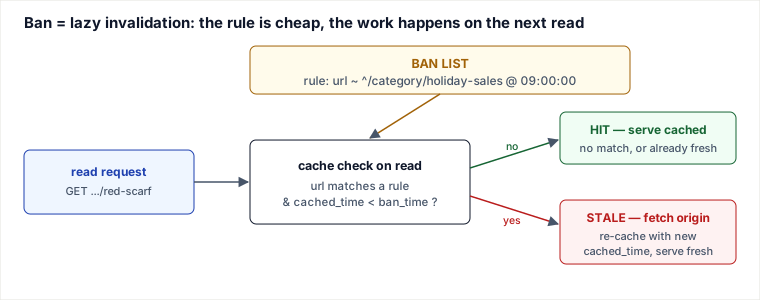
Worked example: ending a holiday sale with one Ban
A CDN caches 40,000 product pages under /category/holiday-sales/…. At 09:00 the sale ends and every price under that path changes. Firing 40,000 individual purges would hammer the origin and the cache's control plane, so instead you issue one ban: pattern ^/category/holiday-sales, timestamped 09:00:00. Here is what the next few reads actually do:
| Time | Request | Object's cached_time | Ban check | Result |
|---|---|---|---|---|
| 09:00:00 | ban issued | — | rule appended to ban list | no objects touched |
| 09:00:03 | GET /category/holiday-sales/red-scarf | 08:45:00 | matches & 08:45 < 09:00 → stale | fetch origin, re-cache at 09:00:03, serve fresh |
| 09:00:05 | GET /category/new-arrivals/blue-hat | 08:50:00 | no pattern match | served from cache (fast HIT) |
| 09:00:08 | GET /category/holiday-sales/red-scarf | 09:00:03 | matches but 09:00:03 > 09:00:00 → fresh | served from cache (fast HIT) |
| ~09:40 | last matching object finally re-fetched | > 09:00:00 | no object can still trip the rule | ban rule garbage-collected |
The cost of invalidation is now paid lazily, per read, only for objects that are actually requested — and only once each. Cold objects nobody asks for are never re-fetched at all; their rule simply sits in the list until GC.
Pitfalls
Invalidate-then-write races (the classic correctness bug)
The intuitive order — delete the cache, then update the DB — is wrong under concurrency:
// WRONG: a reader can slip in between the two lines
cache.delete(key)      // 1. cache is now empty
// <-- concurrent reader misses, reads OLD row, repopulates cache
db.update(key, newVal) // 2. DB now new, but cache holds OLD forever
Why the naive version is wrong: between steps 1 and 2 the DB still holds the old value. A concurrent read misses the empty cache, loads the old row, and writes it back — so the cache is repopulated with stale data that no further event will clear until TTL. Fix the ordering: commit the DB write first, then invalidate (db.update(...); cache.delete(key)), so any repopulating read after the delete can only load the new value. Even this leaves a narrow window; systems that need more use versioned keys or a short "delay-delete" second invalidation.
Purge storms / thundering herd
Purging a hot key sends every concurrent reader to the origin at the same instant (a cache stampede). Prefer refresh (overwrite in place) for hot keys, or add request coalescing / a short lock so only one fetch hits origin.
Ban-list growth
Every read scans the ban list, so its cost is O(list length) per request. Rules for objects nobody re-requests never get to GC, so an unbounded, ever-growing ban list slowly taxes every single read. Cap the list, coalesce overlapping rules, and expire old ones.
Multi-layer invalidation
Browser cache, CDN, and app cache are independent. Purging the CDN does nothing to copies already sitting in users' browsers — those obey the Cache-Control: max-age you sent. Set short/validated TTLs at the edge you cannot purge.
TTL extremes
TTL too long → stale data lingers with no way to force freshness; TTL too short → the cache barely absorbs load and the origin sees near-uncached traffic. TTL is a staleness-vs-load knob, not a fire-and-forget default.
When to use which — and what it costs
The real decision is do you know precisely what changed, and how many keys does it touch?
- Purge — signals: a small, known set of exact keys changed (one product edited). Gain: immediate, exact, no lingering staleness. Cost: you must enumerate every key, so pattern-shaped invalidations explode into huge fan-out, and mass purges cause miss storms.
- Ban — signals: the affected set is large or defined by a pattern you can't cheaply list (a whole category, everything with a header). Gain: O(1) to issue no matter how many objects match; work is amortized over real reads. Cost: every read pays a ban-list scan, stale objects linger until requested, memory held until GC.
- TTL — signals: you can't hook the writers (third-party origin, another team's DB) and bounded staleness is acceptable. Gain: zero invalidation infrastructure, self-healing. Cost: guaranteed staleness up to one TTL; short TTL trades away hit ratio.
- Stale-while-revalidate — signals: user-facing reads where latency matters more than being perfectly current. Gain: reads never block on origin. Cost: knowingly serves stale during the revalidation window; extra background fetches.
Choose Purge when the key set is small and known; prefer Ban when it's large or pattern-defined; reach for TTL when you can't observe the writes; layer Stale-While-Revalidate on top when a read must never wait. The main axis to reason about is Purge (eager, exact, expensive to fan out) versus Ban (lazy, pattern-based, cheap to issue but taxes every read).
Takeaways
- Invalidation answers "when is this cached copy no longer true?" — it is not the same thing as a write policy, which answers "where does a new write land?"
- Event-driven methods (purge/refresh/ban) need a signal from the writer; expiry-driven methods (TTL/SWR) need only a clock. Pick event-driven when you can observe writes, expiry-driven when you can't.
- Ban buys O(1) invalidation of huge, pattern-defined sets by making every read pay a timestamped check — cheap to fire, but the ban list must be bounded and GC'd.
- Order matters: write the store first, then invalidate, or a concurrent read will re-cache the stale value permanently.
Sources: Fastly and Varnish documentation on purge vs. ban and lazy ban-list invalidation; MDN and RFC 5861 on Cache-Control, TTL, and stale-while-revalidate; the well-known cache-aside consistency discussion in Facebook's "Scaling Memcache at Facebook" (NSDI 2013) for the invalidate-ordering race. Re-authored/Deepened for this guide.
🤖 Don't fully get this? Learn it with Claude
Stuck on Cache Invalidation? Open Claude, copy a block below, and it'll teach you this exact concept — visually and interactively.
Build the mental picture, not memorization.
I just read a lesson on **Cache Invalidation** (System Design) and want to truly understand it. Explain Cache Invalidation from first principles using ONE vivid real-world analogy and a visual mental model — draw it as ASCII art or a clear step-by-step diagram — with a concrete example using real numbers. Then ask me one question to check I got the mental picture, and wait for my reply. If you're unsure or a claim isn't standard, say so and reason from first principles instead of guessing.
Socratic — adapts to where you're stuck.
Teach me **Cache Invalidation** interactively. Ask me ONE guiding question at a time, wait for my answer, and adapt to my confusion — build the idea with me step by step instead of explaining it all at once. If you're unsure or a claim isn't standard, say so and reason from first principles instead of guessing.
Active recall exposes what you missed.
Quiz me on **Cache Invalidation** with 5 questions, easy to tricky, ONE at a time. Tell me if each answer is right; at the end, explain clearly what I got wrong and why. If you're unsure or a claim isn't standard, say so and reason from first principles instead of guessing.
Intuition + hook + flashcards for long-term memory.
Help me remember **Cache Invalidation** for the long term: give the one-sentence intuition, a memorable hook/mnemonic, a tiny worked example, and 3 active-recall flashcards (Q -> A). If you're unsure or a claim isn't standard, say so and reason from first principles instead of guessing.