Cache Stampede & Invalidation — Thundering Herd and the Hard Half
The cache made things worse — all at once
A single hot key (a trending post, a config) is cached and serving thousands of reads per second from memory. Its TTL expires. Now every in-flight request misses simultaneously and they all query the database with the same query at the same instant — a cache stampede (thundering herd). The DB, sized for the cache-hit rate, gets hit by 1000× its expected load and can fall over, taking the service with it.
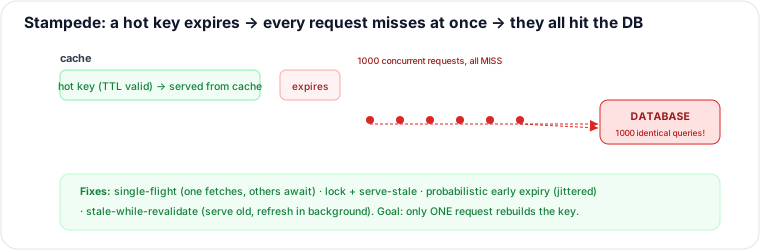
Make sure only ONE request rebuilds the key
- Single-flight / request coalescing: the first miss starts the fetch; concurrent misses for the
same key wait for that one result instead of each querying. (Go's
singleflight, or a per-key in-flight map.) - Lock + serve-stale: the first miss takes a short lock and recomputes; others briefly serve the stale value rather than pile onto the DB.
- Probabilistic early expiration: refresh the key slightly before the TTL, with random jitter, so popular keys don't all expire on the same tick (this also prevents synchronized expiry across keys).
- Stale-while-revalidate: always serve the cached value; refresh asynchronously in the background. Users never wait on a rebuild.
The other hard half: invalidation
"There are only two hard things in computer science: cache invalidation and naming things." — Phil Karlton
Keeping the cache coherent with the source of truth is the deeper problem. Options trade freshness vs complexity: short TTL (simple, allows staleness), write-through (update cache on write — see Caching strategies), explicit invalidation on change (precise but you must catch every write path, incl. other services), or versioned keys. There's no free lunch — pick the staleness you can tolerate.
Takeaways
- A hot-key expiry triggers a stampede: 1000 simultaneous misses → DB overload → cascade.
- Fix so only one request rebuilds: single-flight, lock+stale, probabilistic early expiry, or stale-while-revalidate.
- Invalidation is the hard half — choose TTL / write-through / explicit / versioned by the staleness you can accept.
Re-authored for this guide; stampede diagram hand-authored as SVG. Follows the Memcached/Redis stampede literature and Cloudflare/Instagram engineering. See also: Caching strategies, Designing for Failure (load shedding), Rate Limiting, (Concurrency) the lost-update race.
🤖 Don't fully get this? Learn it with Claude
Stuck on Cache Stampede & Invalidation — Thundering Herd and the Hard Half? Open Claude, copy a block below, and it'll teach you this exact concept — visually and interactively.
Build the mental picture, not memorization.
I just read a lesson on **Cache Stampede & Invalidation — Thundering Herd and the Hard Half** (System Design) and want to truly understand it. Explain Cache Stampede & Invalidation — Thundering Herd and the Hard Half from first principles using ONE vivid real-world analogy and a visual mental model — draw it as ASCII art or a clear step-by-step diagram — with a concrete example using real numbers. Then ask me one question to check I got the mental picture, and wait for my reply. If you're unsure or a claim isn't standard, say so and reason from first principles instead of guessing.
Socratic — adapts to where you're stuck.
Teach me **Cache Stampede & Invalidation — Thundering Herd and the Hard Half** interactively. Ask me ONE guiding question at a time, wait for my answer, and adapt to my confusion — build the idea with me step by step instead of explaining it all at once. If you're unsure or a claim isn't standard, say so and reason from first principles instead of guessing.
Active recall exposes what you missed.
Quiz me on **Cache Stampede & Invalidation — Thundering Herd and the Hard Half** with 5 questions, easy to tricky, ONE at a time. Tell me if each answer is right; at the end, explain clearly what I got wrong and why. If you're unsure or a claim isn't standard, say so and reason from first principles instead of guessing.
Intuition + hook + flashcards for long-term memory.
Help me remember **Cache Stampede & Invalidation — Thundering Herd and the Hard Half** for the long term: give the one-sentence intuition, a memorable hook/mnemonic, a tiny worked example, and 3 active-recall flashcards (Q -> A). If you're unsure or a claim isn't standard, say so and reason from first principles instead of guessing.