Tradeoffs in CAP Theorem
When a network partition cuts a replicated system in two, every node can still take requests locally but can no longer see the other side's writes — so the system must pick one of two behaviors on each side: refuse to answer (so the two sides can never disagree — this is consistency, at the cost of availability) or keep answering from stale local state (so the two sides diverge and must be reconciled later — this is availability, at the cost of consistency). That forced pick during the partition is the entire content of CAP; there is no third option that keeps both, because a node cannot confirm a write is globally agreed while it cannot reach the other replicas.
Why a partition forces the choice
Consider a single key balance replicated on two nodes, N1 and N2, currently both holding $100. A link failure isolates them. A client hits N1 with write balance = $50; a moment later another client hits N2 with read balance. N2 cannot ask N1 whether anything changed. It now has exactly two lawful moves:
- Stay consistent: N2 must not return a value it cannot prove is current, and N1 must not commit a write it cannot prove is durably agreed — so at least one of them stops serving. No client ever sees two conflicting balances, but somebody got an error. (CP)
- Stay available: N1 accepts the write and returns OK; N2 answers the read with its local
$100. Both clients are served, but for the duration of the partition the two replicas disagree ($50 vs $100), and the conflict has to be resolved when the link heals. (AP)
The impossibility is not a limitation of clever engineering — it is that "confirm this write is globally agreed" and "answer without contacting the other side" are mutually exclusive when the sides can't talk.
Traced partition timeline: CP vs AP on the same event
Same three-replica cluster (N1, N2, N3), same key x = 100, same failure. A partition isolates N1 from the majority {N2, N3}. Watch how a CP system (quorum-based, e.g. a MongoDB replica set) and an AP system (e.g. Cassandra with ONE consistency) respond to the identical request stream.
| t | Event | CP system (needs majority = 2/3) | AP system (any node answers) |
|---|---|---|---|
| 0s | Healthy; x = 100 everywhere | Reads/writes served, all agree | Reads/writes served, all agree |
| 5s | Partition: N1 | {N2,N3} | N1 loses contact with majority | All nodes keep running |
| 6s | Client A: write x=50 hits N1 | Rejected / times out — N1 has no quorum, cannot commit | Accepted — N1 stores x=50 locally, returns OK |
| 7s | Client B: write x=80 hits N2 | Committed — {N2,N3} form a majority, x=80 | Accepted — {N2,N3} store x=80 |
| 8s | Client C: read x hits N1 | Rejected (or blocks) — N1 can't prove freshness | Returns stale 50 from N1 (diverged from 80) |
| 20s | Partition heals | N1 rejoins, catches up to x=80 automatically | Conflict 50 vs 80 must be resolved — last-write-wins by timestamp, or app-level merge |
| 21s | Final state | x=80 everywhere; N1 was unavailable 5–20s but never wrong | x=80 (if t=7s wins by clock) — but the t=6s write to N1 is silently lost |
The CP system traded a 15-second availability hole on the minority side for a guarantee that no client ever read a wrong-or-doomed value. The AP system stayed up the whole time but accepted a write it later discarded and served a stale read — the divergence is real and someone must own the reconciliation policy.
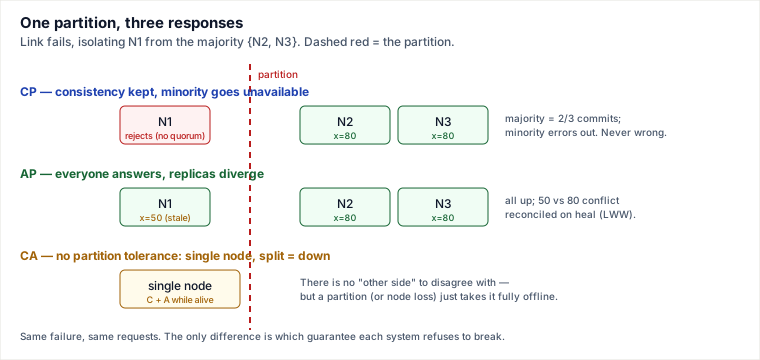
CP, AP, and CA — with correctly-classified systems
- CP (consistency + partition tolerance, availability sacrificed): on a partition the minority side stops serving to avoid divergence. ZooKeeper and etcd refuse reads/writes once they lose a quorum — no answer beats a wrong answer for coordination and locks. A MongoDB replica set pauses writes while it elects a new primary. HBase is CP. Pick CP when a stale or conflicting value is a correctness bug: leader election, distributed locks, config, account balances, inventory decrements.
- AP (availability + partition tolerance, strong consistency sacrificed): every node keeps serving from local state and conflicts are merged later (eventual consistency). Cassandra and DynamoDB (the Dynamo lineage) accept reads/writes on any reachable node; DynamoDB's ancestor was built for an always-writable shopping cart. DNS is the everyday AP system — always resolvable, but a record change takes propagation time. Pick AP when uptime beats freshness: carts, feeds, telemetry, product catalogs, session stores.
- CA (consistency + availability, no partition tolerance): only coherent when there is nothing to partition — a single-node PostgreSQL/MySQL is consistent (ACID) and available while the box is up. It is not a distributed-system category: the instant you add a network between replicas, a partition can happen and you are back to choosing CP or AP. A synchronous primary/replica pair looks CA only until the link splits, at which point it must halt (CP-like) or diverge (AP-like). "CA distributed database" is essentially a category error.
PACELC: the trade-off when there is no partition
| State | Choice | Latency cost | When to pick |
|---|---|---|---|
| Partition (P) | CP: refuse minority requests | Availability hit on minority | Wrong answer is worse than no answer |
| Partition (P) | AP: keep serving from local state | Reconciliation later | Uptime is the primary risk |
| Else (no partition) | EC: wait for global agreement | Cross-replica/region RTT | Reads must be current |
| Else (no partition) | EL: answer from local replica | Replica-local, usually sub-ms | Staleness is acceptable |
CAP is the special case under a partition; PACELC is the daily question. The same data set can answer EL for a tolerant read and EC for a must-be-current read.
Pitfalls
- Treating C/A as a whole-system label, not a per-operation one. Real databases are tunable. Cassandra is AP by default but a
QUORUMread +QUORUMwrite (R + W > N) buys strong consistency and gives up availability on the minority — CP behavior. DynamoDB offers eventually-consistent and strongly-consistent reads. The right question is "CP or AP for this request?", not "is this database CP or AP?". - Optimizing CAP while the real killer is latency. Partitions are rare; the choice between waiting for global agreement and answering fast happens on every request. That is PACELC (else, Latency vs Consistency). A system can be nominally CP yet unusable because every write waits for a cross-region quorum round-trip.
- Believing "eventual consistency" means conflicts vanish on their own. They don't. Last-write-wins silently drops the loser (see t=21s above — the t=6s write is gone). If both writes matter, you need CRDTs, vector clocks, or app-level merge — not a hope that the clocks agree.
- Calling a design CA to dodge the choice. Any multi-node production system is partition-tolerant whether you planned for it or not, because networks fail. "We're CA" almost always means "we haven't decided what happens during a partition" — and the default will be discovered in an outage.
- Assuming CP means the whole cluster is down. Only the side without quorum is unavailable. A 5-node cluster split 3|2 keeps serving on the majority side — CP costs you the minority, not everything.
When to choose CP, when to choose AP
Decision signals that point to CP: a stale or double-applied operation causes a real-world wrong outcome — money moved twice, one lock held by two owners, oversold inventory, split-brain leadership. If your answer to "what if two clients see different values for a few seconds?" is "that's a bug, not an annoyance," you want CP and you accept that the minority partition returns errors.
Decision signals that point to AP: a brief staleness is cosmetic and downtime is the expensive failure — a feed that's a few seconds behind, a cart that occasionally resurrects a removed item, a catalog page. If "the site must answer even if the number is slightly old" wins, you want AP and you must fund a conflict-resolution strategy.
CP vs AP, concretely — what you gain and what it costs: CP gives you a system you can reason about (there is one truth) and removes an entire class of merge bugs; it costs you availability on the minority side, added write latency from quorum round-trips, and a hard dependency on fast, reliable leader election. AP gives you near-100% write availability and low latency answered from the nearest replica; it costs you correctness during partitions, forces you to design and test reconciliation (LWW/CRDT/merge), and pushes "which write wins?" complexity up into the application. Choose CP when a wrong answer is worse than no answer (coordination, ledgers, uniqueness constraints). Prefer AP when no answer is worse than a slightly stale answer (carts, feeds, presence, telemetry). When you cannot cleanly pick, split the system: keep the ledger CP and the cart AP, rather than forcing one guarantee on both.
Takeaways
- A partition forces the choice because a node cannot both confirm global agreement and answer without reaching the other side — CP stops serving to stay consistent, AP keeps serving and diverges.
- CP = minority goes unavailable, never wrong (ZooKeeper, etcd, MongoDB replica sets); AP = everyone serves, reconcile later (Cassandra, DynamoDB, DNS); CA is only a single-node notion — not a real distributed category.
- C-vs-A is chosen per operation and tunable (quorum settings, consistent-read flags), and outside partitions the daily trade is latency-vs-consistency (PACELC), not availability.
- Decide by cost of a wrong answer: wrong-worse-than-none → CP; none-worse-than-stale → AP; if both apply, partition the system by data domain instead of forcing one guarantee everywhere.
Saying CAP in one breath
Interview one-liner: In a distributed replicated system, a network partition forces a choice — either stop answering to guarantee that every answer is consistent, or keep answering and accept that some answers may be stale or conflicting; you cannot do both.
Proof sketch by contradiction
- Assume a replicated system is both consistent and available despite a partition.
- A client writes value
v1to replica N1. - The network partitions, isolating N1 from replica N2.
- A client reads from N2. To be available, N2 must respond. To be consistent, it must return
v1, but it cannot reach N1 to learn it. - Contradiction. Therefore the assumption is false: under partition, consistency and availability cannot both hold.
This is the core of Gilbert and Lynch's proof: in an asynchronous network a partitioned replica cannot tell a dead peer from a slow one, so waiting for agreement means waiting forever, while answering immediately risks being stale.
Real-system mapping
This revisits the CP/AP/CA classification from earlier, but adds the column that matters in practice: the tunable lever — the per-request knob each system exposes to move along its consistency/latency axis.
| Default posture | Representative systems | Why it fits | Latency / consistency lever |
|---|---|---|---|
| CP | HBase (ZooKeeper-coordinated), CockroachDB (serializable default) | A stale or double-committed value is a correctness bug: row keys, account balances, inventory, coordination data. | HBase blocks minority reads/writes; CockroachDB waits for consensus by default but offers follower reads (EL) for stale-tolerant queries. |
| AP | Cassandra (default ONE),Dynamo / DynamoDB (eventual reads) | Uptime and write availability matter more than a briefly stale read: shopping carts, product catalogs, feeds, telemetry. | Cassandra lets you raise read/write consistency to QUORUM when you need stronger guarantees; DynamoDB offers strongly-consistent reads per request. |
| CA | Single-node PostgreSQL / MySQL | Not a distributed category. One box is consistent and available while it is up; the instant replicas exist, partitions force CP or AP behavior. | Synchronous replication looks CA until the link splits, then it must halt (CP) or diverge (AP). |
PACELC latency case. Even without a partition, the same system trades latency for consistency on
every request. In Cassandra a QUORUM read waits for a majority of replicas (EC: consistent but slower);
a ONE read returns the local replica (EL: fast but possibly stale). DynamoDB strongly-consistent reads
wait; eventual reads do not. CockroachDB's default serializable transaction commits through consensus (EC), while
follower reads serve historical snapshots from the nearest replica (EL). The interview move is to name the lever,
not just the label.
Trap box: when CP is the wrong choice
CP is not a virtue in every design. It is the wrong default when the cost of stopping exceeds the cost of being stale:
- Read-heavy, latency-sensitive catalogs. A product page that waits for a cross-region quorum is a page that loses revenue. Serve it AP or EL; reserve CP for stock reservation and payment capture.
- Internal analytics or telemetry. A dashboard that briefly shows last-minute data from one shard is not a bug. Requiring CP turns every network blip into a query outage.
- Global writes where minority unavailability is unacceptable. A shopping cart must accept "add to cart" even when a replica is partitioned; merge the cart later.
The trap: saying "this is important, so CP" without asking "is a stale answer actually wrong, or just slightly out of date?" If the honest answer is the latter, CP buys you correctness you do not need and pays with p99 latency and minority-side outages.
When NOT to invoke CAP as a design trump card
- When there is no partition — CAP does not force AP/CP in the happy path; PACELC (latency vs consistency when Else) often matters more day-to-day.
- When the product needs both linearizable money and global multi-master writes — pick one primary for that ledger; do not hand-wave “eventual CAP.”
- When the real issue is single-node performance — CAP is about distributed trade-offs, not SQL vs cache.
Interviewer follow-ups & drills
- Why not always CP? During partition, rejecting all writes may be worse than serving stale reads for a feed.
- Ops signals: split-brain double-writes, elevated conflict rates, client timeouts during AZ loss.
- Drill: Shopping cart vs bank transfer under AZ partition — which may be AP-ish, which must be CP? Cart can stale; transfer should not double-spend.
Sources: Eric Brewer's PODC 2000 keynote and "CAP Twelve Years Later" (IEEE Computer, 2012); Gilbert & Lynch's 2002 proof of the CAP conjecture; DeCandia et al., "Dynamo: Amazon's Highly Available Key-value Store" (SOSP 2007); Daniel Abadi's PACELC formulation (2012); and the Apache ZooKeeper, Apache Cassandra, and MongoDB documentation for system classifications. Re-authored/Deepened for this guide.
🤖 Don't fully get this? Learn it with Claude
Stuck on Tradeoffs in CAP Theorem? Open Claude, copy a block below, and it'll teach you this exact concept — visually and interactively.
Build the mental picture, not memorization.
I just read a lesson on **Tradeoffs in CAP Theorem** (System Design) and want to truly understand it. Explain Tradeoffs in CAP Theorem from first principles using ONE vivid real-world analogy and a visual mental model — draw it as ASCII art or a clear step-by-step diagram — with a concrete example using real numbers. Then ask me one question to check I got the mental picture, and wait for my reply. If you're unsure or a claim isn't standard, say so and reason from first principles instead of guessing.
Socratic — adapts to where you're stuck.
Teach me **Tradeoffs in CAP Theorem** interactively. Ask me ONE guiding question at a time, wait for my answer, and adapt to my confusion — build the idea with me step by step instead of explaining it all at once. If you're unsure or a claim isn't standard, say so and reason from first principles instead of guessing.
Active recall exposes what you missed.
Quiz me on **Tradeoffs in CAP Theorem** with 5 questions, easy to tricky, ONE at a time. Tell me if each answer is right; at the end, explain clearly what I got wrong and why. If you're unsure or a claim isn't standard, say so and reason from first principles instead of guessing.
Intuition + hook + flashcards for long-term memory.
Help me remember **Tradeoffs in CAP Theorem** for the long term: give the one-sentence intuition, a memorable hook/mnemonic, a tiny worked example, and 3 active-recall flashcards (Q -> A). If you're unsure or a claim isn't standard, say so and reason from first principles instead of guessing.