Beyond CAP Theorem
Mechanism: PACELC works by splitting a distributed system's behavior into two mutually exclusive regimes and forcing a separate trade-off in each — during a partition it trades Availability against Consistency (the CAP choice), and the rest of the time, when the network is healthy, it trades Latency against Consistency, because acknowledging a write from one nearby replica is fast but possibly stale while waiting for a quorum across regions is correct but slow.
CAP only describes the rare partition case and says nothing about the >99.9% of the time the network is fine — yet that is where almost all of your latency budget is actually spent. Daniel Abadi introduced PACELC (~2010, formalized in IEEE Computer, 2012) to close that gap. Read the acronym as a two-clause rule: if P (partition) then A or C; Else (E) then L or C. The first clause is CAP restated; the second clause is the new idea — even with zero failures, replication forces a choice between answering quickly from local state and blocking to confirm agreement.
Concretely, the “E” tension is physical. Replicating a write to a majority of replicas in other regions costs a round-trip you cannot optimize away; skip that round-trip and you answer in microseconds but may hand a client data that a peer has already overwritten. That is the latency-vs-consistency axis CAP is silent about.
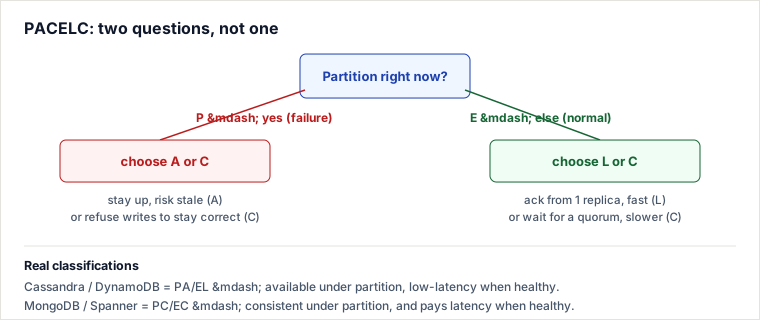
The PACELC quadrant
Every well-known store lands in one of four buckets. The mixed quadrants (PC/EL, PA/EC) are rare but real — Abadi's own headline example was Yahoo's PNUTS, which stays consistent under partition yet favors latency otherwise.
| System (default) | P → | E → | PACELC | Why |
|---|---|---|---|---|
| Cassandra, DynamoDB, Riak | A | L | PA/EL | Leaderless; acks from a tunable number of replicas, defaults toward low latency and staying writable. |
MongoDB (w:"majority") | C | C | PC/EC | Writes funnel through one primary and replicate to a majority before ack, during and outside partitions. |
| Google Spanner | C | C | PC/EC | CP by theory; commit-wait on TrueTime buys global consistency at a latency cost — see nuance below. |
| HBase, VoltDB | C | C | PC/EC | Single owner per key/partition; consistency is the invariant. |
| Yahoo PNUTS | C | L | PC/EL | Per-record master keeps consistency under partition, but serves fast local reads otherwise. |
The Spanner nuance (get this right in interviews): Spanner is CP and PC/EC — a genuine partition that isolates a majority will make it refuse writes rather than serve stale data. It is not a counterexample to CAP. What makes it feel like CA is engineering, not theory: Google runs it over redundant private links so partitions are rare and short, and TrueTime bounds clock uncertainty so transactions can order themselves globally. The price is commit-wait — a read-write transaction waits out roughly 2× the TrueTime uncertainty (historically single-digit milliseconds) before committing, which is the E-side latency PACELC predicts.
Worked example: pricing the “E” choice
The Else clause is not abstract — it is a stopwatch. Take one identical write across three replicas in a fixed topology and watch the latency change purely because of the consistency knob.
Topology: replication factor N=3. Coordinator/primary in us-east-1 (local commit ≈ 1 ms); secondary replicas in us-west-2 (RTT 62 ms) and eu-west-1 (RTT 88 ms). The application issues SET cart:42 = {items:3}.
| Choice | What it waits for | Ack latency | What a later read may see |
|---|---|---|---|
Cassandra CL=ONE (EL) | 1 local replica ack | ≈ 2 ms | A read at CL=ONE hitting eu-west-1 before gossip arrives returns the old cart — a stale window of tens of ms. |
Cassandra CL=QUORUM (tuned to EC) | 2 of 3 acks (east + west) | ≈ 63 ms | With R=QUORUM too, R+W = 4 > N = 3, so read and write sets overlap — the fresh value is guaranteed visible. |
MongoDB w:"majority" (EC default) | primary + 1 secondary (majority) | ≈ 63 ms | Majority-committed; a readConcern:"majority" read never sees a value that could be rolled back. |
Same wires, same data: the EL answer costs ~2 ms, the EC answer costs ~63 ms. That ~30× gap, paid on every request in normal operation, is exactly what CAP cannot express and PACELC names.
CRDTs: converging without coordination
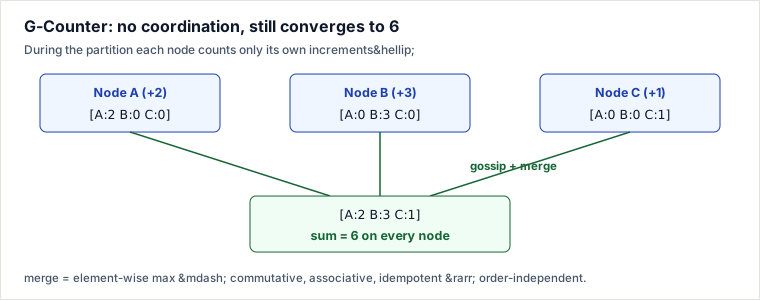
Mechanism: a Conflict-free Replicated Data Type replaces “last write wins” with a merge function that is commutative, associative, and idempotent — a join on a lattice — so replicas can apply updates in any order, receive them duplicated, or re-run the merge, and still land on the identical state. That is how you get strong eventual consistency with zero locks and no leader (a PA/EL sweet spot).
Trace a G-Counter (grow-only counter) across three nodes. Its state is a per-node vector; its value is the sum; its merge is element-wise max.
- Initial state on every node:
[A:0, B:0, C:0]. - Network partitions into three isolated nodes A | B | C.
- Node A takes 2 increments → its replica is
[A:2, B:0, C:0]. - Node B takes 3 increments →
[A:0, B:3, C:0]. - Node C takes 1 increment →
[A:0, B:0, C:1]. - Partition heals; nodes gossip. Merge = element-wise max. A merges B:
[A:2, B:3, C:0]; then merges C:[A:2, B:3, C:1]. - B and C run the same merges in any order (or twice) → all three reach
[A:2, B:3, C:1]. - Value = sum = 2 + 3 + 1 = 6 on every node. No conflict, no coordination.
Why the naive version is wrong: a single scalar counter with “keep the larger value” loses increments — if A reaches 2 and B reaches 3 concurrently, max(2,3)=3 and A's two increments vanish. The per-node vector is what preserves each replica's contribution; only then is max a correct, order-independent merge.
Pitfalls
- Treating a PACELC label as a law. PA/EL and PC/EC are defaults. Cassandra flips per query via
CL; MongoDB viawriteConcern/readConcern. Reason about the specific operation's knobs, not the logo on the database. - Assuming the “eventual” window is short. Under sustained load or a hinted-handoff backlog, stale reads can persist far longer than the happy-path gossip interval. “Eventually” has no upper bound unless you enforce one (read-repair, anti-entropy, quorum reads).
- Believing R+W>N means linearizable. Quorum overlap guarantees a read set intersects the last write set, but concurrent writes still race; without read-repair and version reconciliation you get overlap, not linearizability. People routinely over-claim “strong consistency” from Dynamo-style quorums.
- Reaching for the wrong CRDT. A G-Counter cannot decrement (you need a PN-Counter); a naive LWW-register resolves concurrent writes by wall-clock timestamp, so clock skew silently drops a write — that is data loss dressed up as conflict resolution.
- Calling Spanner “CA”. It is CP/PC-EC; a real majority partition still stalls writes. “CA in practice” is an availability SLA earned by redundant networking, not a repeal of CAP — and commit-wait latency is paid on every read-write transaction.
When to use it / when NOT to
The decision is really “which quadrant do I default to,” and it hinges on a single question: which is more expensive for this data — a slow answer or a wrong one?
Choose PA/EL (Cassandra, DynamoDB) when the concrete signals are: writes must never block on a remote region; availability during a partition is worth more than freshness; and the data tolerates or merges staleness — shopping carts, telemetry/metrics, activity feeds, session stores, anything idempotent or CRDT-shaped. You gain write availability, low tail latency, and horizontal write scaling.
Choose PC/EC (MongoDB majority, Spanner) when the signals are: a correctness invariant must hold globally — money movement, inventory decrement, unique constraints, “read your own write” across regions. You accept cross-region RTT on the write path and reduced availability during partitions in exchange for answers you can trust without reconciliation.
Trade-off vs a named alternative — single-leader synchronous RDBMS (e.g., Postgres with a sync standby, also PC/EC): it gives you the simplest mental model — one truth, transactions, no conflict handling — but the leader is a write bottleneck and a partition that isolates it stalls all writes until failover. A leaderless PA/EL store buys write availability and scale-out, but it costs you: tombstones, read-repair and anti-entropy machinery, no easy multi-key transactions, and application-level conflict resolution you now own.
Crisp rule: choose PA/EL when unavailability costs more than staleness; prefer PC/EC when a wrong answer costs more than a slow one.
Takeaways
- PACELC = CAP plus a latency-vs-consistency axis for the no-partition case; the P clause is rare, the E clause is billed on every request — which is why it drives real-world design more than CAP does.
- Quadrant labels (PA/EL, PC/EC) are defaults, not laws; most engines are per-operation tunable, so reason at the query level.
- CRDTs buy coordination-free convergence for the right data shapes (counters, sets) — but only in value; pick the type that matches your operations or you silently lose data.
- Spanner proves the point that classification is theoretical (CP, PC/EC) while engineering (TrueTime, redundant links) decides your felt availability — architecture, not the theorem, is what your users experience.
Sources: Daniel Abadi, “Consistency Tradeoffs in Modern Distributed Database System Design” (IEEE Computer, 2012) and his 2010 blog post introducing PACELC; Eric Brewer, “CAP Twelve Years Later: How the Rules Have Changed” (IEEE Computer, 2012); Corbett et al., “Spanner: Google's Globally-Distributed Database” (OSDI 2012); Shapiro, Preguiça, Baquero & Zawirski, “Conflict-free Replicated Data Types” (INRIA, 2011); DeCandia et al., “Dynamo: Amazon's Highly Available Key-value Store” (SOSP 2007). Re-authored/Deepened for this guide.
🤖 Don't fully get this? Learn it with Claude
Stuck on Beyond CAP Theorem? Open Claude, copy a block below, and it'll teach you this exact concept — visually and interactively.
Build the mental picture, not memorization.
I just read a lesson on **Beyond CAP Theorem** (System Design) and want to truly understand it. Explain Beyond CAP Theorem from first principles using ONE vivid real-world analogy and a visual mental model — draw it as ASCII art or a clear step-by-step diagram — with a concrete example using real numbers. Then ask me one question to check I got the mental picture, and wait for my reply. If you're unsure or a claim isn't standard, say so and reason from first principles instead of guessing.
Socratic — adapts to where you're stuck.
Teach me **Beyond CAP Theorem** interactively. Ask me ONE guiding question at a time, wait for my answer, and adapt to my confusion — build the idea with me step by step instead of explaining it all at once. If you're unsure or a claim isn't standard, say so and reason from first principles instead of guessing.
Active recall exposes what you missed.
Quiz me on **Beyond CAP Theorem** with 5 questions, easy to tricky, ONE at a time. Tell me if each answer is right; at the end, explain clearly what I got wrong and why. If you're unsure or a claim isn't standard, say so and reason from first principles instead of guessing.
Intuition + hook + flashcards for long-term memory.
Help me remember **Beyond CAP Theorem** for the long term: give the one-sentence intuition, a memorable hook/mnemonic, a tiny worked example, and 3 active-recall flashcards (Q -> A). If you're unsure or a claim isn't standard, say so and reason from first principles instead of guessing.