System Design Tradeoffs in Interviews
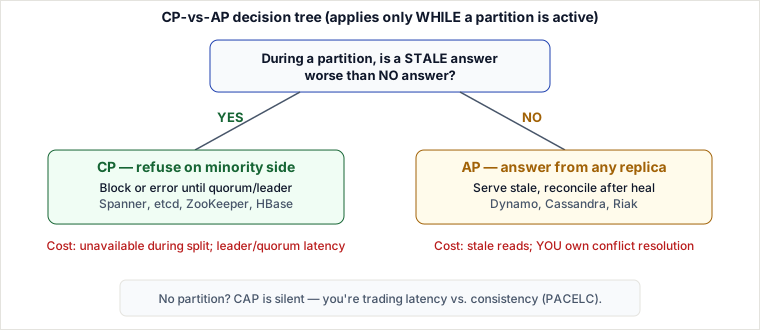
The whole decision collapses to one mechanism: during a network partition a replica that cannot reach its peers must either refuse the request (keep every reader on the latest value — a CP choice) or answer from its own possibly-stale copy (stay up but risk conflicting writes — an AP choice); picking a side is just deciding whether a wrong answer or no answer hurts your users less. Everything an interviewer wants to hear — banking vs. feed, Dynamo vs. Spanner, last-write-wins, tunable consistency — is downstream of that single fork.
So in an interview, don't recite "you can only pick two of three." Say the mechanism, then walk the tree below out loud. P is not one of your two picks — partitions (dropped links, but also a 30-second GC pause or a swapped-out node that looks partitioned) will happen, so the real choice you control is C-vs-A while a partition is active. When there is no partition, CAP says nothing; you're trading latency against consistency instead (that is Abadi's PACELC extension — a great thing to name).
A worked trace: the same shopping cart, two quorum settings
The fork above isn't a philosophy choice — in a Dynamo-style store it is literally the numbers N (replicas), W (acks required to commit a write), and R (replicas read). Say N = 3, one replica per availability zone: A in AZ-1, B in AZ-2, C in AZ-3. A coordinator sends every operation to all three and waits for W acks on writes, R responses on reads.
| Setting | R + W vs N | Guarantee | Behaves like |
|---|---|---|---|
| W=2, R=2 | 4 > 3 | Every read quorum overlaps every write quorum in ≥1 node → a read sees the latest committed write | CP-leaning |
| W=1, R=1 | 2 ≤ 3 | No guaranteed overlap → fast, but reads can miss the newest write | AP-leaning |
Now cut the link so AZ-1 is isolated: the cluster splits into {A} and {B, C}.
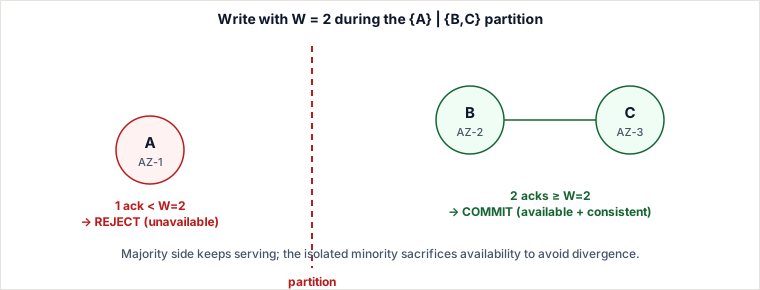
CP config (W=2): the minority goes dark
- User adds "Book". Coordinator in AZ-2 fans out to A, B, C.
- B and C ack; A is unreachable across the split.
2 acks ≥ W=2→ commit succeeds. The majority side is both up and correct.- A request that happens to land on the isolated A tries to write: only A acks,
1 < 2→ rejected. Those users see an error. That is the CP price — the minority is deliberately unavailable so no one reads a divergent cart.
AP config (W=1): everyone stays up, then you pay at read time
- On the {B,C} side a client adds "Book" → one ack from B → success, version
v1. - On the isolated {A} side a different session adds "Pen" → A acks locally → success, version
v1'. Both writes "won"; neither saw the other. - Partition heals. A holds {Pen}; B, C hold {Book}. The versions conflict.
- Last-write-wins keeps only the higher timestamp → the whole losing cart is silently discarded. Real anomaly: the customer's "Book" (or "Pen") just vanishes. LWW is trivial but lossy.
- Dynamo's actual fix for carts: don't LWW — keep both versions as siblings and merge by union at read time → cart = {Book, Pen}. Nothing is lost. The known cost: a previously-removed item can resurrect, because "add" and "remove" both survive the merge. Amazon judged a resurrected item far cheaper than a dropped purchase.
CP vs. AP decision table
| Signal | Lean CP | Lean AP |
|---|---|---|
| Cost of a stale/conflicting answer | Irreversible harm: money moved twice, oversold inventory, two owners of the same lock | Cosmetic or recoverable: feed lag, resurrected cart item, old view count |
| Cost of an error | Acceptable: minority partition returns errors rather than wrong data | Unacceptable: the site must stay writable |
| Concrete mechanism | Quorum/leader reads (R + W > N), commit-wait, fencing tokens | Replica-local reads, last-write-wins, vector clocks/CRDTs, read repair |
| Exemplar systems | Spanner, etcd, ZooKeeper, CockroachDB | Dynamo, Cassandra, Riak, DNS |
Use the table as a checklist, not a label: many systems mix the two — ledger CP, cart AP — and choose per request.
Pitfalls
- Calling something a "CA" system. In a real network you can't drop P, so CA just means "CP that hasn't been partition-tested" — a single-node database or one that halts under a split. Interviewers pounce on "I'll pick CA."
- Believing the trade-off is always on. CAP only constrains you during a partition. The rest of the time — 99.9% of it — your cost is latency vs. consistency. Say PACELC and you sound like you run systems, not flashcards.
- Reaching for last-write-wins by reflex. LWW is a data-loss policy in disguise: concurrent writes silently overwrite each other, and clock skew decides the "winner." Fine for a cache entry; catastrophic for a cart or a counter. Prefer CRDTs / semantic merge when losing a write is unacceptable.
- Naming the wrong exemplar. "Cassandra for strong consistency" is a red flag — Cassandra/Dynamo are AP by design (tunable, but availability-first). Strong, coordinated consistency is Spanner, etcd, ZooKeeper. Match the name to the property.
- Forgetting a slow node reads as a partition. A long GC pause, a saturated NIC, or a leader that's alive-but-unreachable trips the same code path as a cable cut. Your CP system's availability dips are usually these, not literal split cables.
- Choosing one knob for the whole system. "The system is CP" is rarely true. The write path can be CP while analytics reads are AP — decide per operation.
When to choose CP, when to choose AP
Concrete signals for CP (Spanner / etcd / ZooKeeper): a wrong or stale answer causes irreversible harm or lets two actors act on conflicting truth — money movement, inventory decrement / "last seat," uniqueness constraints, leader election, config and feature flags, distributed locks. You gain a single agreed truth and simple application code (no merge logic). You pay in write latency (a quorum round trip or a Spanner commit-wait of a few ms), and in availability: the minority side stops serving during a split.
Concrete signals for AP (Dynamo / Cassandra / Riak): the read tolerates being seconds stale, and downtime is the real business risk — feeds, timelines, product catalog, view counts, presence, shopping carts, telemetry. You gain always-on writes and low, replica-local latency. You pay by owning conflict resolution forever (version vectors, CRDTs, or an accepted LWW loss) and by exposing stale reads to users.
Choose CP when the cost of a wrong answer exceeds the cost of an error message; choose AP when the cost of downtime exceeds the cost of a stale or reconciled answer. And remember it's a dial, not a switch — Cassandra lets you pick per query: route a must-be-current read at QUORUM (or to the leader) for correctness, and let tolerant reads hit ONE for speed. Brewer's own retrospective made this point: within one system, some operations can be handled the available way and others the consistent way.
Saying it in the interview (template)
Compress the whole thing into four beats: "Partitions will happen, so my real choice is C-vs-A during one. For [this operation], a wrong answer is [worse / more tolerable] than no answer, so I'll go [CP / AP] — like [Spanner / Dynamo]. Concretely I'd set [quorum / leader reads / eventual + merge], and mitigate the downside with [graceful degradation / CRDT or LWW / read-repair]. Different operations can sit on different points of the dial." That names the mechanism, the exemplar, the concrete setting, and the mitigation — which is exactly the maturity signal an interviewer is grading.
Takeaways
- The CP/AP fork is mechanical: during a partition a lonely replica either refuses (CP) or serves stale (AP). Everything else is a consequence.
- It's a dial set by real numbers —
R + W > Ngives quorum overlap (CP-leaning); anything less trades correctness for speed (AP-leaning). - Match exemplars to properties: Spanner / etcd / ZooKeeper = CP; Dynamo / Cassandra / Riak = AP. "CA" and "Cassandra for strong consistency" are traps.
- Name PACELC: outside a partition you're trading latency vs. consistency, and the choice is per-operation, not per-system.
Trade-off by system type
The CP/AP choice is not abstract; it is pinned to what the system does. Use this matrix as a starting point, then tune per operation.
| System type | Dominant workload | Default stance | Consistency model | Why this stance |
|---|---|---|---|---|
| Social feed | Read-heavy, fan-out | AP | Eventual + monotonic reads | Staleness of seconds is invisible; downtime loses engagement |
| Payment ledger | Write-heavy, transfers | CP | Linearizable / serializable | A wrong balance is far worse than a declined transaction |
| Analytics pipeline | Batch / streaming ingestion | AP | Eventual | Freshness of minutes is fine; throughput dominates |
| Config / feature flags | Reads massively outnumber writes | CP | Strong consistency | Propagating a bad flag value should not happen; readers need the latest truth |
| Shopping cart | Mixed reads and writes | AP with semantic merge | Eventual + CRDT/union merge | Losing a cart loses revenue; a resurrected item is cheaper than a lost purchase |
| Inventory / seat booking | Conditional writes | CP | Linearizable decrement | Overselling a seat or running out of stock is unacceptable |
Interview dialogue: saying it out loud
Here is how the answer sounds in a real room.
Candidate: "For the payment service, partitions will happen, so the real decision is C-vs-A during a partition. A wrong balance or double charge is much worse than a transient error, so I would go CP — think Spanner or a ledger using leader reads with commit-wait."
Interviewer: "What happens to writes on the minority side during the partition?"
Candidate: "They are rejected. The minority does not have quorum, so it returns an error rather than accept a write that could diverge. When the partition heals, the minority replicas catch up from the majority."
Interviewer: "Why not just use last-write-wins? It is simpler."
Candidate: "LWW is data loss in a tidy dress. Clock skew means the 'later' write is not necessarily the one the user intended, and concurrent writes silently overwrite each other. I would only use LWW for cache entries or telemetry where losing a value is acceptable. For money, I would use a CRDT or, better, avoid the conflict by staying CP."
Interviewer: "And outside of a partition?"
Candidate: "Then CAP is silent. I would name PACELC: with no partition we trade latency against consistency. A must-read-current balance hits the leader or uses QUORUM; a dashboard aggregation can read a replica at ONE."
🪜 Drill ladder: CP/AP follow-up traps
After you name CP or AP, expect these follow-ups. Have the answer ready.
- Minority-side writes in a CP system. They are rejected because the minority lacks quorum. On heal, the minority rejoins the majority and replays committed writes to become consistent.
- Last-write-wins and clock skew. LWW silently discards concurrent writes; the survivor is decided by clocks that can skew. Prefer vector clocks, CRDTs, or semantic merge when losing a write matters.
- Item resurrection in AP merges. If "add Book" and "remove Book" are concurrent siblings and you merge by union, the book can reappear. Amazon accepted this for carts because a resurrected item is cheaper than a lost sale.
- PACELC outside partitions. CAP only applies during a partition. The rest of the time the trade-off is latency vs. consistency — route critical reads to the leader/QUORUM and tolerant reads to replicas.
- The dial, not the switch. One system can be CP for some operations and AP for others. The answer is per-operation, not a tribal label like "we are a CP company."
Re-authored and deepened for this guide. Sources: E. Brewer, "CAP Twelve Years Later: How the Rules Have Changed" (IEEE Computer, 2012); S. Gilbert & N. Lynch, "Brewer's Conjecture and the Feasibility of Consistent, Available, Partition-Tolerant Web Services" (2002); G. DeCandia et al., "Dynamo: Amazon's Highly Available Key-value Store" (SOSP 2007) for the quorum (N/R/W) model and the shopping-cart merge/resurrection anomaly; D. Abadi, "Consistency Tradeoffs in Modern Distributed Database System Design" (PACELC, 2012); M. Kleppmann, Designing Data-Intensive Applications (2017), ch. 5 & 9; Apache Cassandra and Google Cloud Spanner documentation on tunable consistency and commit-wait.
🤖 Don't fully get this? Learn it with Claude
Stuck on System Design Tradeoffs in Interviews? Open Claude, copy a block below, and it'll teach you this exact concept — visually and interactively.
Build the mental picture, not memorization.
I just read a lesson on **System Design Tradeoffs in Interviews** (System Design) and want to truly understand it. Explain System Design Tradeoffs in Interviews from first principles using ONE vivid real-world analogy and a visual mental model — draw it as ASCII art or a clear step-by-step diagram — with a concrete example using real numbers. Then ask me one question to check I got the mental picture, and wait for my reply. If you're unsure or a claim isn't standard, say so and reason from first principles instead of guessing.
Socratic — adapts to where you're stuck.
Teach me **System Design Tradeoffs in Interviews** interactively. Ask me ONE guiding question at a time, wait for my answer, and adapt to my confusion — build the idea with me step by step instead of explaining it all at once. If you're unsure or a claim isn't standard, say so and reason from first principles instead of guessing.
Active recall exposes what you missed.
Quiz me on **System Design Tradeoffs in Interviews** with 5 questions, easy to tricky, ONE at a time. Tell me if each answer is right; at the end, explain clearly what I got wrong and why. If you're unsure or a claim isn't standard, say so and reason from first principles instead of guessing.
Intuition + hook + flashcards for long-term memory.
Help me remember **System Design Tradeoffs in Interviews** for the long term: give the one-sentence intuition, a memorable hook/mnemonic, a tiny worked example, and 3 active-recall flashcards (Q -> A). If you're unsure or a claim isn't standard, say so and reason from first principles instead of guessing.