RabbitMQ vs Kafka vs ActiveMQ
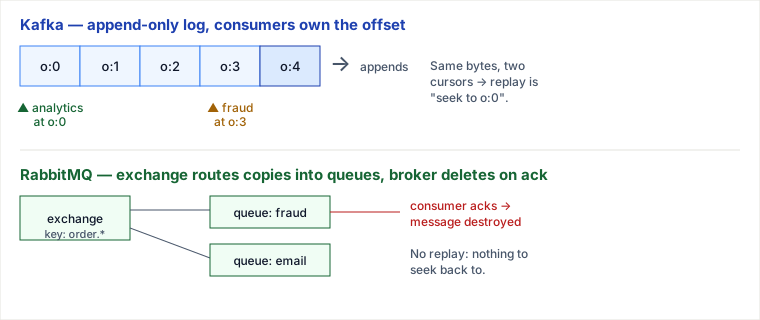
These three brokers behave differently because each stores and hands out a message via a fundamentally different data structure: Kafka appends every message to an immutable, partitioned log that consumers read by advancing their own offset (the broker never deletes on read); RabbitMQ routes each message through an exchange into one or more queues and deletes it the moment a consumer acknowledges; ActiveMQ implements the JMS queue/topic model, tracking per-message delivery state in the broker. Everything else — replay, ordering, throughput, routing power — falls out of that one design choice.
The mechanism, in one picture
The core split is who owns the read cursor. In a log, the consumer owns it, so many independent readers can sit at different positions and the same bytes can be re-read forever. In a queue, the broker owns delivery state, so a message is dequeued and destroyed once acknowledged — cheap and low-latency, but gone.
One event, traced through all three
Scenario: an e-commerce site emits order.created events at ~50,000/sec. Three independent consumers need each event — fraud scoring, email confirmation, and an analytics warehouse loader that occasionally must reprocess the last day. Follow one event, {orderId: 91007, customerId: 8842, amount: 149.00}.
| Step | Kafka | RabbitMQ | ActiveMQ |
|---|---|---|---|
| Publish | Produce to topic orders; key = customerId 8842 → hash → partition 3 of 12 | Publish to topic exchange orders, routing key order.created.US | Send to topic ORDERS |
| Placement | Appended at offset 15203 of partition 3; replicated to 2 follower brokers (ISR) | Bindings copy it into fraud_q and email_q; analytics has its own bound queue | Broker persists to KahaDB; one copy per durable subscriber (fraud, email, analytics) |
| Consume | Each consumer group reads & commits its own offset; fraud commits 15204, analytics still at offset 0 | Broker pushes to each queue's consumer; each acks its own copy | Broker pushes to each durable subscriber; each acks |
| After ack | Message stays until retention (e.g. 7 days) expires — untouched by acks | Message deleted from that queue immediately | Message deleted for that subscriber |
| Reprocess last day | seek analytics group to yesterday's offset — bytes are still there | Impossible from the broker; you must re-publish from an external store | Impossible; message is gone once acked |
| Ordering seen | All of customer 8842's events are in partition 3, so strictly ordered for that customer; no global order across the 12 partitions | FIFO within each queue | FIFO within each destination |
The load-bearing difference is the last two rows: Kafka's offset-owned-by-consumer design makes replay a one-line seek; the queue brokers treated the message as work to be consumed and destroyed.
The 10-dimension comparison
| Dimension | Kafka | RabbitMQ | ActiveMQ |
|---|---|---|---|
| 1. Core model | Distributed append-only log | AMQP exchange → queue | JMS queue / topic |
| 2. Throughput | Very high — millions/sec, sequential disk + batching | Tens of thousands/sec/queue | Tens of thousands/sec |
| 3. Ordering | Per-partition only (not across a topic) | Per-queue FIFO | Per-destination FIFO |
| 4. Consumption | Pull; consumer commits offset | Push; broker deletes on ack | Push; broker deletes on ack |
| 5. Replay / re-read | Yes — seek to any offset within retention | No — acked messages are gone | No — acked messages are gone |
| 6. Routing power | Basic: topic + partition key | Rich: direct / topic / fanout / headers exchanges + bindings | Selectors, virtual topics, composite destinations |
| 7. Priority | No built-in message priority | Yes (priority queues) | Yes (JMS priority) |
| 8. Replication / HA | Built-in per-partition replication (ISR/leader) | Quorum queues (Raft) / classic mirrored queues | Master-slave (shared store / KahaDB) |
| 9. Latency | Low-ms, but batching favours throughput over tail latency | Sub-ms to low-ms — tuned for low latency | Low-ms |
| 10. License | Apache-2.0 | MPL-2.0 (Mozilla) | Apache-2.0 |
Stream processing: Apache Kafka ships Kafka Streams natively (a library bundled with the Apache Kafka distribution); ksqlDB is a separate Confluent-licensed SQL layer that runs on top of Kafka — not part of Apache Kafka; RabbitMQ added a Streams log-like type in 3.9+ (2021) but it is not a stream-processing engine; ActiveMQ has no native stream processing and leans on external libraries.
When to use which — the decision
Stop comparing feature checklists and ask one question first: is this an event stream that multiple consumers replay, or is it work handed to a consumer once? That single distinction resolves most choices.
- Choose Kafka when you have high-volume, replayable event streams — event sourcing, log aggregation, metrics/clickstream ingestion, feeding multiple independent downstream consumers, or anything that needs to reprocess history (new consumer joins and reads from offset 0). Signals: throughput in the 100k+/sec range; "we need to replay"; "three teams want the same events"; ordered-per-key is enough.
- Choose RabbitMQ when you have complex routing, per-message priority, low-latency task queues, RPC-style request/reply, or per-message TTL and dead-lettering. Signals: "route by header/topic pattern to different workers"; "urgent jobs jump the line"; "fan out one message to a few queues with different bindings"; moderate volume, latency-sensitive.
- Choose ActiveMQ when you are in a JMS/Java-EE ecosystem that expects the JMS API, need protocol breadth (STOMP, MQTT, OpenWire, AMQP), or are integrating legacy enterprise systems. ActiveMQ Artemis is the modern high-performance successor.
Trade-offs you are actually accepting
- Kafka over RabbitMQ: you gain replay, huge throughput and cheap fan-out to many consumers; you pay in operational weight (partitions, offsets, consumer-group rebalances, retention tuning), no per-message priority, no arbitrary routing, and no easy per-message ack/redelivery of a single "stuck" message. Killing one poison message means routing it to a dead-letter topic, not selectively nacking it.
- RabbitMQ over Kafka: you gain rich routing, priority, low latency and simple ack/redelivery of individual messages; you pay by losing replay (once acked, it is gone), and throughput ceilings per queue are far lower — a single hot queue becomes a bottleneck, and mirrored queues add latency.
- ActiveMQ over both: you gain the standard JMS contract and multi-protocol reach; you pay in throughput and in a smaller modern community versus Kafka. Prefer Artemis over classic ActiveMQ for new work.
Pitfalls
- Expecting global ordering in Kafka. Ordering is guaranteed only within a partition. If you spread a topic across 12 partitions, events for different keys interleave arbitrarily. Fix: pick a partition key (e.g.
customerId) so all related events land in one partition — at the cost of that key becoming a throughput hot-spot. - Using RabbitMQ as an event store. Teams reach for RabbitMQ then discover they cannot replay — the message was deleted on ack. If you need history, that is a Kafka (or RabbitMQ Streams) job, not a classic queue.
- Treating Kafka like a low-latency task queue. Batching, linger, and consumer-group rebalances make tail latency worse than RabbitMQ for small request/reply workloads. A rebalance can pause consumption for seconds.
- Unbounded RabbitMQ queues. A slow consumer lets a queue grow until the broker pages to disk or hits memory alarms and blocks publishers — a silent, cluster-wide stall. Set max-length / TTL / dead-letter policies.
- Assuming exactly-once for free. All three default to at-least-once; duplicates happen. Kafka offers transactional/idempotent producers within its own boundary, but end-to-end exactly-once still requires idempotent consumers.
- Licensing surprise. RabbitMQ is MPL-2.0 (file-level copyleft), unlike Kafka/ActiveMQ under Apache-2.0 — worth a check for redistribution, though rarely a blocker for internal use.
Takeaways
- One design choice explains everything: log with consumer-owned offsets (Kafka, replayable, fan-out, high throughput) vs broker-owned queues deleted on ack (RabbitMQ/ActiveMQ, rich routing, priority, low latency, no replay).
- Kafka for high-volume replayable streams; RabbitMQ for complex routing, priority, and low-latency task queues; ActiveMQ/Artemis for JMS and multi-protocol enterprise integration.
- Kafka orders per partition, not per topic — choose your partition key deliberately.
- These are not mutually exclusive: many systems run Kafka as the event backbone and RabbitMQ for command/RPC work alongside it.
Re-authored and deepened for this guide. Sources: Apache Kafka documentation (design, replication, consumer groups); RabbitMQ documentation (AMQP model, exchanges, quorum queues, Streams 3.9+); Apache ActiveMQ / Artemis documentation (JMS, protocols); Kleppmann, Designing Data-Intensive Applications, ch. 11 (message brokers vs logs); Confluent engineering blog on log-vs-queue semantics.
When NOT to pick each broker
- When NOT Kafka: simple task queue with complex routing, low volume, need priority/TTL/DLX — RabbitMQ is simpler.
- When NOT RabbitMQ: multi-team replay of history, high fan-out streams, stream processing — log wins.
- When NOT ActiveMQ classic: greenfield cloud — prefer Rabbit/Kafka/SQS unless JMS lock-in is already paid.
Interviewer follow-ups & drills
- Why not “exactly-once” as the selection criterion? Classic queues are at-least-once; EOS is processing design, not a broker checkbox.
- Ops signals: Kafka consumer lag / under-replicated partitions; Rabbit queue depth & memory alarms; DLQ growth.
- Drill: Email send once per order, no replay needed → queue (SQS/Rabbit) + idempotent sender, not Kafka.
🤖 Don't fully get this? Learn it with Claude
Stuck on RabbitMQ vs Kafka vs ActiveMQ? Open Claude, copy a block below, and it'll teach you this exact concept — visually and interactively.
Build the mental picture, not memorization.
I just read a lesson on **RabbitMQ vs Kafka vs ActiveMQ** (System Design) and want to truly understand it. Explain RabbitMQ vs Kafka vs ActiveMQ from first principles using ONE vivid real-world analogy and a visual mental model — draw it as ASCII art or a clear step-by-step diagram — with a concrete example using real numbers. Then ask me one question to check I got the mental picture, and wait for my reply. If you're unsure or a claim isn't standard, say so and reason from first principles instead of guessing.
Socratic — adapts to where you're stuck.
Teach me **RabbitMQ vs Kafka vs ActiveMQ** interactively. Ask me ONE guiding question at a time, wait for my answer, and adapt to my confusion — build the idea with me step by step instead of explaining it all at once. If you're unsure or a claim isn't standard, say so and reason from first principles instead of guessing.
Active recall exposes what you missed.
Quiz me on **RabbitMQ vs Kafka vs ActiveMQ** with 5 questions, easy to tricky, ONE at a time. Tell me if each answer is right; at the end, explain clearly what I got wrong and why. If you're unsure or a claim isn't standard, say so and reason from first principles instead of guessing.
Intuition + hook + flashcards for long-term memory.
Help me remember **RabbitMQ vs Kafka vs ActiveMQ** for the long term: give the one-sentence intuition, a memorable hook/mnemonic, a tiny worked example, and 3 active-recall flashcards (Q -> A). If you're unsure or a claim isn't standard, say so and reason from first principles instead of guessing.