hard Kafka Consumer-Group Rebalancing
A rebalance is the coordinator re-dealing partitions whenever the group's membership changes
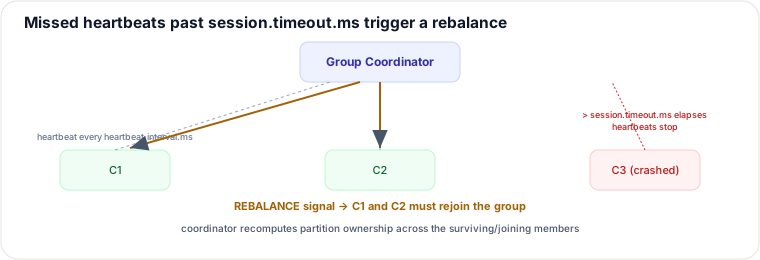
Every partition of a topic must be owned by exactly one consumer within a consumer group at a time. The group coordinator (a broker) tracks membership through heartbeats each consumer sends on heartbeat.interval.ms; if a member's heartbeats stop arriving for longer than session.timeout.ms, or a member explicitly joins or leaves, the coordinator triggers a rebalance — it recomputes which consumer owns which partitions using the group's configured assignor, and hands out the new assignment. The part that actually matters for your throughput is how much processing has to pause while that recomputation happens, and that is entirely determined by which rebalance protocol the group uses.
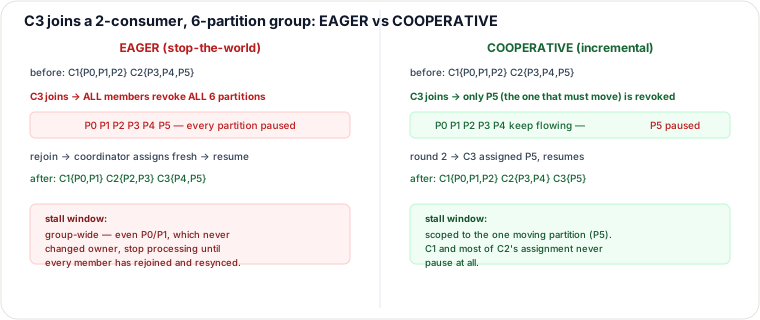
- EAGER (the original protocol) — on any membership change, every consumer in the group revokes all of its partitions (its
onPartitionsRevokedcallback fires for every partition it owned), then all members rejoin. The coordinator waits for every member to check back in before it computes and hands out a brand-new full assignment. Until that round trip completes, no partition in the group is being consumed — including partitions whose ownership never actually changed. - COOPERATIVE / incremental (via
CooperativeStickyAssignor) — the coordinator first figures out the target assignment, then only revokes the partitions that actually need to move to a different consumer. Partitions staying with their current owner are never revoked and keep being processed straight through the rebalance. This typically takes two short rebalance rounds (revoke only what must move, then hand it to its new owner) instead of one full stop-the-world round.
Both protocols answer the same question — "who owns which partition now?" — but eager answers it by pausing everyone and cooperative answers it by pausing only the partitions that changed hands.
Traced: C3 joins a 2-consumer, 6-partition group
Topic has 6 partitions (P0–P5); the group starts with C1 owning {P0,P1,P2} and C2 owning {P3,P4,P5}. A new instance, C3, starts up and sends a JoinGroup request.
| What happens | What keeps processing during the transition | |
|---|---|---|
| Eager | Coordinator detects the new member → sends a rebalance signal → C1 and C2 both revoke all six partitions → all three rejoin → coordinator assigns C1{P0,P1}, C2{P2,P3}, C3{P4,P5} → every consumer resumes together. | Nothing. Even P0/P1, which end up back on C1, are paused for the full round trip. |
| Cooperative | Coordinator computes the same kind of target, but a sticky assignor tries to keep existing ownership: C1{P0,P1,P2} unchanged, C2{P3,P4}, C3{P5}. Round 1: only C2 revokes P5. Round 2: C3 is assigned P5. | P0–P4 keep flowing the entire time; only P5 has a brief gap. |
Rebalance storms & static membership
A rebalance storm is repeated, cascading rebalances that keep the group from ever settling — usually caused by a flapping member: a consumer whose processing occasionally exceeds max.poll.interval.ms (a separate liveness check from the heartbeat thread, introduced so a slow-but-alive consumer doesn't block the group forever) gets treated as dead and kicked out, rejoins, gets reassigned partitions, and repeats. A session.timeout.ms set too aggressively low has the same effect: normal GC pauses or brief network jitter look like a crash, triggering a rebalance that didn't need to happen. Kafka's own default was raised from 10s to 45s (KIP-735) specifically because 10s produced too many false-positive rebalances in production.
Static membership (group.instance.id set to a stable, per-instance value) fixes a different failure mode: routine rolling restarts. Without it, every restarted consumer is a brand-new dynamic member, so a rolling deploy of N consumers triggers N rebalances. With a static ID, the coordinator recognizes the returning process as the same member reconnecting within its session window and simply restores its old assignment — no rebalance fires at all for a planned bounce.
Pitfalls
- Mixing eager and cooperative assignors across a group's clients is unsafe — a rolling upgrade to
CooperativeStickyAssignormust go through Kafka's documented two-phase migration; the protocols don't safely interoperate mid-rollout. - Tuning session.timeout.ms alone doesn't fix a rebalance storm caused by slow processing — that's a
max.poll.interval.ms/max.poll.recordsproblem, since the heartbeat thread is separate from the poll thread and can keep beating while the processing loop is stuck. - Static membership isn't automatic failure tolerance — if the instance doesn't come back within the session/registration window, the coordinator still treats it as gone and rebalances; it only suppresses rebalances for prompt, planned bounces.
- Cooperative still pauses the moving partitions — it shrinks the blast radius, it doesn't eliminate rebalance cost entirely.
When to use eager vs. cooperative — and the trade-off
- Prefer COOPERATIVE (CooperativeStickyAssignor) when the group is large, partition counts are high, or scaling/deploy events are frequent — anywhere a group-wide stall has a real latency or lag-buildup cost. It costs an extra rebalance round trip (revoke-what-moves, then assign) versus eager's single round, and a mandatory two-phase rollout if migrating an existing group.
- EAGER is acceptable for small, stable groups where rebalances are rare and brief enough that a full stop-the-world pause is a non-issue — and it remains the simpler mental model with one rebalance round instead of two.
- Static membership is not a substitute for choosing an assignor — it targets a different cause (planned restarts triggering unnecessary rebalances at all) and combines with either protocol. Use it whenever consumers restart routinely (rolling deploys, autoscaling that recycles instances with the same identity).
Session / heartbeat tuning: fast failure detection vs. false rebalances
Lowering session.timeout.ms detects a genuinely crashed consumer sooner — its partitions sit un-consumed for less time, which matters when consumer lag has a latency SLA. But push it too low and ordinary jitter (a GC pause, a slow disk flush, a momentary network blip) crosses the threshold and fires an unnecessary rebalance, which now stalls the whole group under eager, or at least the moving partitions under cooperative — for a failure that wasn't real. Raising the timeout trades slower failover for fewer false positives. There is no value that is simply "correct"; it is set against how tolerant the workload is of (a) a slow real failover vs (b) an occasional unnecessary pause, which is exactly why Kafka's own shipped default moved from 10s to 45s once the false-positive cost became clear in practice.
Takeaways
- A rebalance fires on any group membership change — join, explicit leave, or heartbeats missing past
session.timeout.ms— and the coordinator recomputes partition ownership. - Eager revokes every partition group-wide before reassigning (full stall); cooperative revokes only the partitions that must move (scoped stall).
- Rebalance storms usually trace back to
max.poll.interval.ms(slow processing) or too-tightsession.timeout.ms(false failure detection) — diagnose which one before tuning either. - Static membership (group.instance.id) eliminates rebalances on planned restarts entirely — a different, complementary fix to picking an assignor.
Sources: Apache Kafka documentation — consumer group protocol, session.timeout.ms/heartbeat.interval.ms/max.poll.interval.ms, ConsumerPartitionAssignor, and static membership (group.instance.id, KIP-345); KIP-429 (Incremental Cooperative Rebalancing); KIP-735 (session timeout default change); Neha Narkhede/Gwen Shapira/Todd Palino, Kafka: The Definitive Guide, ch. 4 (Consumers). Re-authored for this guide; both diagrams hand-authored as SVG. See also: Kafka Internals (partitions & consumer groups), Kafka Durability Under Broker Failure.
🤖 Don't fully get this? Learn it with Claude
Stuck on Kafka Consumer-Group Rebalancing? Open Claude, copy a block below, and it'll teach you this exact concept — visually and interactively.
Build the mental picture, not memorization.
I just read a lesson on **Kafka Consumer-Group Rebalancing** (System Design) and want to truly understand it. Explain Kafka Consumer-Group Rebalancing from first principles using ONE vivid real-world analogy and a visual mental model — draw it as ASCII art or a clear step-by-step diagram — with a concrete example using real numbers. Then ask me one question to check I got the mental picture, and wait for my reply. If you're unsure or a claim isn't standard, say so and reason from first principles instead of guessing.
Socratic — adapts to where you're stuck.
Teach me **Kafka Consumer-Group Rebalancing** interactively. Ask me ONE guiding question at a time, wait for my answer, and adapt to my confusion — build the idea with me step by step instead of explaining it all at once. If you're unsure or a claim isn't standard, say so and reason from first principles instead of guessing.
Active recall exposes what you missed.
Quiz me on **Kafka Consumer-Group Rebalancing** with 5 questions, easy to tricky, ONE at a time. Tell me if each answer is right; at the end, explain clearly what I got wrong and why. If you're unsure or a claim isn't standard, say so and reason from first principles instead of guessing.
Intuition + hook + flashcards for long-term memory.
Help me remember **Kafka Consumer-Group Rebalancing** for the long term: give the one-sentence intuition, a memorable hook/mnemonic, a tiny worked example, and 3 active-recall flashcards (Q -> A). If you're unsure or a claim isn't standard, say so and reason from first principles instead of guessing.