Data Modeling — The Denormalization Decision & Write-vs-Read Cost Framing (Deep Dive)
Data Modeling — The Denormalization Decision & Write-vs-Read Cost Framing (Deep Dive)
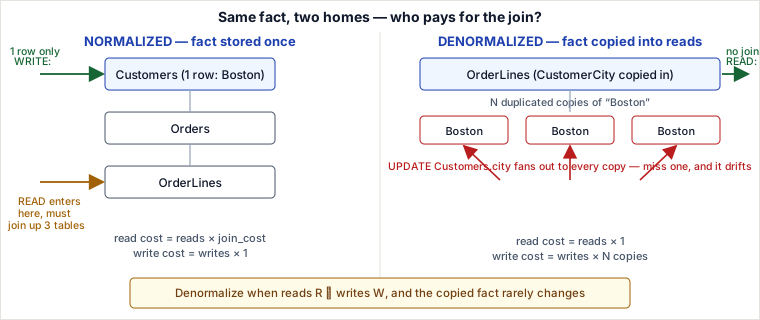
Every fact in a schema has to live somewhere, and the decision that matters is not “is this normalized” but who pays to keep it correct: normalization stores each fact once and makes reads pay to reassemble it (a join); denormalization stores the fact redundantly and makes writes pay to keep every copy in sync. Everything below is that one trade-off, quantified, scaled, and turned into a decision rule.
The core rule: follow the read:write ratio
Normalize: one copy of every fact, one place to update it, zero risk of two rows disagreeing — but reconstructing a “wide” view (order + customer + product) means a join across tables on every read. Denormalize: copy the fact into the row that reads it — the read becomes a single-row fetch, but every write to the source-of-truth now has to fan out to every copy, and if the fan-out is incomplete, the copies disagree with reality. The rule: denormalize a fact when it is read far more often than it is written and the copied value rarely changes; keep it normalized when writes are frequent, or a wrong copy is unacceptable (money, inventory, identity).
Traced example — a post’s comment count, shown on every feed card:
Normalized: COUNT(*) FROM comments WHERE post_id=? | Denormalized: posts.comment_count column | |
|---|---|---|
| Cost per read | ≈80 row-touches (index range scan over that post’s comments) | ≈0 — already reading the post row to render the card |
| Reads/day | 2,000,000 | 2,000,000 |
| Total read cost/day | 160,000,000 row-touches | ≈ 0 extra |
| Cost per write | 0 — nothing to maintain | 1 extra row-update (atomic comment_count = comment_count + 1) |
| Writes/day (new comments) | 50,000 | 50,000 |
| Total write cost/day | 0 | 50,000 row-updates |
Denormalizing trades 0 → 50,000 extra writes/day to erase 160,000,000 → ≈0 read-side row-touches/day. Reads outnumber writes 40:1 here, and each normalized read is ≈80× more expensive than the write-side increment — so the total cost differential (160,000,000 row-touches vs. 50,000 row-updates) is roughly 3,200× in favor of denormalizing. That is what “read-heavy, rarely-updated aggregate” means in numbers, not just in words. Flip the ratio — a field that changes on every write and is read once — and the same arithmetic argues for staying normalized.
The scale half: a join is only cheap if the plan is cheap
The comment-count example hides an assumption: that the normalized join is indexed. On a small table a 3-way join is free either way; on a large table, a join across unindexed foreign keys forces the planner into a nested loop that scans one side per row of the other — the exact blow-up that makes “just normalize it” feel wrong in practice. The fix there is almost never denormalization first — it is putting the right index on the join column, which turns the loop from a scan into a lookup. The full cost-model derivation (selectivity, index vs. hash vs. merge join, when the planner spills) belongs to the Query Execution deep dive — the one-line takeaway to bring here is: index your join and filter columns before you denormalize to avoid the join; denormalization (or a materialized view) is the second move, for when the join is already indexed and still too hot.
When not to normalize — the named alternatives
“Don’t normalize this” is not one decision, it is three different ones, each with a named alternative and a different failure mode if misapplied:
- Star schema (OLAP) vs. normalized OLTP schema. An analytics query that aggregates millions of fact rows across many dimensions pays a huge join/aggregation cost in a normalized schema. A star schema deliberately denormalizes the dimension tables (flat, wide, redundant) around a fact table, because BI queries are read-only, bulk, and tolerate staleness. Decision: keep the transactional system of record in normalized OLTP tables; feed a separate star schema via ETL/CDC for reporting — never make the OLTP schema serve both jobs.
- Document/embedded model vs. relational join. When a parent and its children are always read and written together as one unit (an order and its line items, a blog post and its embedded settings), embedding them in one document removes the join by co-locating the data physically. Decision: embed only when the sub-entity has no independent lifecycle and the embedded collection is bounded — an unbounded array (comments growing forever) or a sub-entity that needs its own independent query/update path (a product looked up across many orders) belongs in its own collection/table instead.
- Materialized view vs. hand-denormalized column. When a specific join is hot but you don’t want application code responsible for keeping a copied column in sync, keep the base tables normalized and add a materialized view (or CDC-fed read model) that precomputes the joined/aggregated shape. Decision: prefer this over hand-copying columns whenever the engine supports it — the database, not your write path, owns consistency, at the cost of refresh compute and bounded staleness.
Cardinality drives physical shape — and collapsing it is what breaks
The relationship’s cardinality is not a diagram detail, it dictates where the foreign key goes and how many tables the data needs:
- 1:1 — usually one row with nullable columns, or a separate table sharing the same primary key when the extra attributes are optional, sensitive, or rarely accessed (e.g.,
Usersvs. a separateUserSecurityCredentials). - 1:N — the foreign key lives on the “many” side (
Orders.customer_id → Customers.id); the “one” side never repeats. - M:N — cannot be a column on either side at all; it requires a junction table (composite or surrogate key plus two FKs) with one row per pairing.
Here is the concrete failure when you collapse a 1:N relationship into one table instead — putting CustomerName and CustomerCity directly on Orders instead of a separate Customers table:
- Update anomaly: the customer moves — you must find and update every order row they ever placed; miss one and the database now disagrees with itself about where they live.
- Insert anomaly: you cannot record a new customer’s city until they place a first order, because no row exists yet to hold it.
- Delete anomaly: deleting their only order erases their address entirely — a customer who still exists vanishes from the data.
Separating Customers from Orders is not a stylistic preference — it is the only shape where a customer’s identity can exist independently of how many orders they have placed (zero, one, or many).
Mechanics covered elsewhere — pointers, not repeats
NULL and NOT IN: once a schema has optional (nullable) foreign keys or attributes, comparisons against NULL stop behaving like ordinary equality — a NOT IN subquery that returns even one NULL silently discards the whole result set. The full three-valued-logic mechanics live in the Relational Model deep dive; the one-line takeaway here is use NOT EXISTS, not NOT IN, whenever the subquery column can be NULL.
Natural vs. surrogate keys: choosing what identifies a row is itself a modeling decision that ripples into every FK you draw above. The full trade-off (stability, size, join cost, business-key drift) lives in the Relational Model deep dive; the one-line takeaway is surrogate keys stay stable when the business identifier changes or turns out not to be unique, but you still need a unique constraint on the natural key to keep business integrity enforced.
Which normal form removes which anomaly: 1NF removes non-atomic (multi-valued) cells, 2NF removes partial dependency on part of a composite key, and 3NF/BCNF remove transitive and overlapping-candidate-key dependencies — each targets one specific anomaly, not normalization “in general.” The full derivation with dependency-preservation and lossless-join proofs lives in the Normalization deep dive; that one-line mapping is the only piece repeated here.
Pitfalls
- Denormalize, then forget to update. The single most common failure: a copied column (or count) is updated in the one code path someone remembered, and silently stops matching reality everywhere else. A denormalized copy is only safe when the engine owns the update — an atomic increment in the same transaction as the source write, a trigger, CDC, or a materialized view refresh — never “we’ll remember to update both call sites.”
- Non-atomic fan-out races. Even when you do remember, a read-modify-write increment done outside a transaction (read count, add 1, write count back) loses updates under concurrency; use an atomic
UPDATE ... SET x = x + 1or the engine’s counter primitive. - Denormalizing before measuring. Guessing that a path is “probably read-heavy” and hand-copying columns pre-emptively adds write cost and drift risk for a win that may not exist; measure the actual read:write ratio on the hot path first.
- Treating a materialized view as always fresh. Callers that assume a materialized view is transactionally current will read stale aggregates during the refresh window — the staleness bound has to be part of the contract, not an accident.
- Collapsing entities that have independent lifecycles. Merging
CustomersintoOrders“because it’s simpler” is not a performance trade-off, it is a modeling bug — it breaks the moment a customer needs to exist with zero orders.
Judgment layer — normalize, denormalize, materialized view, or document?
| Signal on the workload | Recommendation |
|---|---|
| Write-heavy or mixed OLTP; correctness is non-negotiable (money, inventory, identity) | Normalize to 3NF/BCNF — one copy, one place to be right |
| A specific read path is hot, join-heavy, and its data is comparatively stable | Denormalize that column/aggregate, but let the engine (transaction, trigger, CDC) own the update |
| The same expensive join/aggregation shape is needed repeatedly, and the base tables must stay 3NF as source of truth | Materialized view / CDC-fed read model — best of both, paid for in refresh cost and bounded staleness |
| Analytical aggregation over huge fact tables (BI/OLAP), read-only, staleness-tolerant | Star schema — denormalized dimensions around a fact table, fed by ETL/CDC, kept separate from OLTP |
| A parent and child are always read/written together, as a bounded, always-co-accessed unit | Document/embedded model — only while the child has no independent lifecycle and is bounded in size |
Default to normalized OLTP. Reach for denormalization only against a measured hot, stable, read-heavy path. Prefer a materialized view over hand-copying columns whenever the engine supports it. Reserve a star schema for genuinely analytical workloads, and embedding for genuinely bounded, co-accessed aggregates — not as a shortcut around modeling the relationship properly.
Takeaways
- Normalization moves cost to read time (join to reassemble, one copy, cheap and safe to write); denormalization moves cost to write time (fan-out to every copy) to make a specific read cheap — decide from the measured read:write ratio, not intuition.
- On large tables, index the join columns before reaching for denormalization — an unindexed nested-loop join is a planner problem, not a schema problem.
- “Don’t normalize this” has three different correct answers depending on the workload: a star schema for OLAP, a document model for a bounded co-accessed aggregate, or a materialized view for a hot join over an otherwise-normalized OLTP schema.
- Collapsing cardinality levels for convenience (merging a 1:N relationship into one table) is an anomaly generator, not an optimization — separate entities whenever one can exist independently of the other.
Related pages
- Query Execution — Selectivity, the Cost Model, Join Algorithms, Spills & Sargability (Deep Dive) — the join-cost mechanics (selectivity, plan choice, spills) behind the "index before you denormalize" rule above.
- Relational Model — Keys, FK Integrity, NULL Traps & Modeling Judgment (Deep Dive) — the NULL/NOT IN three-valued-logic trap and natural-vs-surrogate key trade-off referenced above, in full.
- Normalization — 3NF vs BCNF Dependency-Preservation, Lossless Join, Synthesis & 5NF (Deep Dive) — the anomaly-by-anomaly derivation this page only maps one line to.
- Indexing & Storage — Fanout Arithmetic, Optimizer Stats, Composite/Skip Scans & NULL/OR Pitfalls (Deep Dive) — how to size and choose the index that makes a join cheap before reaching for denormalization.
Sources: E. F. Codd’s relational-model papers and C. J. Date, An Introduction to Database Systems (normal forms, update/insert/delete anomalies); Martin Kleppmann, Designing Data-Intensive Applications (derived data, materialized views, read models); Ralph Kimball, The Data Warehouse Toolkit (star schema / dimensional modeling for OLAP); MongoDB data modeling documentation (embedding vs. referencing trade-offs). Re-authored/Deepened for this guide.
🤖 Don't fully get this? Learn it with Claude
Stuck on Data Modeling — The Denormalization Decision & Write-vs-Read Cost Framing (Deep Dive)? Open Claude, copy a block below, and it'll teach you this exact concept — visually and interactively.
Build the mental picture, not memorization.
I just read a lesson on **Data Modeling — The Denormalization Decision & Write-vs-Read Cost Framing (Deep Dive)** (Databases) and want to truly understand it. Explain Data Modeling — The Denormalization Decision & Write-vs-Read Cost Framing (Deep Dive) from first principles using ONE vivid real-world analogy and a visual mental model — draw it as ASCII art or a clear step-by-step diagram — with a concrete example using real numbers. Then ask me one question to check I got the mental picture, and wait for my reply. If you're unsure or a claim isn't standard, say so and reason from first principles instead of guessing.
Socratic — adapts to where you're stuck.
Teach me **Data Modeling — The Denormalization Decision & Write-vs-Read Cost Framing (Deep Dive)** interactively. Ask me ONE guiding question at a time, wait for my answer, and adapt to my confusion — build the idea with me step by step instead of explaining it all at once. If you're unsure or a claim isn't standard, say so and reason from first principles instead of guessing.
Active recall exposes what you missed.
Quiz me on **Data Modeling — The Denormalization Decision & Write-vs-Read Cost Framing (Deep Dive)** with 5 questions, easy to tricky, ONE at a time. Tell me if each answer is right; at the end, explain clearly what I got wrong and why. If you're unsure or a claim isn't standard, say so and reason from first principles instead of guessing.
Intuition + hook + flashcards for long-term memory.
Help me remember **Data Modeling — The Denormalization Decision & Write-vs-Read Cost Framing (Deep Dive)** for the long term: give the one-sentence intuition, a memorable hook/mnemonic, a tiny worked example, and 3 active-recall flashcards (Q -> A). If you're unsure or a claim isn't standard, say so and reason from first principles instead of guessing.