Normalization — 3NF vs BCNF Dependency-Preservation, Lossless Join, Synthesis & 5NF (Deep Dive)
Normalization — 3NF vs BCNF Dependency-Preservation, Lossless Join, Synthesis & 5NF (Deep Dive)
A functional dependency X → Y holds on a relation R when any two rows that agree on X must also agree on Y — X determines Y. Every anomaly you have ever seen in a bad schema is a real FD that the table's key structure fails to respect: the fact is repeated because nothing in the key structure forces it to live in exactly one place. The normal forms are just increasingly strict rules about which FDs a legal key structure is allowed to leave lying around:
| Normal form | What it requires | Anomaly it removes |
|---|---|---|
| 1NF | every attribute is atomic, single-valued per row | can't isolate or query one fact inside a crammed multi-valued cell |
| 2NF | no non-key attribute depends on only part of a composite key | partial-dependency redundancy (a fact tied to half the key, repeated per row) |
| 3NF | no non-key attribute depends transitively on the key through another non-key attribute | transitive redundancy (fact-about-a-fact repeated per row) |
| BCNF | every determinant of every FD is a superkey — no exception | the one class of anomaly 3NF still tolerates (see § below) |
| 4NF | no non-trivial multi-valued dependency unless implied by a candidate key | independent multi-valued facts cross-multiplied into spurious combinations |
| 5NF / PJNF | every join dependency is implied by the candidate keys | a cyclic n-way business rule that no 2-way split can hold without inventing rows |
Feel the pain once, concretely. This single table hides all three classic anomalies at once:
| StudentID | StudentEmail | CourseID | CourseName | InstructorID | InstructorOffice |
|---|---|---|---|---|---|
| S1 | ann@x.edu | C1 | Databases | I1 | Room 204 |
| S2 | bob@x.edu | C1 | Databases | I1 | Room 204 |
| S1 | ann@x.edu | C2 | Networks | I2 | Room 310 |
| S3 | cara@x.edu | C2 | Networks | I2 | Room 310 |
- Insert anomaly: you cannot record that course C9 = “Compilers” exists and is taught by I5 in Room 400 until at least one student enrolls —
StudentIDis part of every row. - Update anomaly: if I1 moves offices, you must update every row where
InstructorID = I1(here, two rows); miss one and the same instructor now has two offices in your own data. - Delete anomaly: if S2 drops C1 and S1 never took C1 either, deleting that row silently erases the fact that course C1 and instructor I1's office even exist — a fact unrelated to enrollment got deleted along with the enrollment.
The step-by-step 1NF→2NF→3NF walk that removes these lives in the companion Normalization page. This page owns what that walk leaves as adjectives: what “lossless” and “dependency-preserving” actually mean, the single most-asked BCNF trap, the synthesis algorithm that makes 3NF always achievable, and the 5NF join-dependency case most engineers never see traced.
Lossless-join, defined precisely
A decomposition of R into R1 and R2 (R1 ∪ R2 = R, both projections of R) is lossless-join if and only if, for every legal instance of R, natural-joining R1 and R2 back together reproduces R exactly — no rows lost, none invented. That holds precisely when the shared attribute set is a key of at least one side:
Lossless iff (R1 ∩ R2) → R1, or (R1 ∩ R2) → R2 — the common column(s) must functionally determine everything in one of the two pieces.
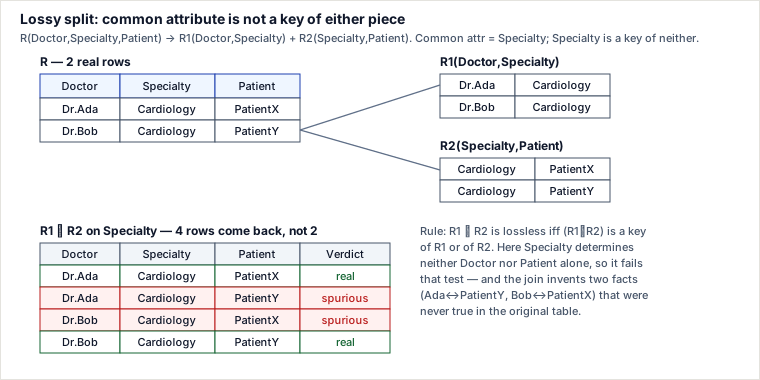
If neither holds, the common attribute can repeat with different partners on both sides, and the join cross-multiplies them into spurious tuples — rows that satisfy the join condition syntactically but were never true. Concretely:
| Doctor | Specialty | Patient |
|---|---|---|
| Dr.Ada | Cardiology | PatientX |
| Dr.Bob | Cardiology | PatientY |
Split this into R1(Doctor,Specialty) and R2(Specialty,Patient). The common attribute is Specialty. It is not a key of R1 (Cardiology doesn't determine a single doctor — Ada and Bob both practice it) and not a key of R2 (Cardiology doesn't determine a single patient either). So the lossless test fails on both sides, and joining R1 ⋈ R2 on Specialty gives back four rows, not two — it invents “Ada treats PatientY” and “Bob treats PatientX,” neither of which was ever recorded. Traced below:
Dependency-preserving, defined precisely
A decomposition {R1, …, Rk} is dependency-preserving if and only if the union of the FDs projected onto each Ri — call it F′ — logically implies every FD in the original set F (F′⁺ ⊇ F). Practically: for every FD X → Y in F, some single Ri must contain both X and Y so the FD is a plain key/uniqueness constraint on one table — checkable without ever joining. If no such Ri exists, that FD becomes a cross-table integrity rule the database can only enforce by physically joining tables on every write. In practice that check is expensive enough that it is often simply not implemented, and the constraint silently rots — the schema looks clean but a real business rule is no longer enforced anywhere.
The #1 BCNF interview point: BCNF can lose what 3NF always keeps
BCNF is strictly stricter than 3NF: it demands that every determinant of every non-trivial FD be a superkey, full stop. 3NF has one carve-out — a violating FD is still allowed if its right-hand side is a prime attribute (part of some candidate key). That single carve-out is the whole story: it is exactly what lets 3NF always be achieved losslessly and dependency-preservingly, while BCNF sometimes cannot achieve both at once. The canonical relation that proves it:
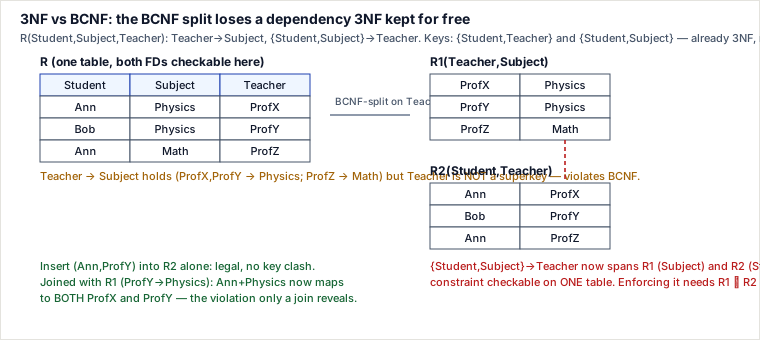
R(Student, Subject, Teacher) with FDs: Teacher → Subject (each teacher teaches one subject) and {Student, Subject} → Teacher (a student taking a subject sees one specific teacher — a subject can have more than one teacher, each with a different roster of students).
| Student | Subject | Teacher |
|---|---|---|
| Ann | Physics | ProfX |
| Bob | Physics | ProfY |
| Ann | Math | ProfZ |
Step 1 — find the candidate keys. {Student,Teacher} determines Subject (via Teacher→Subject) so it determines everything, and it's minimal (drop either half and it stops determining Teacher/Subject) — a candidate key. {Student,Subject} determines Teacher directly (given), hence everything, and it's also minimal — a second candidate key. So R has two overlapping candidate keys: {Student,Teacher} and {Student,Subject}.
Step 2 — check 3NF. Take the violating-looking FD Teacher → Subject: Teacher alone is not a superkey. But 3NF's carve-out asks one more question — is Subject prime (part of some candidate key)? Yes: Subject sits inside {Student,Subject}. So this FD satisfies 3NF's exception clause. The other FD, {Student,Subject}→Teacher, has a determinant that already is a candidate key, so it trivially satisfies 3NF too. R is already in 3NF, no decomposition needed, both FDs stay checkable on this one table.
Step 3 — check BCNF. BCNF has no prime-attribute exception. Teacher → Subject has a determinant (Teacher) that is not a superkey — full stop, this violates BCNF. To reach BCNF you must decompose on it.
Step 4 — decompose and watch the dependency disappear. Split on Teacher → Subject: R1(Teacher,Subject) and R2(Student,Teacher). Both are individually in BCNF now. But {Student,Subject} → Teacher needed Subject and Student in the same table to even state — and Subject now lives only in R1 while Student lives only in R2. The FD cannot be written as a key/uniqueness constraint on either table alone. Concretely: inserting (Ann, ProfY) into R2 is perfectly legal on its own (no key clash in R2) — but R1 says ProfY→Physics, so after any join, Ann+Physics now maps to both ProfX and ProfY, violating the original rule. Neither table's own constraints ever caught it; only a join would. Dependency preservation is lost.
3NF synthesis: why 3NF is always achievable losslessly AND dependency-preservingly
The 3NF synthesis algorithm (Bernstein) is mechanical and always succeeds where BCNF sometimes cannot:
- Compute a minimal (canonical) cover of F: single attribute on every right-hand side, no redundant left-hand-side attributes, no FD implied by the others.
- Group the FDs by identical determinant (left-hand side) X. Each group becomes one synthesized relation schema Ri = X ∪ {every right-hand side in that group}.
- If none of the synthesized Ri already contains a full candidate key of the original R, add one more schema consisting of just that candidate key.
Why it's always lossless: the added (or already-present) key schema ties every other synthesized table back to a superkey of the whole relation, so the natural join across all the Ri is guaranteed to reconstruct R exactly — this is the content of the 3NF-synthesis correctness theorem.
Why it's always dependency-preserving: every FD in the minimal cover is, by construction, fully contained — determinant and dependent together — inside the one Ri built from its own group. Every FD is therefore a single-table key/uniqueness check; nothing is ever split across tables.
Why BCNF can't promise the same: the BCNF algorithm repeatedly finds a violating FD X→Y (X not a superkey) and splits into (X∪Y) and (R−Y)∪X — a purely local fix aimed only at killing that one violation. It has no mechanism for keeping every other FD's determinant and dependent together, and (as traced above) sometimes no dependency-preserving BCNF decomposition exists at all for a given relation. 3NF's prime-attribute exception is precisely the safety valve that avoids this trap — it tolerates one specific, provably-harmless shape of redundancy (a determinant that overlaps a key) so it never has to give up the join-free guarantee.
5NF and join dependencies: when even 3-way splitting is required
4NF and 5NF exist for a different failure than anything above: not two attributes tangled by an FD, but three (or more) independent facts that only make sense together, expressed as a join dependency (JD). The classic case — an Agent who represents a Company, a Company that makes a Product, and the Agent selling that Product, governed by the business rule: an (Agent,Company,Product) combination is valid only if Agent represents Company, Company makes Product, and Agent sells Product, all three independently true. That's a genuine 3-way constraint, not implied by any single candidate key.
Three independently-true source facts (each asserted on its own, not derived from any single combined table): A1 represents both C1 and C2; C1 makes only P1, C2 makes P1 and P2; A1 sells only P1:
| R12(Agent,Company) |
|---|
| (A1,C1) |
| (A1,C2) |
| R23(Company,Product) |
|---|
| (C1,P1) |
| (C2,P1) |
| (C2,P2) |
| R13(Agent,Product) |
|---|
| (A1,P1) |
The “ground truth” — the (Agent,Company,Product) triples consistent with all three facts holding simultaneously — is recovered only by the 3-way natural join of R12, R23 and R13, not by projecting any single table:
| Agent | Company | Product |
|---|---|---|
| A1 | C1 | P1 |
| A1 | C2 | P1 |
Join any two of the three facts and a spurious row appears. R12 ⋈ R23 on Company gives (A1,C1,P1), (A1,C2,P1), and (A1,C2,P2) — but A1 never sells P2, so that third row is invented. Now bring in the third fact R13 = {(A1,P1)} as a filter: keep only rows whose (Agent,Product) pair appears there. (A1,C2,P2) → is (A1,P2) in R13? No — discarded. What's left, (A1,C1,P1) and (A1,C2,P1), is exactly the ground truth shown above. No pair of the three facts reconstructs the ground truth correctly on its own; all three together do. A relation with this shape needs a genuine 3-way (or n-way) split to remove all redundancy without inventing facts — that is what 5NF / Project-Join Normal Form requires: every join dependency the relation satisfies must be implied by its candidate keys, or the relation isn't in 5NF yet.
Normalization at scale, NULLs, and key choice
Normalization vs. query planning. Every normal form you add is another table a query planner may need to join to answer a question, and every join costs planning time, I/O, and (on a bad plan) a full scan. Deliberate denormalization — a wide read-model table, a materialized view, a precomputed rollup — buys back that read cost by re-introducing redundancy on purpose. The number that should decide it is your read:write ratio on that specific hot path: a path read 10,000× more than it's written can amortize the write-time cost of keeping a redundant copy in sync over an enormous number of cheap reads. A write-heavy or correctness-critical path (money, inventory, identity) has the ratio backwards — keep it normalized, because the win from removing joins doesn't cover the cost of every write now needing to keep N copies consistent, and drift there is expensive to be wrong about.
NULLs as a normalization signal. A column that is NULL for most rows is frequently a symptom, not a data-quality nuisance — it usually means an optional fact was crammed into a table it doesn't unconditionally belong to (e.g. a ManagerBonus column that's NULL for every non-manager row belongs in its own table keyed by the employees who actually have one). FD theory itself assumes non-null determinants: under 3-valued logic NULL ≠ NULL, so a determinant column that can be NULL can't be reliably checked for the equality an FD requires — which is exactly why primary keys must be NOT NULL (entity integrity), and why a nullable foreign key is usually a sign the relationship is optional and belongs in a separate table joined only when present.
Surrogate keys don't change the normal form. Swapping a table's exposed primary key from a natural key (e.g. CountryCode) to a surrogate auto-increment id changes nothing about which FDs hold or which normal form the schema satisfies — the surrogate is just a new candidate key that happens to be in 1:1 correspondence with the natural one; the closure of functional dependencies, and therefore the anomaly analysis, is identical either way.
Pitfalls
- “It's in 3NF” ≠ “it's anomaly-free.” With overlapping candidate keys (the Student/Subject/Teacher shape), a 3NF table can still have a determinant that isn't a superkey. Always separately check BCNF before declaring a schema clean.
- Assuming any relation has a dependency-preserving BCNF decomposition. It provably doesn't always exist. If you decompose to BCNF and lose a dependency, you must compensate — a trigger, an application-layer check, or a periodic join-based audit — or knowingly accept the risk.
- Confusing lossless with correct. A decomposition can be lossless (it reconstructs exactly the rows that existed) while still allowing an update that violates a dependency the schema no longer states anywhere — losslessness is about read-back fidelity, not write-time correctness.
- Chasing 4NF/5NF on relations that don't actually have that business rule. Splitting tables for a multi-valued or join dependency that isn't real costs joins for zero anomaly benefit — verify the JD is a genuine constraint of the domain, not a guess from today's data shape.
- Deriving an FD from a sample of data instead of the business rule. A column that happens to be unique or NULL-heavy in today's dataset is not the same as a real determinant — FDs are a property of the domain, not a coincidence of the current rows.
- Denormalizing before measuring. Copying columns for a “hot path” that was never actually measured pays write-amplification for a read that wasn't the real bottleneck.
Judgment layer: BCNF vs 3NF, and when to denormalize
BCNF vs 3NF — when dependency preservation is the deciding factor: choose 3NF-via-synthesis when every business rule must be enforceable as a cheap single-table constraint (a unique index or key) with no cross-table trigger or application-level check — the default for write-heavy OLTP where correctness has to be cheap to verify on every write. Choose BCNF when eliminating every redundancy-driven anomaly is the overriding goal and you can tolerate pushing one rare dependency's enforcement into application logic or a trigger — more defensible when the relation is read-mostly, or the “lost” dependency is low-risk to violate in practice. The trade-off in one line: BCNF buys a stronger structural guarantee (zero anomalies from any determinant); 3NF buys a stronger operational guarantee (every rule is always locally checkable).
Normalized OLTP schema vs. a materialized read model: prefer keeping the normalized tables as the source of truth and layering a denormalized read model on top (materialized view, CDC-fed read table) over hand-copying columns into base tables — the engine, not your application code, then owns keeping the copy consistent, at the cost of refresh compute and bounded staleness.
Decide like this: default to 3NF (synthesis-guaranteed) for anything transactional; reach for BCNF specifically when you've identified redundancy that 3NF's prime-attribute exception is letting through and you can afford to enforce the remaining dependency elsewhere; denormalize only a measured hot read path, and prefer a materialized view over a hand-maintained copy whenever your engine supports it.
Takeaways
- Lossless-join is a precise test — the common attribute of a decomposition must be a key of at least one side — not a vibe; fail it and a join invents rows that were never true.
- 3NF's exception for prime attributes is exactly what lets 3NF-via-synthesis always be both lossless and dependency-preserving; BCNF drops that exception for a stronger anomaly guarantee and can, in trade, lose a dependency's single-table checkability — memorize the Student/Subject/Teacher case as the canonical proof.
- 5NF exists only for genuine n-way join dependencies where no 2-way split reconstructs the data without inventing rows; most schemas never need to go past BCNF/3NF.
- Read:write ratio, not dogma, should decide normalize-vs-denormalize at scale; NULLs are often a normalization smell, and swapping a natural key for a surrogate key never changes the normal form.
Related pages
- Introduction to Normalization — the 1NF→2NF→3NF anomaly walk this deep dive assumes as background.
- Boyce-Codd Normal Form (BCNF) — the baseline BCNF definition this page's 3NF-vs-BCNF trade-off builds on.
- Higher Normal Forms (4NF, 5NF) — the 4NF/multi-valued-dependency ground this page's 5NF join-dependency section extends.
- Functional Dependency — Closure Complexity, Minimal Cover, Finding All Candidate Keys & Real Enforcement (Deep Dive) — the closure/minimal-cover machinery the 3NF synthesis algorithm here relies on.
- Data Modeling — The Denormalization Decision & Write-vs-Read Cost Framing (Deep Dive) — the read:write-ratio framework this page's denormalization section applies.
Sources: E. F. Codd's original relational-model and normal-form papers (1970–1972); C. J. Date, An Introduction to Database Systems (lossless-join and dependency-preservation definitions); Silberschatz, Korth & Sudarshan, Database System Concepts (BCNF vs. 3NF trade-off, the Student/Subject/Teacher-style example, 3NF synthesis algorithm); Elmasri & Navathe, Fundamentals of Database Systems (multi-valued/join dependencies, the Agent/Company/Product 5NF example); R. Fagin's original papers on multivalued dependencies and Project-Join Normal Form (4NF, 5NF); P. Bernstein, “Synthesizing Third Normal Form Relations from Functional Dependencies” (1976). Re-authored/Deepened for this guide.
🤖 Don't fully get this? Learn it with Claude
Stuck on Normalization — 3NF vs BCNF Dependency-Preservation, Lossless Join, Synthesis & 5NF (Deep Dive)? Open Claude, copy a block below, and it'll teach you this exact concept — visually and interactively.
Build the mental picture, not memorization.
I just read a lesson on **Normalization — 3NF vs BCNF Dependency-Preservation, Lossless Join, Synthesis & 5NF (Deep Dive)** (Databases) and want to truly understand it. Explain Normalization — 3NF vs BCNF Dependency-Preservation, Lossless Join, Synthesis & 5NF (Deep Dive) from first principles using ONE vivid real-world analogy and a visual mental model — draw it as ASCII art or a clear step-by-step diagram — with a concrete example using real numbers. Then ask me one question to check I got the mental picture, and wait for my reply. If you're unsure or a claim isn't standard, say so and reason from first principles instead of guessing.
Socratic — adapts to where you're stuck.
Teach me **Normalization — 3NF vs BCNF Dependency-Preservation, Lossless Join, Synthesis & 5NF (Deep Dive)** interactively. Ask me ONE guiding question at a time, wait for my answer, and adapt to my confusion — build the idea with me step by step instead of explaining it all at once. If you're unsure or a claim isn't standard, say so and reason from first principles instead of guessing.
Active recall exposes what you missed.
Quiz me on **Normalization — 3NF vs BCNF Dependency-Preservation, Lossless Join, Synthesis & 5NF (Deep Dive)** with 5 questions, easy to tricky, ONE at a time. Tell me if each answer is right; at the end, explain clearly what I got wrong and why. If you're unsure or a claim isn't standard, say so and reason from first principles instead of guessing.
Intuition + hook + flashcards for long-term memory.
Help me remember **Normalization — 3NF vs BCNF Dependency-Preservation, Lossless Join, Synthesis & 5NF (Deep Dive)** for the long term: give the one-sentence intuition, a memorable hook/mnemonic, a tiny worked example, and 3 active-recall flashcards (Q -> A). If you're unsure or a claim isn't standard, say so and reason from first principles instead of guessing.