Higher Normal Forms (4NF, 5NF)
4NF and 5NF: beyond functional dependencies
1NF–BCNF are all about functional dependencies. 4NF and 5NF address two subtler problems. (The earlier
version's "5NF" example used Course → Instructor — that's a functional dependency, i.e. a
BCNF issue, not a 4NF/5NF one. Here are correct examples.)
4NF — Eliminate Multivalued Dependencies (MVDs)
An MVD X →→ Y states that for a given value of X, there is a set of associated Y values, and this set is completely independent of other columns in the table. When a single table records two independent multivalued facts about the same key, we are forced to store the Cartesian product of those facts. This leads to redundancy and severe anomalies.
Worked Example: The Student-Course-Hobby Table
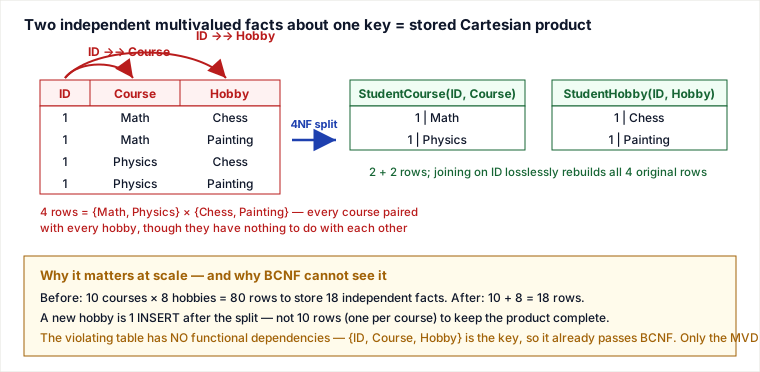
Consider the table Student(ID, Course, Hobby), where a student's courses and hobbies are completely unrelated, but they are both multi-valued attributes of the student:
| ID | Course | Hobby |
|---|---|---|
| 1 | Math | Chess |
| 1 | Math | Painting |
| 1 | Physics | Chess |
| 1 | Physics | Painting |
4NF Anomalies in Action:
- Insertion Anomaly: If student 1 starts a new hobby (e.g., "Cooking"), we cannot simply insert a single row. We must insert two rows:
(1, 'Math', 'Cooking')and(1, 'Physics', 'Cooking')to keep the Cartesian product complete. If they took 10 courses, we would have to insert 10 rows! - Update Anomaly: If student 1's hobby "Chess" changes to "Go", we must locate and update multiple rows:
(1, 'Math', 'Chess')and(1, 'Physics', 'Chess'). Missing one corrupts the independent nature of the facts. - Deletion Anomaly: If student 1 drops "Physics" and "Math", deleting those rows will also completely erase the fact that student 1 plays "Chess" and "Painting".
4NF Solution: Decompose the table into two separate tables: StudentCourse(ID, Course) (2 rows) and StudentHobby(ID, Hobby) (2 rows). Joining these tables losslessly reproduces the original relation without redundant storage.
When 4NF matters — and when BCNF is enough
Notice something uncomfortable about the violating table: it has no functional dependencies at all. The only key is the whole heading {ID, Course, Hobby}, and no proper subset determines anything — so the table already satisfies BCNF perfectly. That is the entire reason 4NF exists: MVD redundancy is invisible to every FD-based normal form. If your habit is "I checked BCNF, I'm done," this is exactly the case that habit misses.
In practice you rarely build this table on purpose. It appears in two recognizable situations:
- Merging two one-to-many exports about the same entity into one wide table — the classic ETL/staging shortcut ("students with their courses AND their hobbies in one sheet").
- Bolting a second multivalued attribute onto an existing junction table instead of giving it its own table ("we already have StudentCourse, just add a Hobby column").
The design rule that keeps you in 4NF for free: every independent one-to-many fact gets its own two-column table from the start. If courses and hobbies are unrelated, no schema should ever place them in the same row — do that and you never need to check for MVDs at all, which is why most working schemas are in 4NF without anyone having named it.
When NOT to decompose: 4NF only applies when the two facts are genuinely independent. If the table actually records a real three-way fact — say, "the student uses hobby X for course Y's elective project," so specific (Course, Hobby) pairs are meaningful — then there is no MVD, the row (1, Math, Chess) says something the split tables cannot, and "decomposing" would destroy information. Independence is a business rule, verified with the domain owner, not something you can read off sample rows — exactly like an FD.
5NF (PJ/NF) — Eliminate Join Dependencies
A relation is in 5NF if and only if every join dependency (JD) in the relation is implied by its candidate keys. 5NF handles the edge case where a table cannot be losslessly decomposed into two tables, but can be losslessly decomposed into three (or more) tables.
Worked Example: Supplies(Supplier, Part, Project)
Consider the table Supplies under the following constraint rule: "If Supplier S supplies Part P, and Part P is used by Project J, and Supplier S supplies Project J, then S must supply Part P for Project J."
Let's look at a valid state of the Supplies table:
| Supplier | Part | Project |
|---|---|---|
| S1 | P1 | J1 |
| S2 | P1 | J1 |
| S1 | P2 | J1 |
| S1 | P1 | J2 |
The Pitfall of Two-Way Decomposition (Lossy Join)
If we try to split Supplies into only two tables, say SP(Supplier, Part) and PJ(Part, Project), and then join them back, we get a lossy join (it invents fake/spurious rows):
| Supplier | Part | Project | Status |
|---|---|---|---|
| S1 | P1 | J1 | Valid |
| S1 | P1 | J2 | Valid |
| S2 | P1 | J1 | Valid |
| S2 | P1 | J2 | SPURIOUS TUPLE! S2 does not supply J2! |
| S1 | P2 | J1 | Valid |
The Three-Way Decomposition (Lossless Join)
To split this losslessly, we must decompose into three binary tables:
SP(Supplier, Part): S1-P1, S2-P1, S1-P2PJ(Part, Project): P1-J1, P1-J2, P2-J1SJ(Supplier, Project): S1-J1, S2-J1, S1-J2
Joining SP and PJ yields the table with the spurious row (S2, P1, J2). But when we join that intermediate result with SJ on (Supplier, Project), the spurious row is filtered out because the pair (S2, J2) does not exist in SJ. The join of all three is lossless.
By decomposing into these three tables, we satisfy 5NF and eliminate the redundancy and update anomalies associated with this multi-way constraint.
Honestly: how often does 5NF bite?
Rarely — and it is worth being precise about why. The violation only exists when a cyclic business rule like the one above ("if S supplies P, P is used by J, and S supplies J, then S supplies P to J") actually holds in the domain, and such rules are genuinely uncommon. Without that rule, the ternary Supplies table is already in 5NF as it stands — and decomposing it would be a bug, because the three binary projections could no longer tell you which supplier ships which part to which project. Worse, no tool can detect the constraint for you: join dependencies live in the business rules, not in the data, so 5NF analysis is a conversation, not a query.
The practical residue to keep: when someone proposes replacing a three-way junction table with two or three pairwise ones "to save rows," run the reconstruction test — join the pieces back and check for invented combinations like (S2, P1, J2) above. If spurious tuples appear, the pairwise split is lossy and the ternary table was correct. That lossless-join check is the one 5NF skill that shows up in real schema reviews.
Takeaways
- An FD-based anomaly (e.g.,
Course → Instructor) is a BCNF issue, not 4NF/5NF. - 4NF: Splits independent multivalued facts (MVDs) so you do not store their Cartesian product.
- 5NF: Splits a relation with a cyclic join dependency (like the 3-way SPJ case) that is not implied by candidate keys.
Re-authored for correctness and clarity. MVD & JD definitions per Date, "An Introduction to Database Systems". See also: BCNF, Functional Dependency.
🤖 Don't fully get this? Learn it with Claude
Stuck on Higher Normal Forms (4NF, 5NF)? Open Claude, copy a block below, and it'll teach you this exact concept — visually and interactively.
Build the mental picture, not memorization.
I just read a lesson on **Higher Normal Forms (4NF, 5NF)** (Databases) and want to truly understand it. Explain Higher Normal Forms (4NF, 5NF) from first principles using ONE vivid real-world analogy and a visual mental model — draw it as ASCII art or a clear step-by-step diagram — with a concrete example using real numbers. Then ask me one question to check I got the mental picture, and wait for my reply. If you're unsure or a claim isn't standard, say so and reason from first principles instead of guessing.
Socratic — adapts to where you're stuck.
Teach me **Higher Normal Forms (4NF, 5NF)** interactively. Ask me ONE guiding question at a time, wait for my answer, and adapt to my confusion — build the idea with me step by step instead of explaining it all at once. If you're unsure or a claim isn't standard, say so and reason from first principles instead of guessing.
Active recall exposes what you missed.
Quiz me on **Higher Normal Forms (4NF, 5NF)** with 5 questions, easy to tricky, ONE at a time. Tell me if each answer is right; at the end, explain clearly what I got wrong and why. If you're unsure or a claim isn't standard, say so and reason from first principles instead of guessing.
Intuition + hook + flashcards for long-term memory.
Help me remember **Higher Normal Forms (4NF, 5NF)** for the long term: give the one-sentence intuition, a memorable hook/mnemonic, a tiny worked example, and 3 active-recall flashcards (Q -> A). If you're unsure or a claim isn't standard, say so and reason from first principles instead of guessing.