Introduction to Normalization
Normalization is not "split tables until it looks tidy." It is a mechanical response to functional dependencies that the key structure fails to respect: when a fact is determined by something other than a key (or only part of a key), that fact gets repeated on every row that shares the determinant — and insert, update, and delete anomalies become structural, not accidental. Normalization rewrites the schema so each independent fact lives in exactly one place, with a key that actually determines it.
The payoff is integrity under change. You trade some join cost on reads for the guarantee that renaming a course, changing an instructor, or deleting an enrollment cannot invent contradictory copies or erase unrelated facts. That is the theory→practice bridge: FDs diagnose the redundancy; normal forms are the repair rules; lossless join and dependency preservation decide whether the repair is still a correct database.
Why Normalize? (Anomalies in Action)
Without normalization, databases suffer from data redundancy, which triggers three major types of operational anomalies. Consider the following unnormalized table tracking student course enrollments:
| Student_ID | Student_Name | Course_ID | Course_Name | Instructor |
|---|---|---|---|---|
| 101 | Asha | CS101 | Intro to CS | Dr. Smith |
| 102 | Ravi | CS101 | Intro to CS | Dr. Smith |
| 103 | Jane | CS102 | Databases | Dr. Jones |
The key is composite: {Student_ID, Course_ID}. But the data obeys stronger FDs than that key alone would suggest:
Student_ID → Student_Name(partial: name depends on only half the key)Course_ID → Course_Name, Instructor(partial: course facts depend on only half the key)
- Update Anomalies: If the instructor for
CS101changes from Dr. Smith to Dr. Davis, we must locate and update every single row whereCS101appears. If we update Ravi's row but miss Asha's, the database enters an inconsistent state, showing two different instructors for the exact same course. - Insertion Anomalies: Suppose the department introduces a new course
CS103(Algorithms) taught by Dr. Alan. BecauseStudent_IDis part of the table's identity/key, we cannot record this new course in the table until at least one student enrolls. We cannot setStudent_IDto NULL if it is part of the primary key. - Deletion Anomalies: If Jane (ID
103) drops the classCS102, we must delete her row. However, doing so completely deletes the fact thatCS102exists and that it is taught by Dr. Jones. Deleting student data should not cause the loss of course metadata.
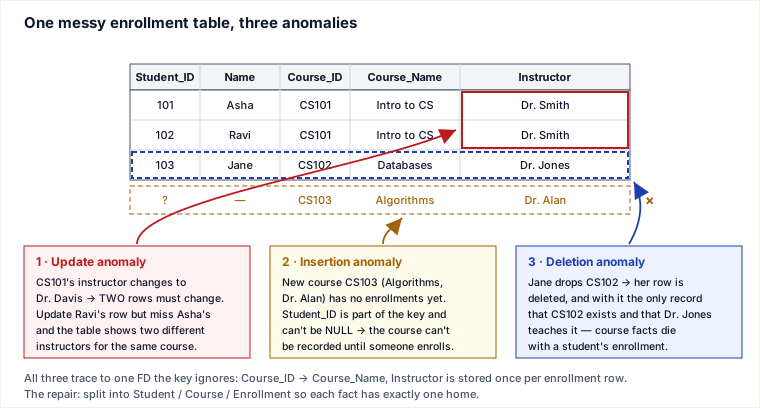
The 2NF repair is mechanical: put each partial determinant in its own table — Student(Student_ID, Student_Name), Course(Course_ID, Course_Name, Instructor), Enrollment(Student_ID, Course_ID) — reconnect with foreign keys. Course facts now update in one row; a course can exist with zero enrollments; dropping Jane's enrollment cannot erase CS102.
Normal Forms — the ladder (what each forbids)
Each normal form is a stricter rule about which FDs a legal key structure may leave lying around. Higher forms presuppose lower ones.
| Form | Requirement (informal) | Anomaly class it removes |
|---|---|---|
| 1NF | Every cell is a single atomic value; no repeating groups | Cannot query, index, or delete one fact inside a crammed multi-value cell |
| 2NF | 1NF + no non-key attribute depends on only part of a composite key | Partial-dependency redundancy (course name repeated per student-enrolled row) |
| 3NF | 2NF + no non-key attribute depends transitively on the key through another non-key | Transitive redundancy (department location repeated per employee via Dept_ID) |
| BCNF | Every determinant of every non-trivial FD is a superkey (no prime-attribute exception) | The residual redundancy 3NF still tolerates when keys overlap |
| 4NF / 5NF | No independent multi-valued facts cross-multiplied; join dependencies implied by keys | Cartesian-product MVDs; cyclic n-way business rules inventing spurious rows |
The formal tests, worked decompositions, and the classic 3NF vs BCNF dependency-preservation trade-off are owned by the dedicated pages that follow. Two properties every decomposition must earn:
- Lossless-join — natural-joining the pieces reconstructs the original relation exactly (no rows lost, none invented). For a two-way split, the shared attributes must be a key of at least one side.
- Dependency-preserving — every original FD can still be checked as a key/uniqueness constraint on a single table, without joining on every write. BCNF can lose this; 3NF synthesis always keeps both lossless and dependency-preserving.
When NOT to normalize further
Normalization is the default for transactional write-heavy schemas. Deliberately stop short when:
- Read path is proven hot and join cost is measured — denormalize that path (with a trigger, MV, or refresh job that owns consistency), not every table "just in case."
- The "duplicate" is a different fact — e.g.
order_line.unit_priceis the price-at-sale, not a stale copy of catalog price; freezing history is not a 3NF violation. - Analytics / OLAP — star schemas and wide fact tables accept controlled redundancy for scan and aggregation speed; the anomaly risk is managed by append-mostly pipelines, not by OLTP-style keys.
Normalize first until every independent fact has one home; relax only against a named query and a plan for keeping copies correct.
Takeaways
- Anomalies are symptoms of FDs the key structure fails to respect — not vague "bad design."
- Normal forms form a ladder: 1NF (atomic cells) → 2NF (no partial deps) → 3NF (no transitive deps) → BCNF (every determinant a superkey) → 4NF/5NF (MVDs and join deps).
- A good decomposition is lossless and ideally dependency-preserving; BCNF may force you to choose between full anomaly freedom and easy single-table FD enforcement.
- Denormalize only against measured read cost, with an automatic sync story — never as a first move.
🎯 STANDOUT elevation: Why / example / when-not / failure / panel / drills — Introduction to Normalization
Why this exists / the decision it encodes
Normalization is a mechanical repair for FDs the key structure fails to respect. Redundancy is not "untidy columns" — it is the same fact determined by a non-key (or part of a composite key) and thus repeated on every matching row. NFs are ordered forbids; lossless-join and dependency-preservation decide whether the repair remains a correct database.
Worked example with numbers or traced SQL/FD
Enrollment flat PK {Student_ID, Course_ID}:
  Student_ID → Student_Name   (partial)
  Course_ID → Course_Name, Instructor  (partial)
CS101 instructor change: must update every enrollment row or Asha/Ravi disagree.
2NF split:
  Student(Student_ID, Name)
  Course(Course_ID, Name, Instructor)
  Enrollment(Student_ID, Course_ID)
Lossless: shared attrs are keys of sides. Dep-preserving: each FD local to one table.
BCNF may force dep-preservation loss; 3NF synthesis keeps both properties.
When NOT / named alternative
Do not normalize further when the "duplicate" is a different fact (order_line.unit_price at sale). Do not denormalize first "because joins are slow" — measure, then denorm with a sync owner. OLAP star schemas intentionally accept redundancy under append-mostly pipelines.
Failure mode / ops fingerprint / interview trap
Interview trap: "normalize until 3NF always" without stating BCNF trade-off or lossless test. Ops: cascade of inconsistency from partial updates on partially-dependent columns in mega-tables.
Domain judgment (K11 theory-bridge / K12 concurrency / K13 query-judgment)
K11: FDs diagnose; NF rules repair; lossless/dep-preservation are the engineering acceptance tests. This is pure theory→practice bridge.
Hostile-panel drills (with model answers)
Q1. State 2NF and 3NF in one line each.
Model answer: 2NF: 1NF + no non-key attr depends on only part of a composite key. 3NF: 2NF + no non-key attr depends transitively on the key via another non-key.
Q2. What does lossless-join require for a two-way split?
Model answer: The attributes shared by both pieces must be a key of at least one piece so natural join neither loses nor invents rows.
Q3. When might you prefer 3NF over BCNF?
Model answer: When BCNF decomposition loses dependency preservation — you cannot enforce an FD as a single-table constraint without joining on every write; 3NF keeps both lossless and dep-preserving.
🤖 Don't fully get this? Learn it with Claude
Stuck on Introduction to Normalization? Open Claude, copy a block below, and it'll teach you this exact concept — visually and interactively.
Build the mental picture, not memorization.
I just read a lesson on **Introduction to Normalization** (Databases) and want to truly understand it. Explain Introduction to Normalization from first principles using ONE vivid real-world analogy and a visual mental model — draw it as ASCII art or a clear step-by-step diagram — with a concrete example using real numbers. Then ask me one question to check I got the mental picture, and wait for my reply. If you're unsure or a claim isn't standard, say so and reason from first principles instead of guessing.
Socratic — adapts to where you're stuck.
Teach me **Introduction to Normalization** interactively. Ask me ONE guiding question at a time, wait for my answer, and adapt to my confusion — build the idea with me step by step instead of explaining it all at once. If you're unsure or a claim isn't standard, say so and reason from first principles instead of guessing.
Active recall exposes what you missed.
Quiz me on **Introduction to Normalization** with 5 questions, easy to tricky, ONE at a time. Tell me if each answer is right; at the end, explain clearly what I got wrong and why. If you're unsure or a claim isn't standard, say so and reason from first principles instead of guessing.
Intuition + hook + flashcards for long-term memory.
Help me remember **Introduction to Normalization** for the long term: give the one-sentence intuition, a memorable hook/mnemonic, a tiny worked example, and 3 active-recall flashcards (Q -> A). If you're unsure or a claim isn't standard, say so and reason from first principles instead of guessing.