Overview of Relational Databases
A relational database stores all data as flat tables of rows and columns, and expresses every relationship between records not with pointers but by storing a matching value in two tables — so the engine can reconstruct any connection at query time by comparing values, and you are free to add, reorder, or index data without ever rewiring links. This indirection-through-values is the whole idea Edgar F. Codd published in 1970 ("A Relational Model of Data for Large Shared Data Banks"): a record is found by what it says, not by where it sits.
The vocabulary is precise, and you will see both the math term and the everyday term used interchangeably:
- A relation is a table — formally an unordered set of rows, so there is no "first" or "last" row.
- A tuple is a row — one complete record (one customer, one order).
- An attribute is a column — a named, typed field that the same kind of value fills for every row.
- A primary key (PK) is the attribute (or set of attributes) whose value uniquely identifies a row; the engine enforces that it is never duplicated and never null.
- A foreign key (FK) is an attribute in one table that holds the primary-key value of a row in another table — this is the stored matching value that is the relationship.
The mechanism on real rows: a join
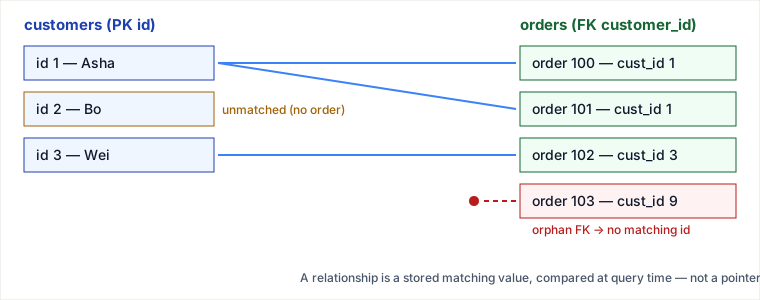
Two tables. customers has primary key id. orders has its own primary key id and a foreign key customer_id that holds a customers.id value. Nothing physically links a customer to their orders — the link is the repeated number.
customers
| id (PK) | name | city |
|---|---|---|
| 1 | Asha | Chennai |
| 2 | Bo | Berlin |
| 3 | Wei | Singapore |
orders
| id (PK) | customer_id (FK) | amount |
|---|---|---|
| 100 | 1 | 40 |
| 101 | 1 | 15 |
| 102 | 3 | 90 |
| 103 | 9 | 25 |
Now run this query and trace exactly what the engine does, row by row:
SELECT c.name, o.id, o.amount
FROM customers c
JOIN orders o ON o.customer_id = c.id;
An inner join walks the orders rows and, for each, looks for the customers row whose id equals that order's customer_id. It keeps a pair only when a match is found:
- Order 100,
customer_id = 1→ matches customer 1 (Asha). Emit(Asha, 100, 40). - Order 101,
customer_id = 1→ matches customer 1 (Asha) again. Emit(Asha, 101, 15). - Order 102,
customer_id = 3→ matches customer 3 (Wei). Emit(Wei, 102, 90). - Order 103,
customer_id = 9→ no customer has id 9. The inner join emits nothing for this row; it silently disappears from the result. - Customer 2 (Bo) has no order at all → never appears, because the join is driven by matches, not by the customer list.
Result of the join:
| name | o.id | amount |
|---|---|---|
| Asha | 100 | 40 |
| Asha | 101 | 15 |
| Wei | 102 | 90 |
If we instead execute a LEFT JOIN (Left Outer Join) to find all customers regardless of whether they have placed an order:
SELECT c.name, o.id, o.amount
FROM customers c
LEFT JOIN orders o ON o.customer_id = c.id;
The engine preserves every customer from the left-hand table. Because customer 2 (Bo) has no matching rows in orders, the columns from orders are filled with NULL (the orphan order 103 is still excluded since it is on the right side):
| name | o.id | amount |
|---|---|---|
| Asha | 100 | 40 |
| Asha | 101 | 15 |
| Bo | NULL | NULL |
| Wei | 102 | 90 |
Two facts fall straight out of this trace and matter in production: order 103 vanished because its FK was an orphan (it points at a customer that does not exist), and Bo vanished because an inner join only keeps matched pairs. If you wanted "every customer, even those with zero orders," you would need a LEFT JOIN customers c ... ON ..., which keeps every left-side row and fills the order columns with NULL when there is no match.
Why "matching value, not pointer" is the design
Because links are values rather than physical addresses, the engine is free to store rows anywhere, reorder them, cache them, or build a B-tree index on customers.id so the per-order lookup in the trace above costs O(log n) instead of a full scan. The same indifference to physical layout is what Codd called data independence: you can re-shape storage, add indexes, or move to faster disks and not one line of application SQL changes. It is also what lets the engine guarantee integrity declaratively — a PRIMARY KEY constraint rejects a duplicate id before it is written, and a FOREIGN KEY (customer_id) REFERENCES customers(id) constraint would have rejected order 103 outright, so the orphan never exists in the first place.
Pitfalls
- No foreign-key constraint → silent orphans. If you skip the
REFERENCESclause (common in MySQL with the MyISAM engine, or when people "add it later"), the database happily stores order 103. Reports under-count, inner joins drop rows, and the bug surfaces months later as "our revenue total is short." - Confusing inner and outer joins. The trace shows Bo disappearing. Writing an
INNER JOINwhen you meant "all customers including those with no orders" is one of the most common reporting bugs; the fix is aLEFT JOINplus handling the resulting NULLs. - NULL is not a value you can match on.
customer_id = NULLis never true (it is unknown), so a row with a NULL FK is dropped by an inner join and is invisible toWHERE customer_id = 9too. UseIS NULL. - Rows are a set, not a sequence. A query without
ORDER BYmay return rows in any order, and the order can change after a vacuum, an index rebuild, or a version upgrade. Never rely on insertion order. - Forgetting to index the join column. Joining a million orders to customers with no index on
customers.idturns each lookup into a scan — the query that ran in milliseconds in dev crawls in production.
Takeaways
- A relationship in a relational database is a repeated value (FK matching a PK), compared at query time — there are no pointers between records.
- A join materializes those relationships by matching values; an inner join keeps only matched pairs, so unmatched rows on either side silently vanish.
- Primary-key and foreign-key constraints are how you make integrity the database's job, not the application's — they would have caught the orphan order before it was written.
- Storing data as values rather than addresses buys data independence: indexes and physical layout can change underneath untouched SQL.
The common RDBMS implementations of this model include PostgreSQL and MySQL (open source), Oracle Database and Microsoft SQL Server (enterprise), and SQLite (embedded, single-file). They differ in features and tuning, but all of them resolve relationships by matching key values exactly as traced above.
Sources: E. F. Codd, "A Relational Model of Data for Large Shared Data Banks," Communications of the ACM, 1970 (the relation/tuple/attribute terminology and the value-based model). C. J. Date, An Introduction to Database Systems, for the set semantics of relations and the role of keys and constraints. PostgreSQL and SQLite documentation for inner vs. outer join behavior and foreign-key enforcement. Re-authored and deepened for this guide: added the value-not-pointer mechanism, a row-by-row join trace exercising primary/foreign keys (including an orphan FK and an unmatched customer), a hand-authored diagram, and engineer-level pitfalls.
🎯 STRICT STANDOUT: Why / worked / when-not / failure / drills — Overview of Relational Databases
Why this concept exists (judgment chain)
The relational model won because identity and relationships are values the engine can re-check, re-index, and re-plan — not fixed memory addresses. That single choice is why declarative integrity (PK/FK), optimizer freedom, and data independence are the same idea: compare matching values at query time.
Worked example with numbers or traced steps
customers: (1,Asha), (2,Bo), (3,Wei)
orders: (100,cust=1), (101,cust=1), (102,cust=3), (103,cust=9 orphan)

INNER JOIN ON customer_id = id:
  100→Asha, 101→Asha, 102→Wei; 103 dropped (orphan); Bo never appears.
LEFT JOIN customers←orders:
  same three matches + Bo with order cols NULL; 103 still absent (right-side orphan).

Production: without FK, revenue reports under-count when orphans appear;
without LEFT JOIN, “all customers” dashboards silently omit zero-order accounts.
When NOT to use / named alternative
Do not force relational joins for pure document/KV access patterns with no shared keys or multi-entity transactions — a document store may fit. Do not skip FKs “for speed” on write-heavy paths without an explicit integrity owner (app + async reconciler). Prefer INNER only when unmatched rows must vanish; prefer LEFT when zeros matter.
Failure / ops fingerprint
Fingerprint: JOIN totals < SUM of source amounts; missing-customers tickets that fix with LEFT JOIN; orphan FKs after bulk load with FKs disabled. Ops: alert on fk_violation_rate; run nightly orphan count WHERE NOT EXISTS parent; require FK or documented exception in schema review.
Hostile-panel drills (defend the decision)
Q1. Why store relationships as values instead of pointers?
Model answer: Physical independence: storage can re-pack, index, or move rows without rewriting links; integrity becomes a declarative constraint the engine enforces on write.
Q2. Trace: which rows vanish on INNER vs LEFT for the sample?
Model answer: INNER drops Bo (no orders) and order 103 (orphan FK). LEFT keeps Bo with NULLs; still drops 103 unless you reverse sides.
Q3. Defend enabling FOREIGN KEY on orders.customer_id under bulk load.
Model answer: Rejects orphans at insert; without it, silent orphans corrupt joins for months. Bulk path: disable carefully, load, re-enable with VALIDATE, fix rejects.
🤖 Don't fully get this? Learn it with Claude
Stuck on Overview of Relational Databases? Open Claude, copy a block below, and it'll teach you this exact concept — visually and interactively.
Build the mental picture, not memorization.
I just read a lesson on **Overview of Relational Databases** (Databases) and want to truly understand it. Explain Overview of Relational Databases from first principles using ONE vivid real-world analogy and a visual mental model — draw it as ASCII art or a clear step-by-step diagram — with a concrete example using real numbers. Then ask me one question to check I got the mental picture, and wait for my reply. If you're unsure or a claim isn't standard, say so and reason from first principles instead of guessing.
Socratic — adapts to where you're stuck.
Teach me **Overview of Relational Databases** interactively. Ask me ONE guiding question at a time, wait for my answer, and adapt to my confusion — build the idea with me step by step instead of explaining it all at once. If you're unsure or a claim isn't standard, say so and reason from first principles instead of guessing.
Active recall exposes what you missed.
Quiz me on **Overview of Relational Databases** with 5 questions, easy to tricky, ONE at a time. Tell me if each answer is right; at the end, explain clearly what I got wrong and why. If you're unsure or a claim isn't standard, say so and reason from first principles instead of guessing.
Intuition + hook + flashcards for long-term memory.
Help me remember **Overview of Relational Databases** for the long term: give the one-sentence intuition, a memorable hook/mnemonic, a tiny worked example, and 3 active-recall flashcards (Q -> A). If you're unsure or a claim isn't standard, say so and reason from first principles instead of guessing.