Relational Vs. Non-Relational Databases
The real split is not SQL vs. no-SQL or one big server vs. many small ones — it is how related data is laid out on disk: a relational engine normalizes data into separate tables and reconstructs answers at read time with joins and multi-row transactions, which are cheap on one node but require coordination once data is spread across machines; a NoSQL engine instead pre-groups everything a query needs into one self-contained unit (a document, a row keyed by partition, a value) so a read or write touches exactly one node — and then refuses or weakens the cross-unit joins and transactions that would force coordination.
Everything else in the comparison flows from that one decision. Both families can run on many servers; what differs is what each makes easy once they do.
Worked example: "show an order with its 3 line items and the customer's name"
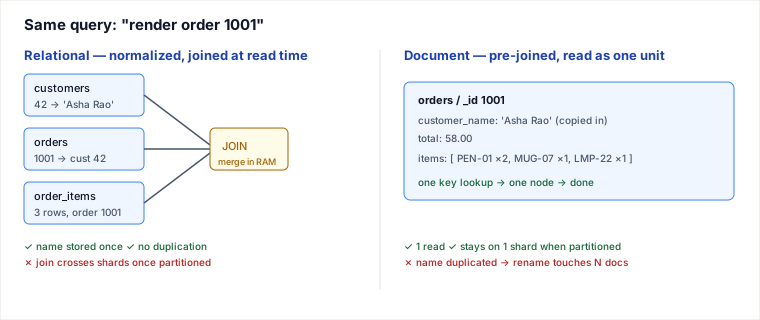
Take a tiny e-commerce dataset. The relational design normalizes it into three tables; the document design embeds the same facts into one order document.
Relational layout (PostgreSQL), normalized into 3 tables
customers:  id=42   name='Asha Rao'
orders:     id=1001 customer_id=42  total=58.00
order_items:                       (3 rows for order 1001)
            order_id=1001  sku='PEN-01'  qty=2  price=3.00
            order_id=1001  sku='MUG-07'  qty=1  price=12.00
            order_id=1001  sku='LMP-22'  qty=1  price=40.00
To render the order page you join across all three:
SELECT o.id, o.total, c.name, i.sku, i.qty, i.price
FROM orders o
JOIN customers  c ON c.id = o.customer_id
JOIN order_items i ON i.order_id = o.id
WHERE o.id = 1001;
On a single node this is fast: the planner uses the primary-key index on customers, the index on orders.id, and the index on order_items.order_id, then merges the matched rows in memory. The customer name 'Asha Rao' is stored once — update it in one place and every order reflects it.
Document layout (MongoDB), one self-contained order
{ "_id": 1001, "customer_id": 42, "customer_name": "Asha Rao", "total": 58.00,
  "items": [ { "sku": "PEN-01", "qty": 2, "price": 3.00 },
             { "sku": "MUG-07", "qty": 1, "price": 12.00 },
             { "sku": "LMP-22", "qty": 1, "price": 40.00 } ] }
db.orders.findOne({ _id: 1001 }) // one document, one node, no joinThe whole order page is one read of one document. The trade is now explicit: customer_name is duplicated into every order Asha ever placed. If she changes her name, you must rewrite N documents — the engine will not do it transactionally for you across all of them.
Step-by-step: what each engine pays
| Step | Relational (3 tables + join) | Document (1 embedded doc) |
|---|---|---|
| Read the order page | 3 index lookups + a join/merge, 1 node | 1 key lookup, 1 node |
| Add a line item | 1 INSERT into order_items | Rewrite the whole document (push into array) |
| Rename customer 42 | 1 UPDATE on customers — every order sees it | UPDATE every order doc holding customer_name |
| Total spend across all customers | One GROUP BY over normalized rows | Aggregation pipeline / map over many docs |
| Spread over 10 shards by customer_id | Join now crosses shards → network coordination | Order + its items live together → still 1 node |
Corrected comparison
The original table framed "vertical vs. horizontal scaling" as an intrinsic property and claimed NoSQL has "no query language." Both are wrong — see the corrected rows below.
| Feature | Relational (RDBMS) | Non-relational (NoSQL) |
|---|---|---|
| Schema | Fixed, declared up front; enforced on write | Flexible; shape enforced (if at all) by the app or on read |
| Data model | Normalized tables linked by keys | Document, key-value, wide-column, or graph |
| Query language | SQL (standardized, joins built in) | Has query languages — MQL, CQL (Cassandra), N1QL/SQL++, Cypher; many are SQL-like. The real loss is cheap cross-entity joins and multi-key transactions, not "a language." |
| Distribution / scaling | Both scale up and out. Postgres, MySQL, Spanner, CockroachDB shard and replicate. Cost: distributed joins & multi-shard transactions need coordination (2-phase commit, consensus). | Also runs on one node or many. Built to partition by key because the model avoids cross-shard joins — so adding nodes is cheaper, by giving up those operations. |
| Transactions | Strong ACID across many rows/tables in one transaction | Often per-key/per-document atomicity; multi-key ACID is limited or opt-in (e.g. Mongo multi-doc txns, DynamoDB TransactWrite) |
| Consistency model | Typically strong/serializable by default | Often tunable — BASE / eventual by default, stronger on request |
| Best fit | Many entities related many ways, ad-hoc queries, money: ledgers, ERP, CRM | One dominant access pattern, huge volume, denormalizable: sessions, feeds, catalogs, IoT, telemetry |
Why the naive "vertical vs. horizontal" row is wrong
It conflates a deployment choice with the data model. Relational systems shard and replicate routinely (Vitess shards MySQL across thousands of nodes; Spanner is a globally distributed SQL database). The honest statement is causal, not categorical: the relational model makes cross-entity joins and multi-row transactions easy, and those are exactly the operations that get expensive to distribute — so going horizontal costs relational systems more. NoSQL pre-pays that cost by denormalizing, which is why it distributes cheaply.
Pitfalls
- "NoSQL is web-scale, SQL is not." A single Postgres node handles tens of thousands of writes/sec and terabytes; most apps never outgrow it. Choosing NoSQL for imagined scale usually buys denormalization pain you didn't need.
- The denormalization update trap. Embedding
customer_nameinto every order is fast to read but means a rename is a fan-out write across N documents — with no transaction guaranteeing all-or-nothing. Stale, inconsistent copies are the classic production bug. - Assuming a single document/row write is the same as a transaction. Per-document atomicity does not span documents. "Decrement inventory and create the order" across two documents needs an explicit multi-document transaction — and if your store doesn't support it, you get oversold stock under concurrency.
- Designing the document model around the wrong query. Embedding optimizes one access pattern. The day product needs "all orders containing SKU LMP-22" or "total spend per customer," an embedded-order schema forces a full scan, while the normalized relational schema answers it with an index and a
GROUP BY. - Forgetting relational can be distributed too. Reaching for Cassandra purely to "go horizontal" when CockroachDB, Spanner, or a sharded Postgres would keep your joins and transactions is a common over-correction.
Takeaways
- The defining axis is data layout: normalized + joined at read time (relational) vs. pre-grouped into one self-contained unit (NoSQL) — not SQL vs. no-SQL and not one server vs. many.
- Relational makes joins and multi-row ACID cheap on a node and expensive to distribute; NoSQL gives those up so each read/write hits one node, making sharding cheap.
- NoSQL stores do have query languages (MQL, CQL, N1QL, Cypher) and relational stores do scale horizontally — the difference is what stays cheap after you distribute.
- Pick by access pattern and consistency need: many related entities + ad-hoc queries + money → relational; one dominant pattern + denormalizable + extreme volume → NoSQL.
Sources: Martin Kleppmann, Designing Data-Intensive Applications, ch. 2–3 (relational vs. document models, normalization vs. locality, the "join is the app's join" argument); PostgreSQL documentation (query planning, joins, MVCC transactions); MongoDB Manual (document model, embedding vs. referencing, multi-document transactions); Apache Cassandra CQL and DataStax data-modeling guides; Google Cloud Spanner and CockroachDB docs (distributed SQL with joins and transactions). Re-authored and deepened for this guide: replaced the misleading "vertical vs. horizontal scaling" row and the "no query language" claim with a mechanism-first explanation, a normalized-vs-embedded worked example, a diagram, and production pitfalls.
🤖 Don't fully get this? Learn it with Claude
Stuck on Relational Vs. Non-Relational Databases? Open Claude, copy a block below, and it'll teach you this exact concept — visually and interactively.
Build the mental picture, not memorization.
I just read a lesson on **Relational Vs. Non-Relational Databases** (Databases) and want to truly understand it. Explain Relational Vs. Non-Relational Databases from first principles using ONE vivid real-world analogy and a visual mental model — draw it as ASCII art or a clear step-by-step diagram — with a concrete example using real numbers. Then ask me one question to check I got the mental picture, and wait for my reply. If you're unsure or a claim isn't standard, say so and reason from first principles instead of guessing.
Socratic — adapts to where you're stuck.
Teach me **Relational Vs. Non-Relational Databases** interactively. Ask me ONE guiding question at a time, wait for my answer, and adapt to my confusion — build the idea with me step by step instead of explaining it all at once. If you're unsure or a claim isn't standard, say so and reason from first principles instead of guessing.
Active recall exposes what you missed.
Quiz me on **Relational Vs. Non-Relational Databases** with 5 questions, easy to tricky, ONE at a time. Tell me if each answer is right; at the end, explain clearly what I got wrong and why. If you're unsure or a claim isn't standard, say so and reason from first principles instead of guessing.
Intuition + hook + flashcards for long-term memory.
Help me remember **Relational Vs. Non-Relational Databases** for the long term: give the one-sentence intuition, a memorable hook/mnemonic, a tiny worked example, and 3 active-recall flashcards (Q -> A). If you're unsure or a claim isn't standard, say so and reason from first principles instead of guessing.