Database management systems (DBMS)
A DBMS turns a declarative request like SELECT balance FROM accounts WHERE acct_id = 4711 into a concrete sequence of disk-page reads by passing it through a fixed pipeline — parse → plan → execute over a buffer pool that caches pages in RAM, with a transaction manager and write-ahead log guaranteeing that committed changes survive a crash even though the data itself sits on slow durable storage.
Textbooks describe a DBMS by its four jobs — define the schema, construct (load) data, manipulate (query/update), and share it among many users. Those are real, but they describe what it does, not how. The interesting machinery is in the engine that answers a single query: it must find your rows without scanning the whole disk, reuse cached pages so the second query is fast, and let the accounting team and the loans team both write at the same time without corrupting each other. The rest of this page traces one query and one update through that engine.
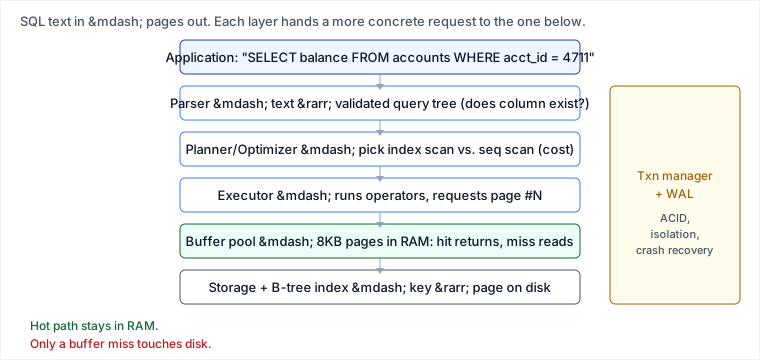
The engine layers, top to bottom
Every production relational engine (PostgreSQL, MySQL/InnoDB, SQLite, Oracle) is organized as the same stack of cooperating layers. A query enters at the top as text and descends; pages it needs travel up from disk and are cached on the way.
Worked trace: one SELECT, real numbers
Suppose the bank's accounts table holds 1,000,000 rows. Each row is ~100 bytes, so with an 8 KB page (the standard PostgreSQL page size) about 80 rows fit per page → roughly 12,500 data pages. There is a B-tree index on acct_id that is 3 levels deep. An accountant runs:
SELECT balance FROM accounts WHERE acct_id = 4711;Here is what the engine actually does, step by step.
| # | Layer | Concrete action on this query | Cost |
|---|---|---|---|
| 1 | Parser | Tokenize text; check accounts and columns balance, acct_id exist in the catalog; build a query tree. | ~0 I/O (catalog cached) |
| 2 | Optimizer | Two options: full sequential scan = read all 12,500 pages; or index scan = 3 index pages + 1 data page. Picks the index scan because acct_id is unique and the estimated cost (4 pages) << 12,500. | chooses 4 pages |
| 3 | Executor → Buffer pool | Asks for B-tree root page. It is hot (every query touches it) → buffer hit, served from RAM (~100 ns). | 0 disk reads |
| 4 | Buffer pool → disk | Root says key 4711 lives in internal page #842 → miss → read page #842 from disk into a free frame. | 1 read (~100 µs SSD) |
| 5 | Buffer pool → disk | Page #842 points to leaf page #5119 → miss → read it. Leaf entry for 4711 holds the row location (heap page #318, slot 12). | 1 read |
| 6 | Buffer pool → disk | Fetch heap page #318 → miss → read it; extract slot 12 → balance = 2,540.00. | 1 read |
| 7 | Executor → app | Return the one row. The 3 pages just read stay cached, so the loans team's next lookup of a nearby key may hit warm. | — |
Total: 3 disk reads instead of 12,500 — a ~4,000× reduction, and the entire reason indexes and the buffer pool exist. Run the same query a second time and steps 4–6 become buffer hits: zero disk I/O.
Worked trace: the UPDATE that survives a crash
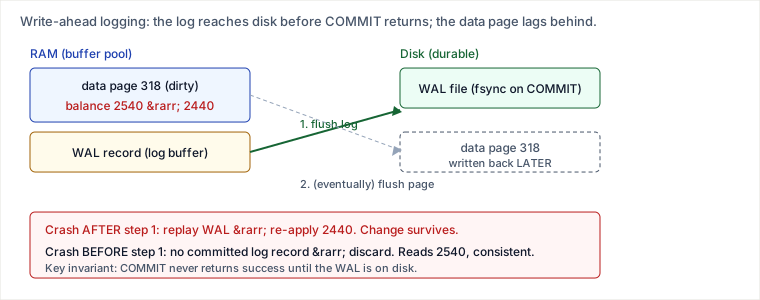
Now the accountant moves money: UPDATE accounts SET balance = balance - 100 WHERE acct_id = 4711; followed by COMMIT;. The dangerous part is durability — the new value lives only on a dirty page in RAM, and RAM is lost on power failure. The DBMS solves this with write-ahead logging (WAL): the rule is append the change to the log and flush the log to disk before reporting COMMIT success. The big data page can be written back lazily, much later.
- Locate row 4711 (same B-tree descent as above), pin its buffer frame.
- Acquire a row-level write lock on row 4711 so a concurrent transfer can't interleave.
- Modify the value in RAM: 2,540.00 → 2,440.00. The page is now dirty.
- Append a WAL record:
(txn 91, page 318, slot 12, before=2540.00, after=2440.00)to the in-memory log buffer. - On
COMMIT: fsync the WAL to disk, then return success. The dirty data page is not yet on disk — that's fine.
If the server loses power one millisecond after COMMIT returns, recovery on restart replays the WAL: it sees txn 91 committed, re-applies after=2440.00 to page 318, and the money stays moved. If the crash happened before the WAL fsync, COMMIT never returned, the WAL has no committed record, and the change is correctly discarded — the account reads 2,540.00 as if nothing happened. Either way the database is consistent. This append-then-fsync trick is why one sequential log write replaces many random data-page writes, and why "durable" doesn't mean "slow".
Why the naive "just write the row" version is wrong
The obvious design — when someone updates a balance, seek to that row on disk and overwrite it in place, then return — fails on two fronts a working engineer hits immediately:
- Torn writes / partial failure. If power drops mid-write, the page on disk is half-old, half-new and unreadable. There is no record of what the value should be, so recovery is impossible. WAL fixes this because the log records the intended
before/aftervalues first; the data page can always be reconstructed. - It is brutally slow. Overwriting a row in place is a random disk write per update. WAL turns N scattered random writes into one sequential append plus a single fsync, then writes the data pages back in batches. Sequential I/O is orders of magnitude faster, so the durable design is also the fast one.
Pitfalls
- Forgetting the index = sequential scan. If there is no index on
acct_id, the optimizer has no choice but to read all 12,500 pages for every lookup. At scale this is the single most common cause of a query that "suddenly got slow" — usually the table grew past the point where the buffer pool can hold it all. - Buffer pool too small → thrashing. If the working set doesn't fit in RAM, the pool constantly evicts pages it's about to need again, so hit rate collapses and every query pays disk latency. Sizing the buffer pool (e.g. InnoDB's
innodb_buffer_pool_size, often ~70–80% of RAM on a dedicated DB box) is one of the highest-leverage tuning knobs. - Long-running transactions hold locks and block others. The row-level write lock from the UPDATE trace is held until COMMIT. A transaction that does an UPDATE then sits idle (e.g. waiting on a slow API call) blocks everyone who wants that row, and can deadlock against another transaction holding a second row. Keep transactions short; never do network I/O while holding a write lock.
- Mistaking "committed" for "on the data file." After COMMIT only the WAL is guaranteed durable; the data page may not be flushed for seconds. This is correct and intended — but it means a backup that copies data files without the WAL is inconsistent. Use the engine's backup tooling, which captures both.
- fsync disabled or lying. Turning off
fsync(or a consumer SSD that ignores flush commands) makes COMMIT return before the WAL is truly on disk. Everything is fast and correct... until a power loss silently eats committed transactions. The durability guarantee is exactly as strong as your weakest fsync.
Takeaways
- A DBMS is fundamentally a query compiler over a cache over a disk: parse → plan → execute, with a buffer pool turning repeated access into RAM speed and indexes turning "scan everything" into a handful of page reads.
- Indexes change the cost class of a lookup (3 reads vs. 12,500); the optimizer's whole job is to pick the cheapest plan from real statistics.
- Write-ahead logging is how durability and speed coexist: append the log and fsync it before COMMIT returns, write data pages back lazily; recovery replays the log.
- Concurrency and durability are the hard parts, not querying. Most real DBMS pain — slow queries, lock contention, lost data — comes from a missing index, an undersized buffer pool, a long transaction, or a broken fsync.
Re-authored and deepened for this guide. The four-function framing (define / construct / manipulate / share) follows Elmasri & Navathe, Fundamentals of Database Systems. The engine pipeline, buffer pool, B-tree access path, and ARIES-style write-ahead logging draw on Hellerstein, Stonebraker & Hamilton, Architecture of a Database System (Foundations and Trends in Databases, 2007); Silberschatz, Korth & Sudarshan, Database System Concepts; and the PostgreSQL documentation (page layout, WAL, and the query planner) and the MySQL/InnoDB manual (buffer pool, redo log). Numbers (8 KB pages, ~80 rows/page, 3-level B-tree) are representative defaults, not vendor guarantees.
🤖 Don't fully get this? Learn it with Claude
Stuck on Database management systems (DBMS)? Open Claude, copy a block below, and it'll teach you this exact concept — visually and interactively.
Build the mental picture, not memorization.
I just read a lesson on **Database management systems (DBMS)** (Databases) and want to truly understand it. Explain Database management systems (DBMS) from first principles using ONE vivid real-world analogy and a visual mental model — draw it as ASCII art or a clear step-by-step diagram — with a concrete example using real numbers. Then ask me one question to check I got the mental picture, and wait for my reply. If you're unsure or a claim isn't standard, say so and reason from first principles instead of guessing.
Socratic — adapts to where you're stuck.
Teach me **Database management systems (DBMS)** interactively. Ask me ONE guiding question at a time, wait for my answer, and adapt to my confusion — build the idea with me step by step instead of explaining it all at once. If you're unsure or a claim isn't standard, say so and reason from first principles instead of guessing.
Active recall exposes what you missed.
Quiz me on **Database management systems (DBMS)** with 5 questions, easy to tricky, ONE at a time. Tell me if each answer is right; at the end, explain clearly what I got wrong and why. If you're unsure or a claim isn't standard, say so and reason from first principles instead of guessing.
Intuition + hook + flashcards for long-term memory.
Help me remember **Database management systems (DBMS)** for the long term: give the one-sentence intuition, a memorable hook/mnemonic, a tiny worked example, and 3 active-recall flashcards (Q -> A). If you're unsure or a claim isn't standard, say so and reason from first principles instead of guessing.