Databases — ACID, Isolation Anomalies & What a DBMS Actually Buys You (Deep Dive)
The intro Database pages name ACID, isolation levels, normalization, indexes, and joins — but they don't tie them into one picture, and most of the real mechanism already has its own deep dive elsewhere in this guide. This page is that missing map: precise one-line definitions of ACID with the mechanism behind each letter, a traced anomaly (dirty read), the three concrete failure modes a flat file has no defense against (with the DBMS mechanism that closes each one), and a set of pointers — normalization, indexing, joins, the NULL trap, tunable consistency — that define the term and send you to the page that actually derives it. Read this first if a concept is still just a name to you; read the linked deep dive if you need the arithmetic.
1. ACID, precisely — one line and one mechanism each
| Property | What it guarantees | The mechanism that delivers it |
|---|---|---|
| Atomicity | a transaction's statements all commit or none do — no half-finished multi-step change is ever visible | UNDO: every write is logged before it touches a data page, so a crash or rollback can unwind an in-progress transaction back to its starting state |
| Consistency | a transaction moves the database from one state that satisfies its constraints to another that does too | mostly not an engine mechanism — the engine enforces the constraints it was told about (PK/FK/UNIQUE/CHECK); whether the transaction logic itself preserves a business invariant is on the application |
| Isolation | concurrent transactions produce a result equivalent to some serial (one-at-a-time) order of them | locking and/or MVCC — block conflicting access, or give every reader its own consistent snapshot instead of touching live rows |
| Durability | once COMMIT returns, the change survives a crash, even if it was never written to the data file | WAL + fsync: the log record is forced to durable storage the instant commit returns; a sequential log write is fast, so durability doesn't wait on random-access disk I/O to the actual table |
Notice the asymmetry: A, I, and D are the engine's job — the WAL/UNDO machinery and the locking/MVCC machinery deliver them whether or not the application does anything sensible. Consistency is different: a schema with no constraints gives the engine nothing to enforce, and "ACID" does not mean "my business logic is bug-free." The full recovery mechanics (STEAL/NO-FORCE, REDO+UNDO passes, checkpointing) and the MVCC snapshot internals are traced in detail in Transactions & Concurrency — Recovery, MVCC Internals, Serializability & Locking; this page assumes the one-liners above and moves on to isolation anomalies and the bigger "why a DBMS at all" question.
2. Isolation levels, timelined against the anomaly they first close
Every isolation level is a trade: allow one more class of interference in exchange for more concurrency. The four SQL levels form a strict ladder — each one closes exactly one more anomaly than the level below it:
| Isolation level | First anomaly it prevents | What's still possible |
|---|---|---|
| Read Uncommitted | — (none) | dirty read, non-repeatable read, phantom |
| Read Committed (Postgres default) | dirty read | non-repeatable read, phantom |
| Repeatable Read (MySQL/InnoDB default) | non-repeatable read | phantom (mostly closed by InnoDB's gap locks, but not by MVCC alone) |
| Serializable | phantom | — (all three closed) |
Trace the first rung concretely — a dirty read at Read Uncommitted, the anomaly every mainstream engine's lowest usable level exists specifically to close:
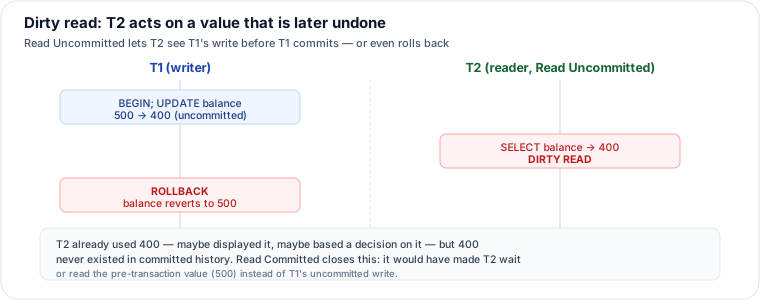
The mechanism gap in each anomaly is always the same shape — a visibility rule too loose for what the transaction actually depends on: dirty read = no rule against seeing an uncommitted write; non-repeatable read = the visibility check is re-run per statement instead of pinned once per transaction; phantom = a lock on rows you already read cannot block a brand-new row from being inserted into a range you depend on. The full anomaly catalog (including write skew and lost update), the concrete non-repeatable-read timeline, and the fix for each are in Isolation Levels & Anomalies; the locking (gap/next-key locks) and MVCC snapshot machinery that actually implement these levels — and why PostgreSQL's SERIALIZABLE (SSI, optimistic-abort) behaves completely differently under load from MySQL/SQL Server's (2PL, blocking) — is derived in Transactions & Concurrency — Recovery, MVCC Internals, Serializability & Locking.
3. What a DBMS buys over a flat file: three failure modes, closed
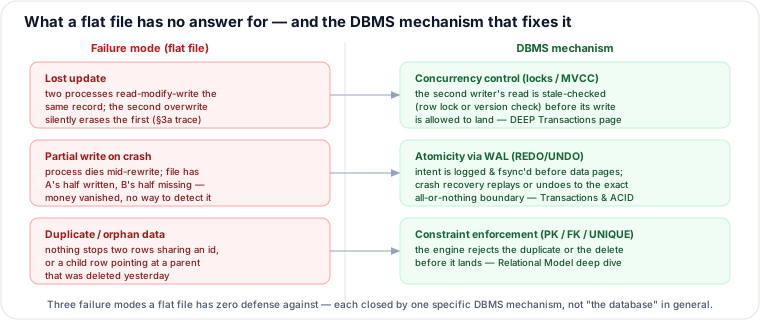
"Just use a folder of JSON/CSV files" fails in three specific, concrete ways — not vaguely "it doesn't scale," but precisely these:
3a. No concurrency control → lost update
Two processes read the same balance, both compute a new value from their own stale read, and the second write clobbers the first with no error, no warning, and no trace that anything went wrong:
| Step | T1 (withdrawal #1) | T2 (withdrawal #2) | balance |
|---|---|---|---|
| 1 | reads balance = 500 | 500 | |
| 2 | reads balance = 500 | 500 | |
| 3 | computes 500−100=400, writes 400, commits | 400 | |
| 4 | computes 500−100=400 (from its own stale read of 500), writes 400, commits | 400 |
Two withdrawals of $100 each should leave 300. The database ends up at 400 — T1's withdrawal is silently lost, because T2 never knew T1 had already changed the row. A flat file has no primitive to prevent this: whichever process writes last simply wins. A DBMS fixes it with concurrency control — a pessimistic row lock (SELECT…FOR UPDATE, forcing T2 to wait and re-read 400) or an optimistic version check (WHERE version = ?, forcing T2's write to fail and retry) — both covered with working SQL in Isolation Levels & Anomalies.
3b. No atomicity → partial writes on crash
Rewrite a customer record in a flat file (or even append two related lines to two files) and lose power halfway through: one field is updated, the other is not, and there is no log to tell you the file is now inconsistent, let alone how to repair it. A DBMS fixes this with the WAL: the intended change is appended to a durable log before it touches the data page, so a crash mid-write is recoverable — replay what committed, undo what didn't. Traced second-by-second (including why STEAL+NO-FORCE buffer policy forces both REDO and UNDO to exist) in Transactions & Concurrency — Recovery, MVCC Internals, Serializability & Locking.
3c. No consistency enforcement → duplicate / orphan data
Nothing in a CSV file stops two rows from sharing the same order_id, and nothing stops an orders.csv row from referencing a customer_id that was deleted from customers.csv yesterday — the file format has no concept of identity or reference. A DBMS fixes this with declared constraints — PRIMARY KEY rejects the duplicate before it lands; FOREIGN KEY rejects the orphan (or cascades/nullifies it, by policy) at write time. The full key/FK/NULL semantics, including the composite-key traps that look right but aren't, are in Relational Model — Keys, FK Integrity, NULL Traps & Modeling Judgment.
4. Pointers: the mechanisms behind the other names you've heard
These are all covered in full mechanism-and-arithmetic depth elsewhere in this guide. Definitions only, here — follow the link for the derivation:
- Normalization / normal forms. A functional dependency X→Y means any two rows agreeing on X must agree on Y; each normal form (1NF→2NF→3NF→BCNF) forbids one more class of FD that a key structure is allowed to leave lying around, and each forbidden class corresponds exactly to one anomaly — insert, update, or delete — that repeating that fact would otherwise cause. Full FD theory, the anomaly-by-anomaly worked table, and when BCNF is worth the join cost it adds: Normalization — 3NF vs BCNF Dependency-Preservation, Lossless Join, Synthesis & 5NF.
- Index internals. A B+tree index turns a lookup into a small number of page reads by branching on fanout (entries per page = page size ÷ entry size): a tree of depth d can address up to fanoutd rows, so depth grows only as log of the row count, not linearly — a few page reads reach a row among hundreds of millions. The fanout arithmetic, composite-index ordering rule, and its skip-scan exception: Indexing & Storage — Fanout Arithmetic, Optimizer Stats, Composite/Skip Scans & NULL/OR Pitfalls.
- Join physical algorithms. The optimizer picks among nested loop (any predicate, wins when one side is small or well-indexed), hash join (equality only, builds a hash table on the smaller side), and sort-merge (walks two sorted streams) based on predicate shape, input size, and existing sort order — not a fixed rule. The cost model, why a non-equality (theta) join is often stuck with nested loop, and what happens when a hash join's build side doesn't fit in memory: Query Execution — Selectivity, the Cost Model, Join Algorithms, Spills & Sargability.
- The
NOT IN+NULLzero-rows trap. SQL is three-valued (TRUE/FALSE/UNKNOWN);NULLcompared to anything isUNKNOWN, andx NOT IN (a,b,NULL)expands to anANDchain where oneUNKNOWNpoisons the whole condition — the query can silently return zero rows even though correct answers exist. Traced row-by-row, with theNOT EXISTSfix: Relational Model — Keys, FK Integrity, NULL Traps & Modeling Judgment.
5. The tunable-consistency one-liner
Once a table is replicated across nodes instead of living on one disk, "isolation" and "consistency" gain a distributed-systems dimension: the same pigeonhole logic that makes a database serializable on one node reappears as a quorum overlap across nodes. If a write must be acknowledged by W replicas and a read must query R replicas out of N total, then R + W > N guarantees the read set and write set share at least one replica — so every read is guaranteed to see the latest acknowledged write. That single inequality is why "tunable consistency" is a real dial and not marketing: shrink R and W below the crossover and you trade that overlap guarantee for lower latency and higher availability, which is exactly the space the CAP theorem describes at the level of an entire partitioned system. Full arithmetic and the failure modes at each (R,W) setting: Quorum Arithmetic — Why R + W > N; the availability/consistency trade-off during a network partition: the CAP Theorem deep dives.
Pitfalls
- Assuming ACID is one indivisible guarantee. A/I/D are engine mechanisms that hold regardless of the app; Consistency is only as good as the constraints and transaction logic the application actually wrote. A schema with no
FOREIGN KEYs and no transactions gets none of "C" for free. - Assuming your isolation level is Serializable by default. Postgres defaults to Read Committed, InnoDB to Repeatable Read — both allow real anomalies (non-repeatable read, and write skew even at Repeatable Read) unless you explicitly raise the level or add locking.
- Treating a lost update as "rare." Any bare read-modify-write in application code (read a counter, add one, write it back) is a lost update waiting for concurrent traffic — it needs a row lock or a version check, not "the database will figure it out."
- Reading "the DBMS prevents X" as automatic. Each fix in §3 is a specific mechanism you must actually use — a table with no declared foreign key gets no orphan protection just because it lives in a relational database.
- Confusing normalization with correctness. A normalized schema removes redundancy-driven anomalies; it does not by itself guarantee good concurrency behavior or fast queries — those are the isolation-level and indexing questions above, argued separately.
Judgment layer: choosing an isolation level
Default to Read Committed for ordinary CRUD where each statement only needs to see a consistent view of itself — it's the cheapest level that closes dirty reads, and it's what most engines ship by default for a reason: highest concurrency, and most business logic doesn't span a multi-statement invariant that a concurrent write could break. Move to Repeatable Read / Snapshot Isolation when a transaction must see one consistent view across several statements — a report, a multi-step calculation, anything where re-reading a row mid-transaction should not change the answer. Reach for full Serializable only when a cross-row business invariant is genuinely non-negotiable (double-spend prevention, capacity limits, "at least one doctor on call") — it is the one level that closes write skew and phantom-driven anomalies, but it costs either blocking-and-deadlock risk (2PL engines) or commit-time aborts requiring app-level retry (Postgres SSI). The trade is never "safety vs. no reason not to" — it is concurrency and latency paid at every level above Read Committed, so raise the level exactly as far as the specific invariant requires and no further.
Takeaways
- ACID splits into two different kinds of guarantee: Atomicity/Isolation/Durability are engine mechanisms (WAL+UNDO, locking/MVCC, WAL+fsync) that hold regardless of the app; Consistency is the application's constraints and transaction logic.
- The four isolation levels form a ladder, each closing exactly one more anomaly (dirty read → non-repeatable read → phantom) than the one below — know your engine's default, because it is rarely the safest.
- A flat file has no answer to three specific failures — lost update, partial writes on crash, duplicate/orphan data — each closed by one specific DBMS mechanism (concurrency control, WAL, constraints), not "the database" as a vague whole.
- Normalization, indexing, joins, the NULL trap, and quorum/CAP are all the same kind of question at a different layer — each has a dedicated deep dive; this page's job was only to name the mechanism and point you there.
Related pages
- Transactions & Concurrency — Recovery (REDO/UNDO), MVCC Internals, Serializability & Locking (Deep Dive) — Databases — the recovery and MVCC mechanics that deliver the A/I/D letters this page only defines
- Isolation Levels & Anomalies — Databases — the full anomaly catalog and fixes behind the ladder introduced in §2
- Normalization — 3NF vs BCNF Dependency-Preservation, Lossless Join, Synthesis & 5NF (Deep Dive) — Databases — the FD theory behind the normalization pointer in §4
- Indexing & Storage — Fanout Arithmetic, Optimizer Stats, Composite/Skip Scans & NULL/OR Pitfalls (Deep Dive) — Databases — the B+tree fanout arithmetic behind the indexing pointer in §4
- Relational Model — Keys, FK Integrity, NULL Traps & Modeling Judgment (Deep Dive) — Databases — the key/FK/NULL semantics behind the constraint-enforcement mechanism in §3c
Synthesized from M. Kleppmann, Designing Data-Intensive Applications ch. 7 & 9; the PostgreSQL documentation on transaction isolation, MVCC, and constraints; the InnoDB manual on isolation levels and locking; C. Mohan et al., the ARIES recovery paper; CMU 15-445/645 (Andy Pavlo) on concurrency control and recovery. Cross-references: "Transactions & ACID," "Isolation Levels & Anomalies," "Transactions & Concurrency — Recovery, MVCC Internals, Serializability & Locking," "Normalization," "Indexing & Storage," "Query Execution," "Relational Model," "Quorum Arithmetic," "CAP Theorem." Re-authored/Deepened for this guide.
🤖 Don't fully get this? Learn it with Claude
Stuck on Databases — ACID, Isolation Anomalies & What a DBMS Actually Buys You (Deep Dive)? Open Claude, copy a block below, and it'll teach you this exact concept — visually and interactively.
Build the mental picture, not memorization.
I just read a lesson on **Databases — ACID, Isolation Anomalies & What a DBMS Actually Buys You (Deep Dive)** (Databases) and want to truly understand it. Explain Databases — ACID, Isolation Anomalies & What a DBMS Actually Buys You (Deep Dive) from first principles using ONE vivid real-world analogy and a visual mental model — draw it as ASCII art or a clear step-by-step diagram — with a concrete example using real numbers. Then ask me one question to check I got the mental picture, and wait for my reply. If you're unsure or a claim isn't standard, say so and reason from first principles instead of guessing.
Socratic — adapts to where you're stuck.
Teach me **Databases — ACID, Isolation Anomalies & What a DBMS Actually Buys You (Deep Dive)** interactively. Ask me ONE guiding question at a time, wait for my answer, and adapt to my confusion — build the idea with me step by step instead of explaining it all at once. If you're unsure or a claim isn't standard, say so and reason from first principles instead of guessing.
Active recall exposes what you missed.
Quiz me on **Databases — ACID, Isolation Anomalies & What a DBMS Actually Buys You (Deep Dive)** with 5 questions, easy to tricky, ONE at a time. Tell me if each answer is right; at the end, explain clearly what I got wrong and why. If you're unsure or a claim isn't standard, say so and reason from first principles instead of guessing.
Intuition + hook + flashcards for long-term memory.
Help me remember **Databases — ACID, Isolation Anomalies & What a DBMS Actually Buys You (Deep Dive)** for the long term: give the one-sentence intuition, a memorable hook/mnemonic, a tiny worked example, and 3 active-recall flashcards (Q -> A). If you're unsure or a claim isn't standard, say so and reason from first principles instead of guessing.