Introduction to ER Models
An ER model works by forcing you to name the things your application stores (entities), the facts about each thing (attributes), and the verbs that link two things (relationships) — so that every box and line can later be mechanically rewritten into tables, primary keys, and foreign keys without you re-thinking the design. The diagram is not decoration: it is a transcription of business rules into a notation that a relational schema can be derived from almost line-by-line.
The three primitives, read off a real fragment
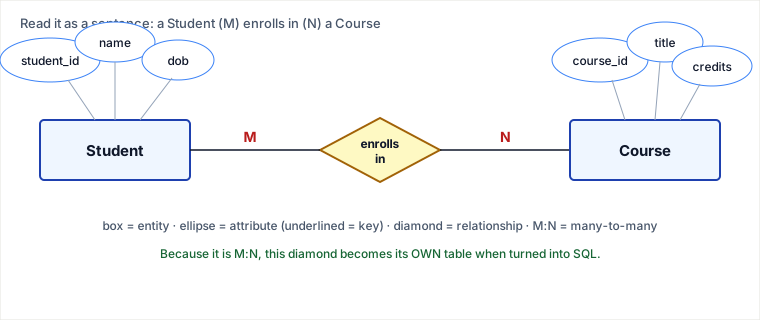
Take one slice of a student-records system: a Student can enroll in a Course. That single English sentence already contains all three ER primitives, and you read it like grammar:
- Entities are the nouns you keep many of and identify individually — Student, Course. Each gets a box.
- Attributes are the adjectives/facts hanging off one entity — a Student has
student_id,name,dob. One of them is underlined because it is the key: the value that uniquely identifies one row (student_id, notname— two students can share a name). - Relationships are the verb connecting two entities — enrolls in. It gets a diamond, and it carries cardinality: one student enrolls in many courses, and one course holds many students, so this verb is many-to-many (M:N).
The mechanism that matters for everything downstream is that cardinality decides how the relationship becomes SQL. A 1:N verb folds into a foreign-key column on the "many" side; an M:N verb cannot — it forces a brand-new table. Reading the diagram is reading those rules.
Chen ER Notation Quick Reference Mapping
| Chen ER Component | Database Concept | SQL Translation |
|---|---|---|
| Rectangle | Entity Set | Independent Table (e.g., CREATE TABLE Student) |
| Ellipse | Attribute | Table Column (e.g., name VARCHAR(100)) |
| Underlined Ellipse | Primary Key | PRIMARY KEY Constraint on column(s) |
| Diamond | Relationship Set | Foreign Key (1:N) or a Junction Table (M:N) |
| Double Rectangle | Weak Entity Set | Separate table referencing strong entity PK |
| Double Diamond | Identifying Relationship Set | Foreign key dependency constraints |
| Double Ellipse | Multivalued Attribute | Junction table with composite PK (Parent_PK, Attribute) |
Worked trace: turn the diagram into a schema
The payoff of ER is that the conversion is mechanical. Walk the fragment above box-by-box and apply the rules in order:
- Each entity → one table; its key → the primary key.
Student(student_id PK, name, dob)andCourse(course_id PK, title, credits). - Classify the relationship's cardinality. "enrolls in" is M:N (a student takes many courses; a course has many students).
- Apply the cardinality rule. M:N cannot live as a foreign key on either side, so it becomes a junction table whose primary key is the pair of both foreign keys:
Enrollment(student_id FK, course_id FK, PRIMARY KEY(student_id, course_id)). Any fact about the enrollment itself — agrade— belongs here, not on Student or Course.
Now plug in real values and watch the tables fill:
| Diagram element | Becomes | Example row(s) |
|---|---|---|
| Student entity | Student table | (S1, "Ada Lovelace", 2003-12-10) |
| Course entity | Course table | (C1, "Databases", 4) · (C2, "Operating Systems", 3) |
| "enrolls in" (M:N) | Enrollment junction | (S1, C1, "A") · (S1, C2, "B+") |
Read the last two rows back as English and they are exactly the original sentence with values: Ada (S1) is enrolled in Databases and Operating Systems. The same Ada appears twice in Enrollment but only once in Student — that is the M:N rule doing its job, and it is why the design has no duplicated student data.
Pitfalls
- Modeling an M:N as a foreign-key column. The tempting shortcut — putting a
course_idcolumn onStudent— only stores one course per student. Ada can then take Databases or OS but never both. The instant you need a second enrollment you are either overwriting data or stuffing a comma-separated list into one cell (which destroys querying and joins). M:N requires the junction table; there is no FK-on-one-side version that is correct. - Hanging a relationship's attribute on an entity. Where does
gradego? Not on Student (a student has many grades) and not on Course (a course gives many grades). It is a fact about the pairing, so it lives on theEnrollmentrelationship. Putting it on an entity forces duplication and update anomalies. - Choosing a non-unique attribute as the key. Underlining
nameinstead ofstudent_idlooks fine on paper until two students share a name; the "key" then can't identify a row and every relationship pointing at it breaks. Keys must be guaranteed unique, ideally a surrogate id you control. - Confusing an attribute with an entity. If a "department" needs its own attributes (a head, a building) and is referenced by many students, it is an entity with its own box, not a string attribute repeated on every Student row. The tell: anything you'd otherwise copy across many rows wants to be its own entity.
Takeaways
- An ER diagram is a notation you read: nouns are boxes (entities), facts are ellipses (attributes, key underlined), verbs are diamonds (relationships).
- Cardinality is the load-bearing part — 1:N folds into a foreign key on the many-side; M:N forces a separate junction table.
- A fact about a pairing (like a grade) belongs on the relationship, never on either entity.
- Done right, the diagram converts to a relational schema almost mechanically, which is the whole point of building it before you write CREATE TABLE.
Sources: Elmasri & Navathe, Fundamentals of Database Systems (7th ed.), ch. 7 (ER model, entities/attributes/relationships, cardinality ratios); Silberschatz, Korth & Sudarshan, Database System Concepts, ch. 6 (ER-to-relational mapping, junction tables for M:N). Peter Chen's original 1976 paper "The Entity-Relationship Model — Toward a Unified View of Data" established the box/diamond/ellipse notation. The full student-management diagram is built up across the following lessons in this topic. Re-authored/Deepened for this guide: added the mechanism-first framing, a read-the-diagram-then-build-the-schema worked trace with real rows, a hand-authored SVG of the Student–enrolls-in–Course fragment, and a Pitfalls section covering the M:N foreign-key mistake.
🎯 STRICT STANDOUT: Why / worked / when-not / failure / drills — Introduction to ER Models
Why this concept exists (judgment chain)
ER exists so business rules become mechanical CREATE TABLE decisions before you write DML. Cardinality is the load-bearing signal: 1:N → FK on the many side; M:N → junction table; relationship attributes (grade) live on the pairing, not on either entity. Skipping ER dumps duplicated attributes into tables and forces later migrations.
Worked example with numbers or traced steps
Student(student_id PK) — Course(course_id PK) — enrolls M:N.
Tables: Student(S1,'Ada',...); Course(C1,'Databases',4),(C2,'OS',3);
Enrollment(S1,C1,'A'),(S1,C2,'B+') — grade on junction.
Wrong: Student.course_id FK stores only one course; Ada cannot take both.
Right: junction PK (student_id, course_id) + grade column.
When NOT to use / named alternative
Skip a full Chen diagram for throwaway prototypes with one table. Prefer UML/class diagrams when the audience is application code, not schema. Do not invent a junction for true 1:N (it just adds an extra join with no new fact).
Failure / ops fingerprint
Schema smell: comma-separated course lists or course1/course2 columns. Update anomaly: renaming a course requires touching many student rows if course was denormalized as a string. Ops: migration tickets titled "add second enrollment" that rewrite the whole Student table.
Hostile-panel Q&As (model answers)
Q1. Why can't M:N be a single FK column?
Model answer: A column holds one value, not a set. Second enrollment overwrites the first or forces multi-value cell hell.
Q2. Where does grade belong?
Model answer: On Enrollment — it is a fact about the pairing. On Student it duplicates; on Course it is ambiguous.
Q3. When is a "department" an entity vs an attribute?
Model answer: Entity when it has its own attributes/identity and is referenced by many rows; string attribute only if never reused or enriched.
🤖 Don't fully get this? Learn it with Claude
Stuck on Introduction to ER Models? Open Claude, copy a block below, and it'll teach you this exact concept — visually and interactively.
Build the mental picture, not memorization.
I just read a lesson on **Introduction to ER Models** (Databases) and want to truly understand it. Explain Introduction to ER Models from first principles using ONE vivid real-world analogy and a visual mental model — draw it as ASCII art or a clear step-by-step diagram — with a concrete example using real numbers. Then ask me one question to check I got the mental picture, and wait for my reply. If you're unsure or a claim isn't standard, say so and reason from first principles instead of guessing.
Socratic — adapts to where you're stuck.
Teach me **Introduction to ER Models** interactively. Ask me ONE guiding question at a time, wait for my answer, and adapt to my confusion — build the idea with me step by step instead of explaining it all at once. If you're unsure or a claim isn't standard, say so and reason from first principles instead of guessing.
Active recall exposes what you missed.
Quiz me on **Introduction to ER Models** with 5 questions, easy to tricky, ONE at a time. Tell me if each answer is right; at the end, explain clearly what I got wrong and why. If you're unsure or a claim isn't standard, say so and reason from first principles instead of guessing.
Intuition + hook + flashcards for long-term memory.
Help me remember **Introduction to ER Models** for the long term: give the one-sentence intuition, a memorable hook/mnemonic, a tiny worked example, and 3 active-recall flashcards (Q -> A). If you're unsure or a claim isn't standard, say so and reason from first principles instead of guessing.