Attributes of Relationship Types
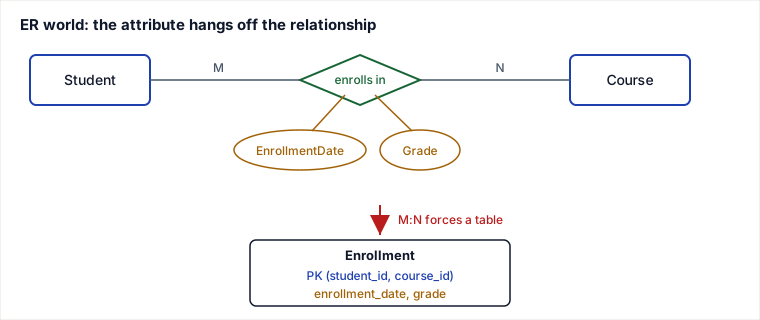
A relationship attribute is a fact whose value is fixed only once you name both participating entities together — so it has no row to live on in either entity's table, and when the relationship is many-to-many the mapping rules are forced to spin up a third table (a junction/associative table) just to hold it.
That forced table is the whole point for a systems engineer. "Enrollment Date" is not a property of a student (a student enrolls in many courses on different dates) and not a property of a course (many students enroll on different dates). It is a property of the pairing (this student, this course). The relational model has exactly one place to store a per-pairing fact: a row keyed by the composite of both foreign keys.
The mechanism, step by step
Take the academic example: Student enrolls in Course, many-to-many, with relationship attributes EnrollmentDate and Grade. Walk through where each attribute can physically go.
- Try to put EnrollmentDate on Student. Student S1 (Asha) enrolls in CS101 on 2026-01-08 and in MA200 on 2026-01-15. A single
student.enrollment_datecolumn can hold one value, not two. It breaks the moment a student takes a second course. - Try to put it on Course. Course CS101 is taken by S1 on 2026-01-08 and by S2 (Ben) on 2026-01-09. Same collision: one column, two true values.
- Conclusion forced by the data. The attribute is functionally determined by the pair
(student_id, course_id), not by either id alone. So it must live in a row identified by that pair. That row is the junction tableEnrollment.
Concretely, the M:N relationship plus its attributes maps to:
CREATE TABLE Student (
  student_id  INT PRIMARY KEY,
  name        VARCHAR(80)
);

CREATE TABLE Course (
  course_id   VARCHAR(8) PRIMARY KEY,
  title       VARCHAR(120)
);

-- the relationship becomes its own table;
-- the relationship attributes are its non-key columns
CREATE TABLE Enrollment (
  student_id      INT,
  course_id       VARCHAR(8),
  enrollment_date DATE NOT NULL,   -- attribute of the relationship
  grade           CHAR(2),         -- attribute of the relationship
  PRIMARY KEY (student_id, course_id),
  FOREIGN KEY (student_id) REFERENCES Student(student_id),
  FOREIGN KEY (course_id)  REFERENCES Course(course_id)
);
The composite primary key (student_id, course_id) is doing two jobs at once: it enforces "a student can enroll in a given course only once," and it gives enrollment_date and grade the only key they could possibly hang off.
With real rows the table reads cleanly — each line is one pairing and its per-pairing facts:
| student_id | course_id | enrollment_date | grade |
|---|---|---|---|
| S1 (Asha) | CS101 | 2026-01-08 | A |
| S1 (Asha) | MA200 | 2026-01-15 | B+ |
| S2 (Ben) | CS101 | 2026-01-09 | A- |
Notice Asha appears twice with two different dates and grades, and CS101 appears twice with two different students — impossible to represent if the attribute lived on either entity.
The 1:N case is different — and that asymmetry matters
The forced junction table is specific to M:N. For a 1:N relationship, the relationship attribute can fold into the table on the "many" side, because that row is already unique per pairing.
Example: Employee works in Department, 1:N (one department has many employees, each employee in exactly one department), with relationship attribute Position. Each employee participates in this relationship exactly once, so (employee_id) already identifies the pairing. Position lands directly on Employee alongside the dept_id foreign key — no third table needed:
CREATE TABLE Employee (
  employee_id INT PRIMARY KEY,
  name        VARCHAR(80),
  dept_id     INT,          -- FK captures the 1:N "works in"
  position    VARCHAR(40),  -- relationship attribute, safe here
  FOREIGN KEY (dept_id) REFERENCES Department(dept_id)
);
So the same modeling concept ("attribute belongs to the association") produces two different physical shapes depending on cardinality: M:N → new table; 1:N → column on the many side. Reading the cardinality off the ER diagram tells you, in advance, which schema you are about to generate.
Pitfalls
- Stashing an M:N relationship attribute on an entity. Putting
gradeonStudentorcourse_meeting_timeon a multi-instructor course silently assumes a 1:1 or 1:N relationship. The first time a second pairing shows up, you either overwrite the previous value (lost data) or duplicate the whole entity row (update anomaly — change the student's name and you must change it in every copy). The data model lies about the real cardinality. - Forgetting the composite primary key on the junction table. If
Enrollmenthas noPRIMARY KEY (student_id, course_id), nothing stops a student from being enrolled in the same course twice with conflicting grades. The composite key is not bookkeeping — it is the M:N business rule "at most one pairing." - Surrogate key that drops the uniqueness guarantee. Many ORMs auto-add an
id BIGSERIAL PRIMARY KEYto the join table. That is fine, but only if you also add aUNIQUE (student_id, course_id)constraint. Replace the composite PK with a bare surrogate and you have re-opened the duplicate-pairing hole. - Attribute that actually belongs to a richer concept. If the "relationship" grows its own attributes that need their own relationships (e.g., an enrollment that has many assignment submissions, or itself relates to a payment), it has outgrown a plain relationship attribute. Promote it to a full associative entity — the table is the same, but you now treat
Enrollmentas a first-class entity with its own surrogate key and outgoing foreign keys. - Multi-valued relationship attribute. If a pairing can have several values of one attribute (a student-course pairing with multiple graded submissions), a single column on the junction table is not enough — you need yet another table keyed by
(student_id, course_id, submission_no). One column per pairing only works when the attribute is single-valued.
Takeaways
- A relationship attribute is determined by the pairing of entities, not by either entity alone — that is why it cannot live on either entity table.
- M:N + attribute → junction table whose composite primary key is the two foreign keys and whose non-key columns are the relationship attributes. This is the systems payoff: the ER attribute dictates a concrete extra table.
- 1:N + attribute → column on the many side; no extra table. Cardinality, not the attribute, decides the physical shape.
- The composite key (or an equivalent UNIQUE constraint) is the cardinality rule; drop it and the schema no longer enforces "one pairing." When the relationship needs its own relationships, promote it to an associative entity.
Sources: Elmasri & Navathe, Fundamentals of Database Systems (7th ed.), ch. 3 (relationship attributes) and ch. 9 (ER-to-relational mapping, esp. step 5 for binary M:N relationships); Silberschatz, Korth & Sudarshan, Database System Concepts (7th ed.), ch. 6 on descriptive attributes of relationship sets; PostgreSQL documentation on composite primary keys and UNIQUE constraints. Re-authored and deepened for this guide to add the M:N-forces-a-junction-table mechanism, a traced worked example with real rows, the 1:N contrast, and engineering pitfalls.
🎯 STRICT STANDOUT: Why / mental model / when-not / worked / failure / hostile panel — Attributes of Relationship Types
Why this concept exists (judgment layer)
Hours/Grade/EnrollmentDate are facts about a pairing. Putting them on either entity lies about cardinality and creates anomalies. This is the theory→schema bridge interviewers use to catch junior ER mistakes.
Mental model (install this intuition)
Attribute of relationship = functionally determined by the pair of keys. M:N + attribute → junction table non-key columns. 1:N + attribute → column on the many side (that row already identifies the pair).
Worked example with numbers or traced steps
S1 enrolls CS101 2026-01-08 grade A
S1 enrolls MA200 2026-01-15 grade B+
student.grade = ?  → cannot hold both  → must be Enrollment(student_id, course_id, grade)
1:N works_in: Employee.dept_id + Employee.position OK (one dept per employee)
Surrogate Enrollment.id needs UNIQUE(student_id, course_id) or pairing duplicates return
When NOT to use / named alternative
If the 'relationship' grows its own children (submissions, payments), promote to an associative entity with a surrogate PK and outgoing FKs — not a skinny junction. Do not put Grade on Student when students take many courses.
Failure mode & ops fingerprint
Fingerprint: grade overwritten when student takes second course; junction with only serial PK and no UNIQUE on (student_id, course_id) → double enrollment; ORM join table missing uniqueness → silent data corruption.
Hostile-panel drills (defend the decision)
Q1. Why can't Hours live on Employee for Works_On projects M:N?
Model answer: One employee works many projects with different hours; one column cannot hold many true values without violating 1NF or losing history.
Q2. M:N vs 1:N placement of a relationship attribute?
Model answer: M:N forces junction non-key columns; 1:N folds the attribute onto the many-side table next to the FK.
Q3. What business rule does PRIMARY KEY (student_id, course_id) encode?
Model answer: At most one enrollment pairing per student-course; the composite key is the cardinality constraint.
🤖 Don't fully get this? Learn it with Claude
Stuck on Attributes of Relationship Types? Open Claude, copy a block below, and it'll teach you this exact concept — visually and interactively.
Build the mental picture, not memorization.
I just read a lesson on **Attributes of Relationship Types** (Databases) and want to truly understand it. Explain Attributes of Relationship Types from first principles using ONE vivid real-world analogy and a visual mental model — draw it as ASCII art or a clear step-by-step diagram — with a concrete example using real numbers. Then ask me one question to check I got the mental picture, and wait for my reply. If you're unsure or a claim isn't standard, say so and reason from first principles instead of guessing.
Socratic — adapts to where you're stuck.
Teach me **Attributes of Relationship Types** interactively. Ask me ONE guiding question at a time, wait for my answer, and adapt to my confusion — build the idea with me step by step instead of explaining it all at once. If you're unsure or a claim isn't standard, say so and reason from first principles instead of guessing.
Active recall exposes what you missed.
Quiz me on **Attributes of Relationship Types** with 5 questions, easy to tricky, ONE at a time. Tell me if each answer is right; at the end, explain clearly what I got wrong and why. If you're unsure or a claim isn't standard, say so and reason from first principles instead of guessing.
Intuition + hook + flashcards for long-term memory.
Help me remember **Attributes of Relationship Types** for the long term: give the one-sentence intuition, a memorable hook/mnemonic, a tiny worked example, and 3 active-recall flashcards (Q -> A). If you're unsure or a claim isn't standard, say so and reason from first principles instead of guessing.