Cardinality and Participation
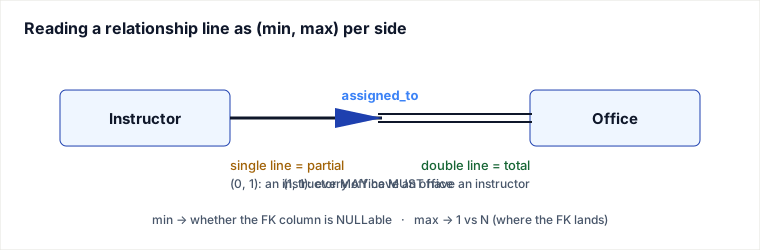
Cardinality and participation are counting rules the model attaches to a relationship line: cardinality fixes the maximum number of partners an instance may have (1 or many), and participation fixes the minimum (0 = optional, 1 = mandatory) — together a (min, max) pair per side that the eventual table schema must mechanically enforce through where the foreign key lands and whether its column is NOT NULL.
The three knobs, precisely
Every binary relationship carries two of these (min, max) pairs — one per side. Read each pair from the perspective of one instance asking "how many of the other can I touch?"
- Degree — how many entity types the relationship wires together. Unary (one type related to itself, e.g. Employee supervises Employee), binary (two types, the common case), ternary (three types at once).
- Cardinality (the max) — 1 or N on each side, giving 1:1, 1:N, N:1, M:N.
- Participation (the min) — total (every instance must appear; min = 1; drawn as a double line) or partial (some may sit out; min = 0; single line).
The payoff is that these four symbols decide three concrete schema facts: which side gets the foreign key, whether a separate junction table is needed, and whether the FK column is nullable.
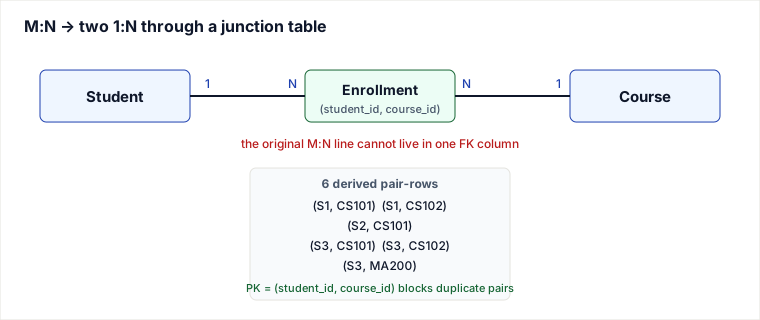
Worked trace: resolving M:N into a junction table
Labeling a line "M:N" is not the end — a relational store cannot hold "many" in a single column, so an M:N relationship must be mechanically turned into a third table. Take the canonical case: Student ⟷ enrolls_in ⟷ Course, with these real rows.
| Student (S) | enrolls in |
|---|---|
| S1 Ravi | CS101, CS102 |
| S2 Meera | CS101 |
| S3 Arjun | CS101, CS102, MA200 |
Three students touch up to three courses each; CS101 is touched by three students. Both maxes are > 1, so this is M:N. Now derive the schema step by step.
- Try putting the FK on one side. Add
course_idtoStudent? S1 needs both CS101 and CS102 — one column can hold only one value. Addstudent_idtoCourse? CS101 needs S1, S2, and S3. Either direction loses rows. An M:N max cannot be stored as a single FK. - Introduce a junction (associative) table
Enrollment(student_id, course_id). Each (student, course) pair becomes exactly one row. - Expand the data into pairs. S1 contributes (S1,CS101),(S1,CS102); S2 contributes (S2,CS101); S3 contributes (S3,CS101),(S3,CS102),(S3,MA200) — 6 rows total.
- Set the primary key. The composite
(student_id, course_id)is the PK; it blocks the same student enrolling in the same course twice. Two FKs point out toStudentandCourse. - Re-encode cardinality. The single M:N line has become two 1:N lines — Student 1:N Enrollment and Course 1:N Enrollment — which is exactly the shape relational tables can store.
- Re-encode participation. "Every student must enroll in at least one course" (total participation, the double line) is not enforceable by the schema alone — a junction table only stores pairs that exist. It needs an application-level or trigger check; the FK columns being
NOT NULLonly guarantees that a row, once present, references real entities.
The resulting junction table:
| student_id (FK) | course_id (FK) |
|---|---|
| S1 | CS101 |
| S1 | CS102 |
| S2 | CS101 |
| S3 | CS101 |
| S3 | CS102 |
| S3 | MA200 |
Composite PK = (student_id, course_id). Row count = sum of each student's course count = 2 + 1 + 3 = 6, matching the source data exactly — no information lost, which is the whole point of step 1's failed attempts.
Where the FK lands for the other cardinalities
Once you see M:N forcing a junction, the others follow from the same "a column holds one value" rule:
- 1:N (Department 1:N Course) — put the FK on the many side.
Course.dept_idholds one department; no junction needed. N:1 is the same picture read from the other end. - 1:1 (Instructor 1:1 Office) — FK can go on either side; put it on the side with total participation and mark it
UNIQUE NOT NULLso the 1:1 max and the mandatory min are both enforced by one constraint. - M:N — always a junction table, as traced above.
Ternary relationships do not decompose
A ternary relationship Works_In(Employee, Department, Location) records a fact about all three at once: "Ravi works in Sales at the Austin office." Splitting it into three binary relationships (Employee–Department, Employee–Location, Department–Location) is lossy. Suppose the binaries say Ravi↔Sales, Ravi↔Austin, Sales↔Austin, and also Ravi↔Marketing, Ravi↔Boston, Marketing↔Boston. The binaries cannot tell you whether Ravi does Sales in Austin or Sales in Boston — every combination is implied. Only a single junction table with the composite key (emp_id, dept_id, loc_id) preserves which triples are real. The fix is the same junction-table mechanism as M:N, just with three FKs in the key instead of two.
Pitfalls
- Reading the line from the wrong end. In 1:N the FK goes on the N side, but beginners put
students_liston Department. A column holds one value — the FK always lives where the max is 1. - Forgetting that total participation is not free. The double line says min = 1, but a junction table or a nullable FK happily stores zero matches. "Every student must enroll" needs a
NOT NULLFK (only for 1:N), a trigger, or app logic — the diagram symbol alone enforces nothing across an M:N junction. - Decomposing a true ternary into binaries. If the three pairwise facts together do not reconstruct the original triples, you have silently invented combinations that never happened. Test it: can you regenerate every real triple and no spurious ones from the binaries? If not, keep it ternary.
- Missing the composite PK on the junction. Without
PRIMARY KEY (student_id, course_id)the table will accept (S1, CS101) twice, double-counting enrollments and corrupting anyCOUNT(*)report. - Confusing N:1 with 1:1. Both put one FK on one side; the difference is the
UNIQUEconstraint. Drop it and a "1:1" office assignment silently becomes 1:N.
Takeaways
- A relationship side is a (min, max) pair: max (1 or N) decides where the FK goes; min (0 or 1) decides whether that FK is nullable / how the mandatory side is enforced.
- M:N and ternary relationships always become a junction table with a composite primary key — because no single column can hold "many," and the failed FK attempts prove no information-preserving shortcut exists.
- The double line (total participation) is a constraint to enforce, not a fact the table stores for free — match it with
NOT NULL,UNIQUE, triggers, or app checks. - Resolving the diagram into a schema, with real rows, is the test of whether you actually understood the symbols — labeling "M:N" without producing the six-row table is half an answer.
Re-authored and deepened for this guide. Built on Elmasri & Navathe, Fundamentals of Database Systems (Chs. 3 & 9, ER constraints and ER-to-relational mapping), Silberschatz, Korth & Sudarshan, Database System Concepts (entity-relationship model, mapping cardinalities and participation), and the standard junction-table / associative-entity treatment of M:N and ternary relationships. The original page correctly noted that a ternary cannot decompose into binaries without information loss; this version adds the traced M:N→junction-table derivation with real rows, the (min, max) reading of the line, and the schema-enforcement pitfalls that the example-labeling version omitted.
🤖 Don't fully get this? Learn it with Claude
Stuck on Cardinality and Participation? Open Claude, copy a block below, and it'll teach you this exact concept — visually and interactively.
Build the mental picture, not memorization.
I just read a lesson on **Cardinality and Participation** (Databases) and want to truly understand it. Explain Cardinality and Participation from first principles using ONE vivid real-world analogy and a visual mental model — draw it as ASCII art or a clear step-by-step diagram — with a concrete example using real numbers. Then ask me one question to check I got the mental picture, and wait for my reply. If you're unsure or a claim isn't standard, say so and reason from first principles instead of guessing.
Socratic — adapts to where you're stuck.
Teach me **Cardinality and Participation** interactively. Ask me ONE guiding question at a time, wait for my answer, and adapt to my confusion — build the idea with me step by step instead of explaining it all at once. If you're unsure or a claim isn't standard, say so and reason from first principles instead of guessing.
Active recall exposes what you missed.
Quiz me on **Cardinality and Participation** with 5 questions, easy to tricky, ONE at a time. Tell me if each answer is right; at the end, explain clearly what I got wrong and why. If you're unsure or a claim isn't standard, say so and reason from first principles instead of guessing.
Intuition + hook + flashcards for long-term memory.
Help me remember **Cardinality and Participation** for the long term: give the one-sentence intuition, a memorable hook/mnemonic, a tiny worked example, and 3 active-recall flashcards (Q -> A). If you're unsure or a claim isn't standard, say so and reason from first principles instead of guessing.