ER Models — EER/ISA Hierarchies, Notation Ambiguity, Access-Path Consequences & When to Embed (Deep Dive)
An ISA hierarchy exists because a relational table can only have one shape, but real entities come in variants that share a common core and diverge in the rest — the mapping decision that follows is really a decision about where you pay for that variance: in NULL columns, in joins, or in duplicated rows. This page assumes the base ER vocabulary (entities, attributes, cardinality, weak entities) from the earlier ER Models lessons and the key/FK mechanics from "Relational Model — Keys, FK Integrity, NULL Traps & Modeling Judgment" and the anomaly vocabulary from "Normalization — 3NF vs BCNF Dependency-Preservation, Lossless Join, Synthesis & 5NF" — both are cross-referenced, not re-derived, below.
1. Generalization/specialization (EER/ISA hierarchies): three ways to fold a subclass into tables
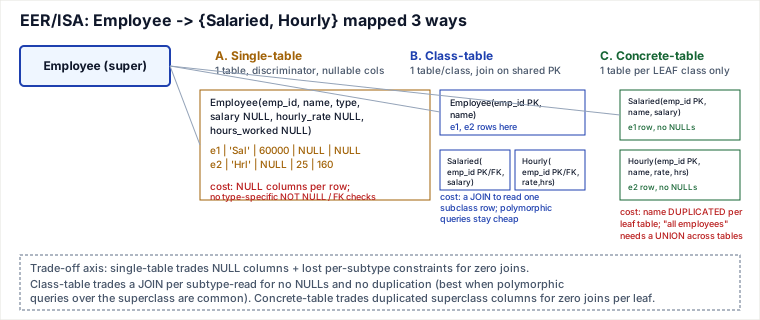
An EER hierarchy says a superclass (Employee) has subclasses (Salaried, Hourly) that share every superclass attribute plus their own. A relational table cannot express "this row is one of several possible shapes" directly — the schema designer must pick one of three mechanical translations, and each one moves the variance cost somewhere different.
Traced example: the same hierarchy, three schemas, two real employees
Ada is salaried (salary 60000); Ravi is hourly (rate 25, 160 hours this period). Trace both rows through all three mappings:
| Mapping | Tables | Ada's row(s) | Ravi's row(s) |
|---|---|---|---|
| A. Single-table | One Employee table with a type discriminator and every subclass column, nullable | (e1,'Ada','SAL',60000,NULL,NULL) | (e2,'Ravi','HRL',NULL,25,160) |
| B. Class-table | Employee(emp_id PK,name) + Salaried(emp_id PK/FK,salary) + Hourly(emp_id PK/FK,rate,hours) | Employee(e1,'Ada') + Salaried(e1,60000) | Employee(e2,'Ravi') + Hourly(e2,25,160) |
| C. Concrete-table | One table per leaf only: Salaried(emp_id PK,name,salary), Hourly(emp_id PK,name,rate,hours) — no shared Employee table at all | Salaried(e1,'Ada',60000) | Hourly(e2,'Ravi',25,160) |
Now ask the same question of all three — "what is total payroll cost across every employee?" — and watch where the cost lands:
- Single-table answers it in one scan with a
CASE WHEN type='SAL' THEN salary ELSE rate*hours END, no join — but every row wastes space on the columns it doesn't use, and the database cannot enforce "a Salaried row must have a non-NULL salary" or "an Hourly row's rate must be positive" as a table-levelNOT NULL/CHECK, because the same column is legitimately NULL for the other type. You've traded structural integrity for query simplicity. - Class-table needs a join (or a
LEFT JOIN+UNION) to reassemble one employee's full row, but every column is exactly where it belongs —Salaried.salarycan beNOT NULLfor real, and a query that only needsEmployee.name(ignoring subtype) never touches the subclass tables at all. - Concrete-table needs a
UNION ALLacross every leaf table just to answer "all employees," andnameis physically duplicated in both leaf tables' schemas (not the same row, but the same column defined twice) — a hierarchy three levels deep means the shared columns are copied into every leaf table's definition. In exchange, a leaf-only query (payroll for salaried staff specifically) needs no join at all.
Disjoint vs overlapping, total vs partial — the two constraints that pick the mapping for you
Disjoint means one employee is exactly one subtype (Salaried XOR Hourly) — a single discriminator column is enough, and concrete-table mapping is safe because no employee needs a row in two leaf tables. Overlapping means an entity can be several subtypes at once (a Person who is both a Student and an Employee) — now a single discriminator column can't hold two values cleanly, and concrete-table mapping breaks outright (you'd have to duplicate the whole superclass row into two unrelated leaf tables with no shared key tying them back together). Single-table (multiple non-NULL subtype-column groups on one row) and class-table (two subclass rows, one in Student and one in Employee, both pointing at the same superclass PK) both survive overlap without structural damage.
Total participation means every superclass instance must belong to at least one subclass — every employee is Salaried or Hourly, no third option. Partial means some instances belong to neither (a contractor billed a third way). Total participation is cheap to state but expensive to enforce in class-table mapping: SQL has no native "a row must exist in one of these child tables" constraint, so it typically falls to a trigger or the application layer; single-table enforces it more directly with a CHECK (type IN ('SAL','HRL')) plus NOT NULL on type.
2. Notation ambiguity: the same diagram can read backwards
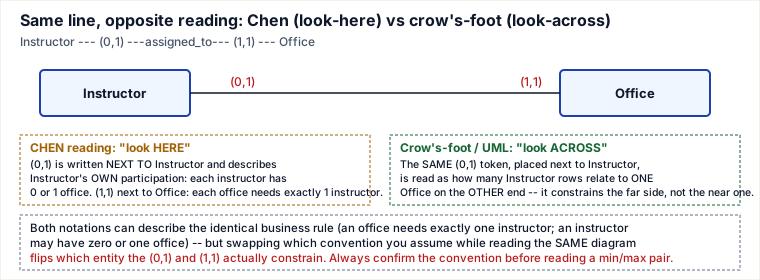
Chen notation and crow's-foot/UML notation both attach a (min,max) pair to each end of a relationship line, but they answer different questions with that pair — mixing up which convention you're reading is a real interview trap because the diagram itself gives no visual hint of which rule applies.
- Chen: "look HERE." The (min,max) written next to an entity describes that entity's own participation — how many times one instance of the entity next to the label appears in the relationship.
Instructor --(0,1)-- assigned_to --(1,1)-- Officereads as: one Instructor instance participates 0 or 1 times (may have no office); one Office instance participates exactly 1 time (every office needs an instructor). - Crow's-foot / UML: "look ACROSS." The multiplicity written next to an entity describes how many instances of that entity relate to one instance on the other end of the line. A "0..1" next to Office in UML means one Instructor connects to 0 or 1 Offices — the label physically sits by Office but constrains the Instructor side's fan-out.
The two conventions can describe the identical business rule and still place semantically opposite readings on the same visual token. There is no way to tell which convention a diagram uses by looking at the diagram alone — you must know the author's notation before trusting a single min/max pair.
Ternary relationships make it worse: the (min,max) itself is ambiguous, not just the convention
The earlier ER Models lesson on Cardinality & Participation shows why a ternary relationship — Works_In(Employee, Project, Location) — cannot be split into three binaries without losing information. What that lesson doesn't cover is that even within Chen's own (min,max) notation, a ternary relationship's participation numbers are read two genuinely different ways by different textbooks, and both readings are defensible:
- Reading 1 — "how many combinations." The (min,max) written next to
Employeecounts how many (Project, Location) pairs one Employee instance can appear with. A max of N means one employee can be tied to many project/location combinations simultaneously. - Reading 2 — "how many of me, for one fixed pair." The same (min,max) next to
Employeeinstead counts how many distinct Employee values can appear for one fixed (Project, Location) combination — i.e. it constrains the other two entities' joint instance, not Employee's own fan-out.
These produce different real-world constraints from the identical diagram. Elmasri & Navathe explicitly flag this as a source of disagreement across ER textbooks. The safe habit for a ternary relationship: don't trust the (min,max) pair alone — write out the business rule in a sentence ("can one employee work on the same project at two different locations?") and verify the diagram's numbers against that sentence, or avoid ternary (min,max) altogether and enforce the rule with an explicit CHECK/trigger on the resolved junction table instead.
3. Access-path consequences of relationships — the physical angle
A relationship's cardinality decides the FK/junction-table shape (covered in the base ER lessons); what decides whether a given query is fast is the column order of whatever index backs that FK or junction table — and that's a physical decision the ER diagram never shows.
Traced example: a composite PK only serves lookups leading with its first column
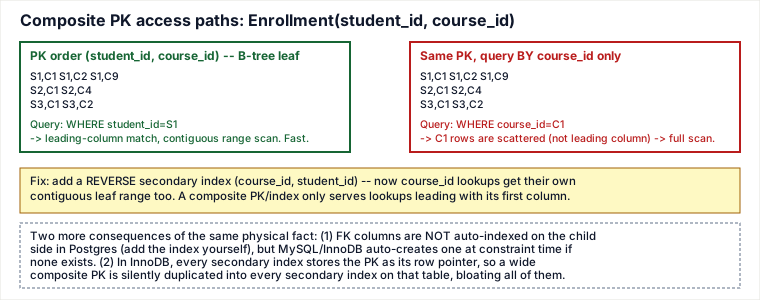
Take the familiar M:N junction Enrollment(student_id, course_id) with PRIMARY KEY(student_id, course_id) — a B-tree physically sorted by student_id first, then course_id within each student_id. Trace two queries against the same index:
WHERE student_id = 'S1'— the engine seeks directly to theS1prefix; every matching row (S1,C1,S1,C2,S1,C9) sits contiguously in that one leaf range. One seek, a short sequential read. Fast.WHERE course_id = 'C1'—course_idis the second key column, so rows withcourse_id='C1'(S1,C1,S2,C1,S3,C1) are scattered across whicheverstudent_idprefix they happen to fall under. The composite index cannot narrow the search bycourse_idalone — the engine must scan the whole table (or the whole index) checking every row's second column.
The fix is mechanical, not a schema redesign: add a second, reverse-order index (course_id, student_id). Now a "seats taken in C1" query gets its own contiguous leaf range too — at the cost of a second index to maintain on every insert/delete. The general rule: a composite key or index only accelerates lookups whose WHERE clause supplies a prefix of its column order — reversing which column leads is a genuinely different index, not the same one read differently.
Two more consequences that follow from the same physical fact
- FK columns are not auto-indexed — engine-dependent. Declaring
FOREIGN KEY (dept_id) REFERENCES Department(dept_id)in Postgres creates no index on the child table'sdept_idcolumn — only the parent side's primary key is indexed automatically, so every join on that FK, and every check the engine runs when a parent row is deleted (to see if any child still references it), falls back to a full scan of the child table unless you explicitly addCREATE INDEX ON child(dept_id). MySQL/InnoDB behaves differently: it auto-creates an index on the child FK column at constraint-creation time if one doesn't already exist covering it as a leftmost prefix — so the unindexed-FK scan hazard above is Postgres-specific, not universal. - Wide composite keys propagate into every child index. In InnoDB (MySQL), every secondary index stores the table's primary key as its row pointer (to look the full row back up in the clustered primary index). A wide composite PK — say a 3-column natural key — is silently duplicated into the leaf entry of every other secondary index on that table, inflating each one's size and, transitively, its buffer-cache footprint. This is the same access-path argument that motivates preferring a narrow surrogate key (covered in the Relational Model keys page) — here it's specifically the secondary-index bloat, not the write-locality argument, that makes a wide natural composite key expensive.
4. The 1:1 collapse decision: which side holds the FK?
The Relational Model keys page already covers whether to merge a 1:1 relationship into one table (default: merge, unless sparsity/hot-path/security forces a split) and the FK-as-PK pattern for enforcing 1:1 correctly. What it doesn't walk through is the decision this page adds: once you've decided to keep two tables, which table's PK becomes the FK — the answer is not arbitrary.
Rule 1: put the FK on the side with partial (optional) participation
Every Payroll row must reference a real Employee (total participation on the Payroll side), but not every Employee has a Payroll row yet — a new hire before their first pay cycle (partial participation on the Employee side, looked at from Payroll's relationship). Putting employee_id as both PK and FK on Payroll matches this exactly: a Payroll row cannot exist without a valid employee (the FK enforces it, NOT NULL by virtue of being the PK), and an Employee row is free to exist with zero matching Payroll rows (nothing on the Employee side requires one). Flipping the FK to the other table — a passport_id column on Employee — would force every employee to reference a passport row that might not exist yet, or require the column to be nullable, muddying which side is actually optional.
Rule 2: when both sides are genuinely optional, put the FK where the join actually happens
Some 1:1 pairs have no natural mandatory side at all — User and UserProfile, where either could exist first depending on your onboarding flow. Here the tie-breaker is access pattern, not integrity: put the FK (and its UNIQUE NOT NULL) on whichever table is more often read together with its partner in the same query, because that is the table whose row already carries a direct pointer to the other without an extra lookup. If UserProfile is always fetched by starting from a known User, an FK on UserProfile pointing back is the natural direction; if code more often starts from a profile and needs the user, symmetric reasoning applies in reverse. The two sides being interchangeable in principle doesn't mean the choice is free in practice — it means the workload decides it.
Partial participation on the many side of 1:N: nullable FK vs mandatory FK
The same optional/mandatory question shows up in ordinary 1:N, not just 1:1. Employee(emp_id, name, dept_id FK) — if some employees genuinely have no department yet (a new hire, a contractor between assignments), dept_id must be nullable, and every query that joins to Department needs to decide between an inner join (silently drops the unassigned employees) and a LEFT JOIN (keeps them, with NULL department columns) — a decision that has to be made deliberately at every query site, not once at the schema. The alternative — making dept_id NOT NULL by inventing a sentinel "Unassigned" department row — trades that recurring query-site decision for a one-time schema decision (maintain the sentinel row, exclude it explicitly wherever "employees with no real department" matters, e.g. headcount-by-department reports). Neither is universally correct: nullable FK models reality directly and is the default; a sentinel row earns its keep only when the "no NULL join surprises" property is worth maintaining a fake entity for.
5. ER vs. embedded: when a normalized relational model is the wrong tool
Everything above assumes the target is a normalized relational schema. That assumption itself has a boundary: an embedded/document model (MongoDB-style) beats a normalized ER design specifically when an aggregate is always read and written together and rarely joined across other aggregates — the two conditions the relational model doesn't optimize for by default.
Take Order and its OrderLineItems. In a normalized relational design this is a classic 1:N — one Orders row, many OrderLineItems rows, each carrying an FK back to the order. Fetching one order for display means a join (or a second round trip); writing one order means N+1 inserts inside one transaction. If line items are never queried independently of their order (nobody runs "find all line items across all orders for product X" as a primary access path — that's what a separate reporting/analytics store is for), embedding the line items as an array field inside one Order document collapses that N+1 write into one document write and that join into one document read — genuine read/write locality, not just a syntactic convenience.
The trade-off is named, not hand-waved: embedding trades read/write locality for two specific costs. First, update anomalies return in a different form — if each embedded line item duplicates the product's current price and name (denormalized on purpose, to avoid a lookup on read), a price change must now be pushed into every order document that embedded it, or the document is left holding stale data by design (acceptable for a historical order record, wrong for a live catalog). Second, unbounded arrays are a real ceiling — embedding every chat message of a conversation inside one conversation document works until the array outgrows the document size limit or simply degrades write performance as the document balloons, at which point the design needs a "bucketing" workaround (splitting one logical aggregate across several physical documents) that reintroduces exactly the multi-document coordination the embedding was chosen to avoid.
The judgment is not "documents are better" or "relational is better" — it's matching the storage shape to the actual access pattern: embed when the aggregate's write/read boundary and the document's boundary coincide and stay bounded; keep it relational (or reference instead of embed) the moment either the aggregate is queried in pieces from outside its own boundary, or its embedded collection has no natural size ceiling.
Pitfalls
- Concrete-table mapping under an overlapping constraint. If an entity can be more than one subtype at once, concrete-table mapping has no shared key to tie the duplicate superclass rows together — it silently only works under a disjoint constraint.
- Trusting a (min,max) label without confirming the notation. The same pair means "this entity's own fan-out" in Chen and "the other entity's fan-out" in crow's-foot/UML — reading one diagram with the wrong convention flips the constraint.
- Assuming a ternary relationship's (min,max) has one obvious meaning. Different textbooks read "how many combinations" vs "how many of me for one fixed pair" differently — verify against the plain-English business rule, don't trust the numbers alone.
- Assuming a composite PK indexes both column orders.
PRIMARY KEY(student_id, course_id)only accelerates queries that supplystudent_id(or both); acourse_id-only query needs its own reverse index. - Assuming a declared FK is indexed. Most engines index the parent's PK automatically but never the child's FK column — an unindexed FK means every join and every parent-delete integrity check falls back to a scan.
- Embedding an unbounded child collection. A "conversation messages" or "activity log" array with no natural cap will eventually hit the document size ceiling or degrade write latency well before that ceiling — bound it or don't embed it.
Judgment layer
- Which ISA mapping: single-table when subtypes are few, shallow, and mostly queried together with no strict per-subtype constraints needed; class-table when subtypes have real integrity rules of their own and polymorphic "any employee" queries matter; concrete-table only under a disjoint constraint, when leaf-only queries dominate and a shared superclass view is rarely needed.
- Which side gets the 1:1 FK: the side with partial participation (so the FK's mandatory-existence-of-parent constraint matches the actual optional side); if both sides are equally optional, whichever side the workload joins from most often.
- Nullable vs sentinel FK on the many side of 1:N: default to nullable — it's simpler and models reality; reach for a sentinel "unassigned" row only when eliminating NULL-join surprises across many query sites is worth maintaining a fake entity.
- Normalized ER vs embedded document: embed when the aggregate is always read/written as a unit, rarely queried in pieces from outside its own boundary, and has a bounded child collection; otherwise keep it relational (or reference rather than embed) — the moment any one of those three conditions breaks, the embedding trade-off stops paying for itself.
Takeaways
- An ISA hierarchy's three relational mappings trade the same variance three different ways: single-table pays in NULLs and lost per-subtype constraints, class-table pays in joins, concrete-table pays in duplicated columns and lost "query all" — pick based on disjoint/overlapping and total/partial, not habit.
- (min,max) notation is convention-dependent (look-here vs look-across) and, on a ternary relationship, ambiguous even within one convention — verify against the plain-English business rule before trusting the diagram.
- A relationship's cardinality decides the schema shape; its physical key/index column order decides which queries are fast — a composite PK or FK is only as useful as the column order a given query actually supplies.
- Embedding beats a normalized ER model exactly when an aggregate is always read/written whole, rarely queried in pieces, and bounded in size — otherwise it just relocates the anomalies normalization was built to remove.
Related pages
- Relational Model — Keys, FK Integrity, NULL Traps & Modeling Judgment (Deep Dive) — key/FK mechanics this page builds on
- Normalization — 3NF vs BCNF Dependency-Preservation, Lossless Join, Synthesis & 5NF (Deep Dive) — anomaly vocabulary this page assumes
- Introduction to ER Models — base entity/attribute/relationship vocabulary
- Cardinality and Participation — foundational cardinality concepts extended here
- Indexing & Storage — Fanout Arithmetic, Optimizer Stats, Composite/Skip Scans & NULL/OR Pitfalls (Deep Dive) — companion on composite-key access paths
Re-authored/Deepened for this guide.
🤖 Don't fully get this? Learn it with Claude
Stuck on ER Models — EER/ISA Hierarchies, Notation Ambiguity, Access-Path Consequences & When to Embed (Deep Dive)? Open Claude, copy a block below, and it'll teach you this exact concept — visually and interactively.
Build the mental picture, not memorization.
I just read a lesson on **ER Models — EER/ISA Hierarchies, Notation Ambiguity, Access-Path Consequences & When to Embed (Deep Dive)** (Databases) and want to truly understand it. Explain ER Models — EER/ISA Hierarchies, Notation Ambiguity, Access-Path Consequences & When to Embed (Deep Dive) from first principles using ONE vivid real-world analogy and a visual mental model — draw it as ASCII art or a clear step-by-step diagram — with a concrete example using real numbers. Then ask me one question to check I got the mental picture, and wait for my reply. If you're unsure or a claim isn't standard, say so and reason from first principles instead of guessing.
Socratic — adapts to where you're stuck.
Teach me **ER Models — EER/ISA Hierarchies, Notation Ambiguity, Access-Path Consequences & When to Embed (Deep Dive)** interactively. Ask me ONE guiding question at a time, wait for my answer, and adapt to my confusion — build the idea with me step by step instead of explaining it all at once. If you're unsure or a claim isn't standard, say so and reason from first principles instead of guessing.
Active recall exposes what you missed.
Quiz me on **ER Models — EER/ISA Hierarchies, Notation Ambiguity, Access-Path Consequences & When to Embed (Deep Dive)** with 5 questions, easy to tricky, ONE at a time. Tell me if each answer is right; at the end, explain clearly what I got wrong and why. If you're unsure or a claim isn't standard, say so and reason from first principles instead of guessing.
Intuition + hook + flashcards for long-term memory.
Help me remember **ER Models — EER/ISA Hierarchies, Notation Ambiguity, Access-Path Consequences & When to Embed (Deep Dive)** for the long term: give the one-sentence intuition, a memorable hook/mnemonic, a tiny worked example, and 3 active-recall flashcards (Q -> A). If you're unsure or a claim isn't standard, say so and reason from first principles instead of guessing.