What is Dynamic Programming
Dynamic Programming (DP) solves a problem faster than brute force by caching the answers to subproblems the recursive brute-force approach would otherwise recompute exponentially many times, then reusing those cached answers to assemble the final result in polynomial time.
Recognize the pattern
- The problem asks to optimize (min/max/count ways) over a sequence of choices — not "find one arrangement" but "find the best/count of arrangements."
- A brute-force recursive solution exists whose recursion tree has repeated calls with identical arguments (overlapping subproblems).
- The optimal answer to the whole problem can be built purely from optimal answers to strictly smaller instances (optimal substructure) — no need to know how a subproblem's optimum was achieved, only its value.
- Keywords: "minimum/maximum number of ways," "longest/shortest," "can we partition," "count distinct ways."
Brute force → optimal
Take computing the n-th Fibonacci number, Fib(n) = Fib(n-1) + Fib(n-2), Fib(0)=0, Fib(1)=1.
Brute-force recursion: call Fib(n-1) and Fib(n-2) directly, no caching. The number of calls grows exponentially, because fib(2), fib(1), etc. get recomputed from scratch every time they appear in the tree. O(2^n) is the standard loose upper bound quoted for this recursion; the exact growth rate is smaller and is derived precisely below. Space is O(n) for the call stack.
Optimal (DP): cache each Fib(k) the first time it's computed. Each of the n distinct subproblems is now solved once in O(1) work, giving O(n) time. Two equivalent ways to realize this:
- Top-down with memoization — keep the natural recursion, add an array/map cache; before recursing, check the cache.
- Bottom-up with tabulation — no recursion; fill a table from the smallest index upward, since each entry only needs the two before it.
Complexity, derived
Brute force: let C(n) be the exact number of calls to compute Fib(n). C(n) = C(n-1) + C(n-2) + 1, with C(0)=C(1)=1 (the "+1" counts the call itself). This is the same shape as the Fibonacci recurrence, so it has the same growth rate: C(n) = Θ(φ^n), where φ = (1+√5)/2 ≈ 1.618. This is the tight bound — the tighter, more informative fact than the loose O(2^n) ceiling mentioned above, and the two differ by an exponential factor as n grows (φ^n ≪ 2^n). Space is O(n) for the deepest recursion stack.
Memoized / tabulated: there are exactly n distinct subproblems (Fib(0) … Fib(n)). Each is computed exactly once, and each computation does O(1) work (one addition, one/two cache lookups). Total work = n subproblems × O(1) each = O(n) time. Space is O(n) for the cache/table (top-down also pays O(n) call-stack depth); bottom-up tabulation can be shrunk to O(1) space by keeping only the last two values, since Fib(k) only ever depends on Fib(k-1) and Fib(k-2).
Traced worked example — Fib(6), bottom-up
| i | 0 | 1 | 2 | 3 | 4 | 5 | 6 |
|---|---|---|---|---|---|---|---|
| dp[i] | 0 | 1 | 1 | 2 | 3 | 5 | 8 |
Each cell after the first two is dp[i] = dp[i-1] + dp[i-2]: dp[2]=1+0, dp[3]=1+1, dp[4]=2+1, dp[5]=3+2, dp[6]=5+3=8. That is five additions total (one per computed cell dp[2]..dp[6]). Compare against the brute-force call count using C(n)=C(n-1)+C(n-2)+1, C(0)=C(1)=1: C(2)=3, C(3)=5, C(4)=9, C(5)=15, C(6)=25 calls — not the loose 2^6=64 ceiling, which is a valid but slack upper bound, not the exact count for this tree.
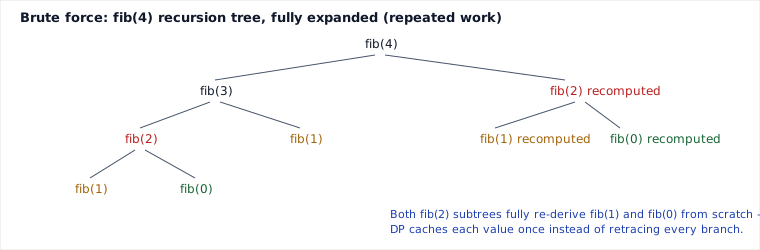
Pitfalls
- Wrong state definition: if the DP state doesn't capture everything needed to make future decisions (e.g. forgetting a "remaining capacity" dimension), memoized answers become wrong, not just slow.
- Recursion depth in memoization: a naive top-down recursion for large n (e.g. n = 10^6) can blow the call stack; bottom-up tabulation or an explicit stack avoids this.
- Forgetting base cases or off-by-one indices when translating the recurrence into array indices.
- Over-allocating space: using an O(n) or O(n·m) table when the recurrence only ever looks back a constant number of steps (rolling-array optimization applies, as with Fibonacci's O(1)-space version).
- Confusing a loose asymptotic bound with an exact count: quoting
O(2^n)for naive Fibonacci is a correct but slack ceiling — the exact call count follows C(n)=C(n-1)+C(n-2)+1 and grows as the tighter Θ(φ^n); don't treat the loose bound as the derived answer.
When to use / when NOT
Use DP when the problem has both overlapping subproblems and optimal substructure — it turns exponential brute force into polynomial time at the cost of extra memory.
vs. plain (greedy) recursion / divide-and-conquer: divide-and-conquer (e.g. merge sort) splits into disjoint subproblems, so there's nothing to cache — adding memoization there wastes memory for no speedup. Use DP specifically when subproblems overlap.
vs. Greedy: greedy makes one irrevocable locally-optimal choice per step and never revisits it — O(n) or O(n log n), no extra space for a table, but only correct when the problem provably has the greedy-choice property. DP is safer (explores/reuses all subproblem outcomes) but costs more time and space; prefer greedy when you can prove it's optimal, DP when you can't or when counting all ways.
vs. Backtracking: backtracking enumerates actual configurations (every valid arrangement), so reach for it when the problem asks you to list the solutions or when the constraints are irregular enough that no compact state captures them. DP applies precisely when you need only the aggregate optimum/count and the same subproblem recurs — then DP collapses backtracking's exponential enumeration into |states| work.
Java: brute force vs memoized vs tabulated
class Fibonacci {
  // Brute force: exact call count C(n)=C(n-1)+C(n-2)+1 = Theta(phi^n);
  // O(2^n) is the loose textbook ceiling. Space: O(n) call stack.
  static long fibBrute(int n) {
    if (n <= 1) return n;
    return fibBrute(n - 1) + fibBrute(n - 2);
  }

  // Top-down memoization: O(n) time, O(n) space
  static long fibMemo(int n, long[] cache) {
    if (n <= 1) return n;
    if (cache[n] != -1) return cache[n];
    cache[n] = fibMemo(n - 1, cache) + fibMemo(n - 2, cache);
    return cache[n];
  }

  // Bottom-up tabulation, rolled to O(1) space
  static long fibTab(int n) {
    if (n <= 1) return n;
    long prev2 = 0, prev1 = 1;
    for (int i = 2; i <= n; i++) {
      long cur = prev1 + prev2;
      prev2 = prev1;
      prev1 = cur;
    }
    return prev1;
  }
}
Takeaways
- DP = brute-force recursion + caching, applicable exactly when subproblems overlap and the problem has optimal substructure.
- Memoization (top-down) and tabulation (bottom-up) compute the same n subproblems; tabulation avoids recursion overhead and often permits O(1) space via rolling variables.
- Always derive complexity as (number of distinct subproblems) × (work per subproblem) — for Fibonacci that's n × O(1) = O(n), versus the brute-force call count C(n)=Θ(φ^n) (exactly 25 calls for Fib(6), far below the loose O(2^n)=64 ceiling).
- DP is not free: it trades memory (and design effort in choosing the right state) for time; when subproblems don't overlap, plain divide-and-conquer is simpler and equally fast.
Recall: Why does naive recursive Fibonacci take exponential time while the memoized version takes linear time, in terms of the number of distinct subproblems?
L0 · Dynamic Programming solves complex problems by breaking them into overlapping subproblems, computing each once, and storing results.
L1 · ⑤ Adversary/Edge — “If you use a top-down memoization approach, when does it fail compared to a bottom-up tabulation approach?”
Trap: Memoization is slower because of hash map lookups.
Bar: Memoization fails with a StackOverflowError due to deep recursion stack frames when the subproblem dependency chain exceeds 10,000 calls; bottom-up tabulation avoids recursion stack limits entirely by computing subproblems iteratively. What is DP
L2 · ② Failure — “You are solving a DP problem where the subproblems do not overlap (e.g. Merge Sort). What is the time complexity if you apply memoization?”
Trap: It makes the algorithm faster by caching intermediate results.
Bar: Caching results when there are no overlapping subproblems adds unnecessary hash table lookup overhead without reducing computations, keeping complexity at O(N log N). What is DP
L3 · ③ Scale — “A DP state table has dimensions dp[N][W] where N = 1,000 and W = 1,000,000. How do you prevent out-of-memory errors?”
Trap: Allocate a 2D array of size N × W.
Bar: A 2D array of 1,000,000,000 integers consumes 4GB of memory; if the state transition only depends on the previous row, use a rolling array of size 2 × W (or 1 × W) to reduce space complexity to O(W). What is DP
L4 · ① Concurrency — “Can you parallelize a bottom-up DP tabulation loop across multiple CPU cores?”
Trap: Divide the DP table into chunks and let each thread compute its chunk concurrently.
Bar: DP table entries have data dependencies on previous entries; identify the dependency direction and execute threads along independent diagonal wavefronts to prevent race conditions. What is DP
L5 · ⑥ Cost/Simplicity — “What are the trade-offs between Top-Down Memoization and Bottom-Up Tabulation?”
Trap: Tabulation is always better because it doesn't use recursion.
Bar: Memoization only computes states that are actually visited by the recursion path, whereas tabulation computes all states in the table; choose Memoization when the state space is sparse. What is DP
The floor keeps dropping: How do you solve the knapsack problem with dynamic programming when the weights are floating-point values instead of integers?
Self-locate: died at L1 → you present mid-level; L4+ → staff signal.
Facing any new concept? Hit it with the six: concurrent? failing? at 100×? over time? adversarial? worth the cost? — that's the interviewer's whole playbook.
Adapted from Grokking Dynamic Programming Patterns (Educative) and standard CLRS treatment of overlapping subproblems and optimal substructure.
🤖 Don't fully get this? Learn it with Claude
Stuck on What is Dynamic Programming? Open Claude, copy a block below, and it'll teach you this exact concept — visually and interactively.
Build the mental picture, not memorization.
I just read a lesson on **What is Dynamic Programming** (DSA) and want to truly understand it. Explain What is Dynamic Programming from first principles using ONE vivid real-world analogy and a visual mental model — draw it as ASCII art or a clear step-by-step diagram — with a concrete example using real numbers. Then ask me one question to check I got the mental picture, and wait for my reply. If you're unsure or a claim isn't standard, say so and reason from first principles instead of guessing.
Socratic — adapts to where you're stuck.
Teach me **What is Dynamic Programming** interactively. Ask me ONE guiding question at a time, wait for my answer, and adapt to my confusion — build the idea with me step by step instead of explaining it all at once. If you're unsure or a claim isn't standard, say so and reason from first principles instead of guessing.
Active recall exposes what you missed.
Quiz me on **What is Dynamic Programming** with 5 questions, easy to tricky, ONE at a time. Tell me if each answer is right; at the end, explain clearly what I got wrong and why. If you're unsure or a claim isn't standard, say so and reason from first principles instead of guessing.
Intuition + hook + flashcards for long-term memory.
Help me remember **What is Dynamic Programming** for the long term: give the one-sentence intuition, a memorable hook/mnemonic, a tiny worked example, and 3 active-recall flashcards (Q -> A). If you're unsure or a claim isn't standard, say so and reason from first principles instead of guessing.