Count of Subset Sum
Counting subsets that sum to a target works by building, for every prefix of the array and every achievable partial sum, the number of ways to reach that sum — each new element either joins existing subsets (carrying their count forward into a larger sum) or is skipped, so the count at dp[sum] accumulates contributions from both choices instead of just a yes/no reachability flag.
Recognize the pattern
- Phrase is "number of subsets/ways" (not "does a subset exist") that hit an exact sum or partition target.
- Elements are used at most once each (0/1, not unbounded) and are positive.
- Answer scales combinatorially — duplicates in the input produce distinct subsets by position, e.g. {1,3} and {1,3} from two different 1's both count.
- Sibling problems that reduce to this same table: Equal Subset-Sum Partition (target = totalSum/2, only possible if totalSum is even); Minimum Subset-Sum Difference (scan reachable sums near totalSum/2); Target Sum, assigning +/- to each element to hit a value
target— split elements into a positive set P and negative set N, thensum(P) - sum(N) = targetandsum(P) + sum(N) = totalSum, sosum(P) = (totalSum + target) / 2; feed that derived value in asSand count subsets exactly as below (no solution iftotalSum + targetis odd or negative).
Brute force → optimal
Brute force: recurse on each index with a choice to include or exclude it, summing the count of ways from both branches; base case succeeds when the running sum hits 0. This explores every subset: O(2n) time, O(n) recursion stack.
Optimal: the recursion only depends on (index, remainingSum), and remainingSum ranges over just 0..S — a classic overlapping-subproblems + optimal-substructure signature, so memoize or tabulate into a 2-D (or rolled 1-D) DP: O(n·S) time, O(S) space.
Complexity from first principles
Let dp[s] = number of ways to form sum s using elements processed so far. Recurrence per new element num:
dp_new[s] = dp_old[s]                 // exclude num
          + dp_old[s - num]  (if s >= num)   // include num
There are n elements, each requiring a pass over S+1 sum slots → exactly n·(S+1) constant-time updates: Time O(n·S). Only the previous row is ever read, so one array of length S+1 suffices, iterated right-to-left per element to avoid reusing an item twice in the same pass: Space O(S) (O(n·S) if you keep the full 2-D table for traceability/teaching).
Worked example
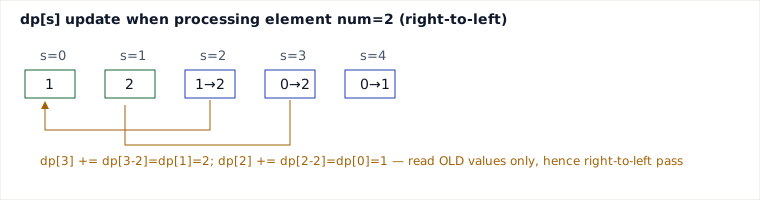
Input {1, 1, 2, 3}, S = 4. Rows = elements processed so far, columns = sum 0..4, dp[0]=1 always (empty subset makes sum 0). Each cell reads only the previous row's values (right-to-left pass), which is what keeps this 0/1 rather than unbounded.
| after | 0 | 1 | 2 | 3 | 4 |
|---|---|---|---|---|---|
| {} | 1 | 0 | 0 | 0 | 0 |
| +1 | 1 | 1 | 0 | 0 | 0 |
| +1 | 1 | 2 | 1 | 0 | 0 |
| +2 | 1 | 2 | 2 | 2 | 1 |
| +3 | 1 | 2 | 2 | 3 | 3 |
Trace the last two rows by hand: before processing 2, dp = [1,2,1,0,0]. Reading old values right-to-left, dp[4] += dp[2]=1 (→1), dp[3] += dp[1]=2 (→2), dp[2] += dp[0]=1 (→2), giving [1,2,2,2,1]. Then processing 3: dp[4] += dp[1]=2 (→1+2=3), dp[3] += dp[0]=1 (→2+1=3), giving the final row [1,2,2,3,3]. dp[4] = 3 matches direct enumeration: {1,1,2}, {1,3} using the first 1, and {1,3} using the second 1 — three position-distinct subsets, exactly what the recurrence counts.
Reference implementation (Java)
static int countSubsetSum(int[] nums, int S) {
    int[] dp = new int[S + 1];
    dp[0] = 1; // empty subset makes sum 0
    for (int num : nums) {
        for (int s = S; s >= num; s--) {
            dp[s] += dp[s - num];
        }
    }
    return dp[S];
}
Pitfalls
- Iterating the sum loop left-to-right reuses the same element multiple times in one pass, silently turning this into unbounded knapsack (Coin Change-style) instead of 0/1 counting.
- Forgetting
dp[0] = 1makes every count come out zero — the empty subset is the base case that seeds all others. - Confusing this with reachability (
booleanDP for "can we hit sum S") — that variant uses OR, this uses +, and mixing them gives a yes/no answer instead of a count. - Overflow: counts grow combinatorially (up to 2n); use
longfor large n. - Zeros in the input double the count of every sum they touch: a
0can be independently included or excluded without changing any sum, so each zero multiplies the answer by 2 (the updatedp[s] += dp[s-0]degenerates todp[s] += dp[s]). This is correct behavior, but a common surprise if you expect zeros to be inert.
When to use / when not
Use when items are used at most once, the target is small enough that S fits in memory (pseudo-polynomial, not polynomial in the numeric value of S), and you need a count rather than existence or an optimal value. If S is astronomically large but n is small (≤ ~20), prefer meet-in-the-middle: split into two halves, enumerate all 2n/2 subset sums per half, sort one half and binary-search/count matches against S - sum from the other — O(2n/2·log(2n/2)) time, no dependency on S at all. If you only need existence (not count), the boolean 0/1 knapsack reachability DP is cheaper to reason about and equally O(n·S).
Takeaways
- Counting DP replaces boolean OR with integer addition — same state space, richer answer.
dp[0] = 1is the seed; every other count is built from it.- Iterate sums right-to-left per element to preserve the 0/1 (use-once) constraint.
- Target Sum reduces to this table via
S = (totalSum + target) / 2; when S is huge but n is small, switch strategies entirely to meet-in-the-middle.
Recall: why must the inner sum loop run from S down to num, not from num up to S?
Pattern generalizes Kadane-adjacent 0/1 knapsack counting; canonical treatment in Grokking the Coding Interview (Subset Sum pattern) and CLRS-style DP-over-subset-sums exercises.
🤖 Don't fully get this? Learn it with Claude
Stuck on Count of Subset Sum? Open Claude, copy a block below, and it'll teach you this exact concept — visually and interactively.
Build the mental picture, not memorization.
I just read a lesson on **Count of Subset Sum** (DSA) and want to truly understand it. Explain Count of Subset Sum from first principles using ONE vivid real-world analogy and a visual mental model — draw it as ASCII art or a clear step-by-step diagram — with a concrete example using real numbers. Then ask me one question to check I got the mental picture, and wait for my reply. If you're unsure or a claim isn't standard, say so and reason from first principles instead of guessing.
Socratic — adapts to where you're stuck.
Teach me **Count of Subset Sum** interactively. Ask me ONE guiding question at a time, wait for my answer, and adapt to my confusion — build the idea with me step by step instead of explaining it all at once. If you're unsure or a claim isn't standard, say so and reason from first principles instead of guessing.
Active recall exposes what you missed.
Quiz me on **Count of Subset Sum** with 5 questions, easy to tricky, ONE at a time. Tell me if each answer is right; at the end, explain clearly what I got wrong and why. If you're unsure or a claim isn't standard, say so and reason from first principles instead of guessing.
Intuition + hook + flashcards for long-term memory.
Help me remember **Count of Subset Sum** for the long term: give the one-sentence intuition, a memorable hook/mnemonic, a tiny worked example, and 3 active-recall flashcards (Q -> A). If you're unsure or a claim isn't standard, say so and reason from first principles instead of guessing.