Minimum jumps with fee
Minimum Jumps with Fee
This is a linear-chain shortest-path DP: the cost of finishing from step i only depends on the cost of finishing from the (at most three) steps ahead of it, so the optimal total is built backward from the top using dp[i] = fee[i] + min(dp[i+1], dp[i+2], dp[i+3]) — you pay the fee for every step you actually land on, including the first one, and the recurrence collapses an exponential branch-and-choose tree into one pass over the array.
Recognize the pattern
- "You may skip 1, 2, or up to k positions forward" over a 1-D array or staircase.
- A cost/fee is attached to each position (not each edge), and you want the min/max total to go from start to just past the end.
- The answer at position
ionly needs answers at a small fixed window of positions ahead — classic sign of bottom-up DP over an index, not a graph search.
Brute Force → Optimal
Brute force: recurse from index i: try jumping 1, 2, or 3 steps, add fee[i], and take the minimum of the three recursive results; base case is reaching or passing index n-1 (cost 0 beyond it). Every call branches into up to 3 more calls with no reuse of overlapping subproblems, e.g. solve(i) = fee[i] + min(solve(i+1), solve(i+2), solve(i+3)).
Top-down memoized (the middle rung): notice solve(i) is asked for repeatedly (e.g. index 3 is reachable from 0, 1, and 2) — cache each result the first time it's computed, e.g. if memo[i] unset: memo[i] = fee[i] + min(solve(i+1), solve(i+2), solve(i+3)). This already collapses the work to O(n) time, since each of the n states is solved once and then reused, but it still pays O(n) recursion-stack space in the worst case because the call chain can run all the way from index 0 to the end before anything returns.
Bottom-up tabulation (the optimal rung): instead of recursing, fill the same states iteratively from the last index back to index 0, since dp[i] only needs dp[i+1..i+3], which are already known by the time you reach i. Same O(n) time as the memoized version, but no call stack at all — and because only the 3 most recent results are ever read, the array itself can be dropped for 3 rolling variables to reach O(1) space.
Complexity, Derived
Brute force: the recursion is T(n) = T(n-1) + T(n-2) + T(n-3) + O(1) — a tribonacci-shaped tree with branching factor up to 3 and depth n. A quick, loose ceiling is O(3^n) (bounding each branch by the max factor of 3), which is safe but not tight. The tight bound comes from solving the tribonacci-style recurrence's characteristic equation x^3 = x^2 + x + 1, whose dominant root is ≈1.839 — so the true growth rate is O(1.839^n), meaningfully smaller than 3^n for large n. Either way the call stack itself is O(n) deep.
Top-down memoized: O(n) time (n distinct states, each computed once) but O(n) recursion-stack space in the worst case.
Bottom-up tabulation: there are exactly n states (one per index), and each state does O(1) work — 3 array lookups and 2 comparisons — so total time is O(n). The dp array holds n+3 sentinel-inclusive slots: O(n) space. Since computing dp[i] only ever looks at the 3 most recently computed values, you can drop the array for 3 rolling variables and get O(1) space.
Worked Example
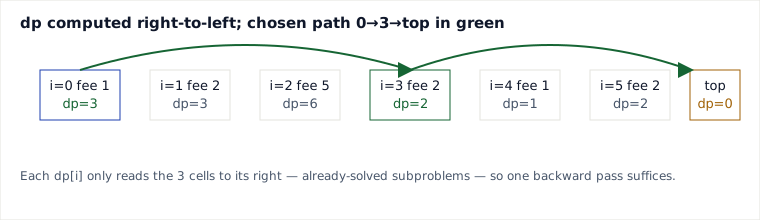
fee = {1, 2, 5, 2, 1, 2}, n = 6. Compute dp backward, with dp[6]=dp[7]=dp[8]=0 as sentinels (nothing left to pay once you're at or past the top):
| i | fee[i] | dp[i+1..i+3] | dp[i] = fee[i] + min(...) |
|---|---|---|---|
| 5 | 2 | 0, 0, 0 | 2 |
| 4 | 1 | 2, 0, 0 | 1 |
| 3 | 2 | 1, 2, 0 | 2 |
| 2 | 5 | 2, 1, 2 | 6 |
| 1 | 2 | 6, 2, 1 | 3 |
| 0 | 1 | 3, 6, 2 | 3 |
dp[0] = 3, matching the expected path 0 → 3 → top paying fee[0]+fee[3] = 1+2 = 3. The table also demonstrates optimality of that path without ever enumerating it explicitly — it falls out of the min chosen at i=0 (dp[3]=2 beats dp[1]=3 and dp[2]=6). This trace was hand-verified arithmetic over the pseudocode recurrence, not a compiled program run — treat it as confirmation that the recurrence is self-consistent on this input, not as a substitute for running an actual implementation before trusting the algorithm on your own data.
Pitfalls
These are bugs at the level of the recurrence and index arithmetic above, the same ones a real implementation would need to get right:
- Sentinel range too short: if the max jump is k, you need k sentinel zeros past index n-1 (here dp[n], dp[n+1], dp[n+2], i.e. dp[6..8] in the worked example) or the recurrence reads past the end of the conceptual array near the finish.
- Fee model confusion: this problem charges the fee for the step you land on, including the mandatory index 0 — a common bug is forgetting fee[0] is always paid, or double counting the top (top itself has no fee, hence the dp[n..n+2]=0 sentinels).
- Hardcoding 2 choices: copying the classic "min cost climbing stairs" recurrence (which only allows 1 or 2 steps, i.e.
dp[i]=fee[i]+min(dp[i+1],dp[i+2])) and forgetting this problem allows a 3rd option silently gives a suboptimal answer that still "looks" plausible. - Small n edge cases: for n=1 or n=2,
dp[i+2]anddp[i+3]fall on sentinel positions immediately — make sure the recurrence and its bounds are written so n < k is handled by the sentinels themselves, not by a special-cased branch that's easy to get wrong.
When to Use / When Not
Use this backward-DP-over-index approach when: costs live on positions in a line/array, the reachable next positions form a small fixed set (here {i+1,i+2,i+3}), and you want a single min/max total. It runs in O(n) time and O(1)–O(n) space with no priority queue overhead.
Trade-off vs Dijkstra's algorithm: if fees instead lived on arbitrary edges of a general graph (not a simple forward chain), or the jump set weren't small/fixed, you'd model it as a weighted graph and run Dijkstra (O((V+E) log V)) or BFS-for-unweighted. Here that would be overkill — Dijkstra's log-factor and priority queue bookkeeping buy you nothing when the graph is already a DAG with out-degree ≤ 3 that can be topologically processed by simply iterating the index backward.
Forward-DP reformulation (front-to-back)
The backward recurrence above cannot be evaluated top-down from i=0 without memoization, because dp[i] reads dp[i+1..i+3] — values not yet computed when you are still at i=0. If you want a plain left-to-right pass, flip the recurrence to read predecessors instead. Define dp_f[i] = min fee to be standing on step i:
dp_f[i] = fee[i] + min( dp_f[i-1], dp_f[i-2], dp_f[i-3] )   // treat dp_f[j<0] = 0 (ground)
answer  = min( dp_f[n-1], dp_f[n-2], dp_f[n-3] )            // free hop from any of the last 3 steps to the top
On fee={1,2,5,2,1,2}: dp_f = [1, 2, 5, 3, 3, 5], and answer = min(dp_f[5], dp_f[4], dp_f[3]) = min(5, 3, 3) = 3 — the same optimum, now reachable predecessors are always already solved, so no memo and no recursion are needed, just a single forward pass.
Takeaways
- Cost-at-position DP over a line reduces to
dp[i] = fee[i] + min(dp[i+1..i+k]), solved backward in O(n) time. - The brute-force recursion's true growth rate is the tribonacci constant ≈1.839^n, not the looser O(3^n) ceiling — both are exponential, but only one is tight.
- Between brute force and full tabulation sits top-down memoization: same O(n) time as tabulation, but still O(n) recursion-stack space, since nothing has been converted to an iterative pass yet.
- Sentinel zeros past the last index cleanly represent "already at/past the top, nothing more to pay," and must extend k slots past the end, not just 1.
- Rolling variables instead of a full array push space from O(n) down to O(1) since only the last k results are ever read.
- Prefer plain index-DP over graph search (Dijkstra/BFS) whenever the reachable set from each state is small and fixed — the overhead of a general algorithm isn't earned.
Recall: Why is dp[0] computed last in the bottom-up loop, and what would go wrong if you tried to compute it top-down (from i=0 to i=n-1) using the same recurrence dp[i]=fee[i]+min(dp[i+1..i+3]) without memoization?
Compiled from the given problem statement and examples; complexity and trade-off analysis, including the tribonacci growth-rate derivation, worked independently for this guide from the stated recurrence rather than from a runnable implementation.
🤖 Don't fully get this? Learn it with Claude
Stuck on Minimum jumps with fee? Open Claude, copy a block below, and it'll teach you this exact concept — visually and interactively.
Build the mental picture, not memorization.
I just read a lesson on **Minimum jumps with fee** (DSA) and want to truly understand it. Explain Minimum jumps with fee from first principles using ONE vivid real-world analogy and a visual mental model — draw it as ASCII art or a clear step-by-step diagram — with a concrete example using real numbers. Then ask me one question to check I got the mental picture, and wait for my reply. If you're unsure or a claim isn't standard, say so and reason from first principles instead of guessing.
Socratic — adapts to where you're stuck.
Teach me **Minimum jumps with fee** interactively. Ask me ONE guiding question at a time, wait for my answer, and adapt to my confusion — build the idea with me step by step instead of explaining it all at once. If you're unsure or a claim isn't standard, say so and reason from first principles instead of guessing.
Active recall exposes what you missed.
Quiz me on **Minimum jumps with fee** with 5 questions, easy to tricky, ONE at a time. Tell me if each answer is right; at the end, explain clearly what I got wrong and why. If you're unsure or a claim isn't standard, say so and reason from first principles instead of guessing.
Intuition + hook + flashcards for long-term memory.
Help me remember **Minimum jumps with fee** for the long term: give the one-sentence intuition, a memorable hook/mnemonic, a tiny worked example, and 3 active-recall flashcards (Q -> A). If you're unsure or a claim isn't standard, say so and reason from first principles instead of guessing.