Equal Subset Sum Partition
The equal-subset-sum-partition problem asks whether a set of positive integers can be split into two groups whose sums are identical; because the total sum S is fixed, this is really a disguised question of whether some subset sums to exactly S/2 — turning a partition problem into the classic 0/1 subset-sum decision problem, solved by deciding, item by item, which attainable sums remain reachable.
Recognize the pattern
- You are asked for a yes/no (or count) on splitting a set/array into two parts under a sum constraint.
- Each element can be used at most once (0/1, not unbounded) — that rules out coin-change-style unbounded knapsack.
- The total sum is small-to-moderate and known up front, so a target like
S/2can be computed before searching. - Odd total sum is an instant "False" — no need to search at all.
Brute force → optimal
Brute force: try every subset (2^n possibilities), sum each, check if any equals S/2. Correct but exponential — for n=200 (the stated constraint) this is astronomically infeasible.
Optimal (0/1 knapsack DP): build a boolean table dp[i][s] = "can the first i numbers form sum s?", where s only ever ranges over 0..target (sums above the target are never tracked — they're irrelevant to the yes/no question). Transition: dp[i][s] = dp[i-1][s] OR (s >= num[i-1] AND dp[i-1][s-num[i-1]]) — either skip the i-th number, or take it and check whether the remainder was reachable without it. Base case: dp[i][0] = true for all i (empty subset sums to 0). Answer = dp[n][S/2].
Complexity, derived
The table has (n+1) rows and (S/2+1) columns, and each cell is computed in O(1) from two already-known cells — so total work equals the cell count:
Time  = O(n * S/2) = O(n*S)   -- pseudo-polynomial (depends on VALUE of S, not just n)
Space = O(n * S) for the full table, or O(S) if you roll the table
        to one row and iterate sums DESCENDING (so a cell isn't
        reused within the same item's update).
With n≤200 and num[i]≤100, S≤20000, so n*S ≤ 4,000,000 — comfortably fast, even though it looks exponential-adjacent on paper.
Worked example
Array = {1, 5, 11, 5}. Total sum S = 22, even, so target = 11. Rolling 1-D dp array has size target + 1 = 12, valid indices 0..11 — the same bound used by the reference Java code below, so every sum in this trace stays inside that range. dp[0]=true initially, all else false. Process sums DESCENDING per item so each item is used at most once.
| After item | Sums reachable so far (dp[s]=true, s in 0..11) |
|---|---|
| 1 | {0, 1} |
| 5 | {0, 1, 5, 6} |
| 11 | {0, 1, 5, 6, 11} — target first becomes reachable here, via dp[11] |= dp[0] |
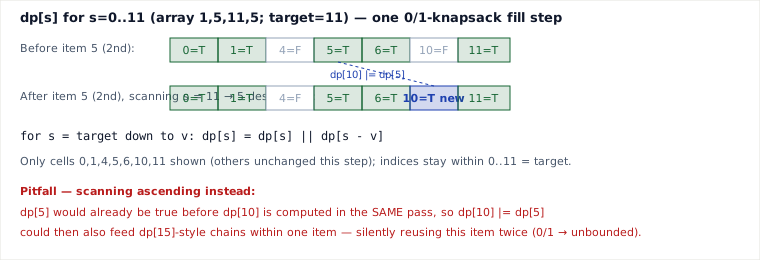
| 5 (2nd occurrence) | {0, 1, 5, 6, 10, 11} — 10 is newly reachable (dp[10] |= dp[5]); dp[11] was already true from the previous item, this pass just confirms it (dp[11] |= dp[6] finds the same true value again) |
dp[11] is true (first via subset {11}, also via {5, 5, 1}), so the array partitions into two subsets each summing to 11 — e.g. {11} and {1, 5, 5}. Answer: True.
Pitfalls
- Scanning sums ascending in the 1-D rolling array lets one item be used multiple times within the same item's pass (turns 0/1 knapsack into unbounded knapsack) — always scan target → item value, descending.
- Forgetting the odd-sum short-circuit wastes a full DP pass on an instantly-impossible input.
- Off-by-one on array size: the dp array needs indices
0..targetinclusive, i.e. sizetarget+1— never larger, since sums above target are never useful. - Confusing this with "count the number of subsets" (a related but distinct DP that sums counts, not ORs booleans).
When to use / when NOT — trade-offs
Use this DP when the target/sum range is small enough that O(n·S) is tractable (as bounded here: n≤200, S≤20000). It is simple, robust, and easy to verify.
Named alternative — meet-in-the-middle: split the array in half, enumerate all 2^(n/2) subset sums per half, sort one half and binary-search/two-pointer against the other for a match to S/2. Runs in O(2^(n/2) · n) time and O(2^(n/2)) space — better than the DP when S is huge (values up to 10^9) but n is small (≤40), the opposite regime from this problem's constraints.
Named alternative — bitset trick: represent the dp row as a single big-integer/bitset and do bits |= bits << v per item; this keeps the same O(n·S) asymptotic work but with a much smaller constant (word-level parallelism), useful when S is large and n is small-to-moderate.
Don't reach for full brute force or recursion-without-memoization outside of teaching contexts — it's correct but exponential and will not pass any real constraint.
Takeaways
- Partition-into-two-equal-halves reduces to subset-sum with target = totalSum/2; odd totals are immediately False.
- The DP is 0/1 knapsack in disguise: iterate items outer, sums inner-descending, to enforce "use each item once."
- Every sum tracked stays within
0..target— the dp array size is exactlytarget+1, never unbounded. - Complexity is pseudo-polynomial — O(n·S) — fast only because S is bounded by the problem's constraints, not because the algorithm is inherently polynomial in input size.
- Space can be compressed from a 2-D table to a single rolling 1-D array of size S+1.
Recall: why must the inner sum loop iterate in descending order when using a single 1-D dp array, and what bug appears if you iterate ascending instead?
Reference implementation (Java)
class Solution {
    public boolean canPartition(int[] num) {
        int sum = 0;
        for (int n : num) sum += n;
        if (sum % 2 != 0) return false; // can't split an odd sum evenly
        int target = sum / 2;
        boolean[] dp = new boolean[target + 1]; // indices 0..target only
        dp[0] = true; // empty subset sums to 0
        for (int v : num) {
            for (int s = target; s >= v; s--) { // descending: use v at most once
                dp[s] = dp[s] || dp[s - v];
            }
        }
        return dp[target];
    }
}
Source: adapted from the classic 0/1-Knapsack-family "Equal Subset Sum Partition" formulation; complexity, worked trace, and trade-off analysis derived first-principles for this guide.
🤖 Don't fully get this? Learn it with Claude
Stuck on Equal Subset Sum Partition? Open Claude, copy a block below, and it'll teach you this exact concept — visually and interactively.
Build the mental picture, not memorization.
I just read a lesson on **Equal Subset Sum Partition** (DSA) and want to truly understand it. Explain Equal Subset Sum Partition from first principles using ONE vivid real-world analogy and a visual mental model — draw it as ASCII art or a clear step-by-step diagram — with a concrete example using real numbers. Then ask me one question to check I got the mental picture, and wait for my reply. If you're unsure or a claim isn't standard, say so and reason from first principles instead of guessing.
Socratic — adapts to where you're stuck.
Teach me **Equal Subset Sum Partition** interactively. Ask me ONE guiding question at a time, wait for my answer, and adapt to my confusion — build the idea with me step by step instead of explaining it all at once. If you're unsure or a claim isn't standard, say so and reason from first principles instead of guessing.
Active recall exposes what you missed.
Quiz me on **Equal Subset Sum Partition** with 5 questions, easy to tricky, ONE at a time. Tell me if each answer is right; at the end, explain clearly what I got wrong and why. If you're unsure or a claim isn't standard, say so and reason from first principles instead of guessing.
Intuition + hook + flashcards for long-term memory.
Help me remember **Equal Subset Sum Partition** for the long term: give the one-sentence intuition, a memorable hook/mnemonic, a tiny worked example, and 3 active-recall flashcards (Q -> A). If you're unsure or a claim isn't standard, say so and reason from first principles instead of guessing.