Solution Subset Sum
Problem Statement
Given a set of positive numbers, determine if there exists a subset whose sum is equal to a given number 'S'.
Example 1:
Input: {1, 2, 3, 7}, S=6
Output: True
The given set has a subset whose sum is '6': {1, 2, 3}
Example 2:
Input: {1, 2, 7, 1, 5}, S=10
Output: True
The given set has a subset whose sum is '10': {1, 2, 7}
Example 3:
Input: {1, 3, 4, 8}, S=6
Output: False
The given set does not have any subset whose sum is equal to '6'.
Basic Solution
This problem follows the 0/1 Knapsack pattern and is quite similar to "Equal Subset Sum Partition".
A basic brute-force solution could be to try all subsets of the given numbers to see if any set has a sum equal to 'S'.
So our brute-force algorithm will look like:
for each number 'i'
  create a new set which INCLUDES number 'i' if it does not exceed 'S', and recursively
     process the remaining numbers
  create a new set WITHOUT number 'i', and recursively process the remaining numbers
return true if any of the above two sets has a sum equal to 'S', otherwise return false
Since this problem is quite similar to "Equal Subset Sum Partition", let's jump directly to the bottom-up dynamic programming solution.
Bottom-up Dynamic Programming
We'll try to find if we can make all possible sums with every subset to populate the array dp[TotalNumbers][S+1].
For every possible sum ‘s’ (where 0 <= s <= S), we have two options:
- Exclude the number. In this case, we will see if we can get the sum ‘s’ from the subset excluding this number =>
dp[index-1][s] - Include the number if its value is not more than ‘s’. In this case, we will see if we can find a subset to get the remaining sum =>
dp[index-1][s-num[index]]
If either of the above two scenarios returns true, we can find a subset with a sum equal to ‘s’.
Let's draw this visually, with the example input {1, 2, 3, 7}, and start with our base case of size zero:
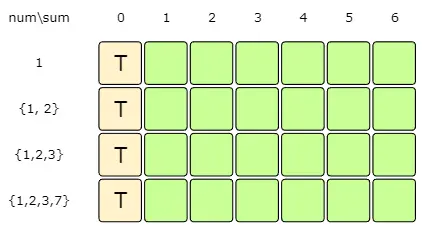
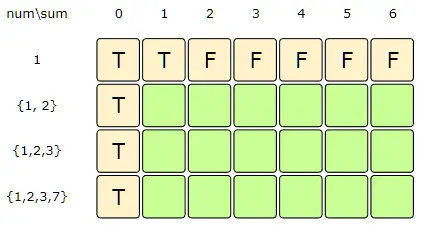
![sum: 1, index:1=> (dp[index-1][sum] , as the 'sum' is less than the number at index '1' (i.e., 1 < 2)](/assets/c78e5c170b1cc31c.webp)
![sum: 2, index:1=> (dp[index-1][sum] || dp[index-1][sum-2])](/assets/22e9759f8e5d4dd1.webp)
![sum: 3, index:1=> (dp[index-1][sum] || dp[index-1][sum-2])](/assets/4054bce5425958a6.webp)
![sum: 4-6 index:1=> (dp[index-1][sum] || dp[index-1][sum-2])](/assets/5282bed93e9c5ae5.webp)
![sum: 1,2,3, index:2=> (dp[index-1][sum] || dp[index-1][sum-3])](/assets/40e10484fa14161c.webp)
![sum: 4, index:2=> (dp[index-1][sum] || dp[index-1][sum-3])](/assets/4edabba242a0b450.webp)
![sum: 5, 6, index:2=> (dp[index-1][sum] || dp[index-1][sum-3])](/assets/cdd17a6fe43755c7.webp)
![sum: 1-6, index:3=> (dp[index-1][sum] || dp[index-1][sum-7])](/assets/8f0569bc1997eb2a.webp)
Code
Here is the code for our bottom-up dynamic programming approach:
class Solution {

  public boolean canPartition(int[] num, int sum) {
    int n = num.length;
    boolean[][] dp = new boolean[n][sum + 1];

    // populate the sum=0 columns, as we can always form '0' sum with an empty set
    for (int i = 0; i < n; i++) dp[i][0] = true;

    // with only one number, we can form a subset only when the required sum is
    // equal to its value
    for (int s = 1; s <= sum; s++) {
      dp[0][s] = (num[0] == s ? true : false);
    }

    // process all subsets for all sums
    for (int i = 1; i < num.length; i++) {
      for (int s = 1; s <= sum; s++) {
        // if we can get the sum 's' without the number at index 'i'
        if (dp[i - 1][s]) {
          dp[i][s] = dp[i - 1][s];
        } else if (s >= num[i]) {
          // else include the number and see if we can find a subset to get the remaining
          // sum
          dp[i][s] = dp[i - 1][s - num[i]];
        }
      }
    }

    // the bottom-right corner will have our answer.
    return dp[num.length - 1][sum];
  }

  public static void main(String[] args) {
    Solution ss = new Solution();
    int[] num = { 1, 2, 3, 7 };
    System.out.println(ss.canPartition(num, 6));
    num = new int[] { 1, 2, 7, 1, 5 };
    System.out.println(ss.canPartition(num, 10));
    num = new int[] { 1, 3, 4, 8 };
    System.out.println(ss.canPartition(num, 6));
  }
}
The above solution has time and space complexity of
Challenge
Can we further improve our bottom-up DP solution? Can you find an algorithm that has
Hint
Similar to the space optimized solution for "0/1 Knapsack".
Try it yourself
public class Solution {

  public boolean canPartition(int[] num, int sum) {
    //TODO: Write - Your - Code
    return false;
  }
}
Solution
🤖 Don't fully get this? Learn it with Claude
Stuck on Solution Subset Sum? Open Claude, copy a block below, and it'll teach you this exact concept — visually and interactively.
Progressively stronger hints — you still solve it.
I'm working on the problem **Solution Subset Sum** (DSA). Give me a HINT LADDER: start with the tiniest nudge, then wait. Only reveal the next, stronger hint when I ask. Do NOT show the full solution unless I type 'show solution'. Keep me doing the thinking. If you're unsure or a claim isn't standard, say so and reason from first principles instead of guessing.
See the technique, not just code.
Explain the optimal approach to **Solution Subset Sum** with a VISUAL walkthrough: trace it on a small concrete example using ASCII art / a step-by-step diagram, narrate what changes each step, then give time & space complexity with a one-line derivation. If you're unsure or a claim isn't standard, say so and reason from first principles instead of guessing.
Catch bugs, edge cases, sub-optimality.
I'll paste my solution to **Solution Subset Sum**. Review it for correctness, missed edge cases, and time/space complexity, then coach me toward the optimal — don't just rewrite it. Ask me to paste my code now. If you're unsure or a claim isn't standard, say so and reason from first principles instead of guessing.
Lock in recognition with look-alikes.
Give me 2 problems that use the SAME underlying pattern as **Solution Subset Sum**. For each, let me attempt first, then review my answer and name the trigger signal that reveals the pattern. If you're unsure or a claim isn't standard, say so and reason from first principles instead of guessing.