Solution 01 Knapsack
Introduction
Given the weights and profits of 'N' items, we are asked to put these items in a knapsack that has a capacity 'C'. The goal is to get the maximum profit from the items in the knapsack. Each item can only be selected once, as we don't have multiple quantities of any item.
Let's take Merry's example, who wants to carry some fruits in the knapsack to get maximum profit. Here are the weights and profits of the fruits:
Items: { Apple, Orange, Banana, Melon }
Weights: { 2, 3, 1, 4 }
Profits: { 4, 5, 3, 7 }
Knapsack capacity: 5
Let's try to put different combinations of fruits in the knapsack, such that their total weight is not more than 5:
Apple + Orange (total weight 5) => 9 profit
Apple + Banana (total weight 3) => 7 profit
Orange + Banana (total weight 4) => 8 profit
Banana + Melon (total weight 5) => 10 profit
This shows that Banana + Melon is the best combination, as it gives us the maximum profit and the total weight does not exceed the capacity.
Problem Statement
Given two integer arrays to represent weights and profits of 'N' items, we need to find a subset of these items which will give us maximum profit such that their cumulative weight is not more than a given number 'C'. Write a function that returns the maximum profit. Each item can only be selected once, which means either we put an item in the knapsack or skip it.
Basic Solution
A basic brute-force solution could be to try all combinations of the given items (as we did above), allowing us to choose the one with maximum profit and a weight that doesn’t exceed ‘C.’ Take the example of four items (A, B, C, and D), as shown in the diagram below. To try all the combinations, our algorithm will look like:
for each item 'i'
  create a new set which INCLUDES item 'i' if the total weight does not exceed the capacity, and
     recursively process the remaining capacity and items
  create a new set WITHOUT item 'i', and recursively process the remaining items
return the set from the above two sets with higher profit
Here is a visual representation of our algorithm:

All green boxes have a total weight that is less than or equal to the capacity (7), and all the red ones have a weight that is more than 7. The best solution we have is with items [B, D] having a total profit of 22 and a total weight of 7.
Code
Here is the code for the brute-force solution:
public class Solution {

  public int solveKnapsack(int[] profits, int[] weights, int capacity) {
    return this.knapsackRecursive(profits, weights, capacity, 0);
  }

  private int knapsackRecursive(
    int[] profits,
    int[] weights,
    int capacity,
    int currentIndex
  ) {
    // base checks
    if (capacity <= 0 || currentIndex >= profits.length) return 0;

    // recursive call after choosing the element at the currentIndex
    // if the weight of the element at currentIndex exceeds the capacity, we shouldn't process this
    int profit1 = 0;
    if (weights[currentIndex] <= capacity) profit1 =
      profits[currentIndex] +
      knapsackRecursive(
        profits,
        weights,
        capacity - weights[currentIndex],
        currentIndex + 1
      );

    // recursive call after excluding the element at the currentIndex
    int profit2 = knapsackRecursive(
      profits,
      weights,
      capacity,
      currentIndex + 1
    );

    return Math.max(profit1, profit2);
  }
}
The above algorithm's time complexity is exponential
The space complexity is
Let's visually draw the recursive calls to see if there are any overlapping sub-problems. As we can see, in each recursive call, profits and weights arrays remain constant, and only capacity and currentIndex change. For simplicity, let's denote capacity with 'c' and currentIndex with 'i':
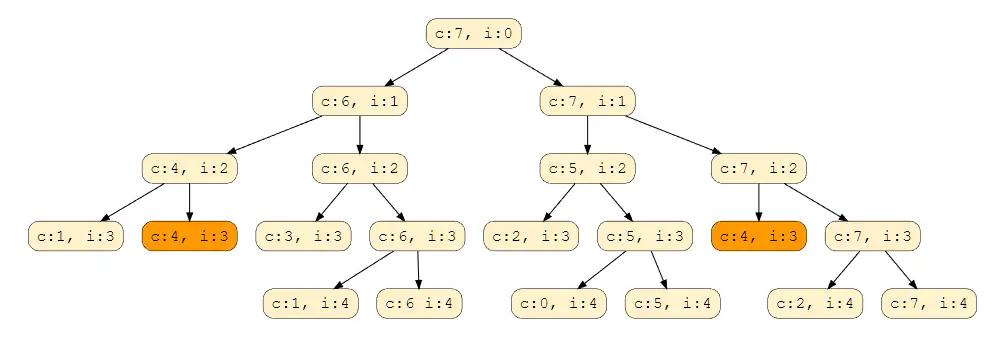
We can clearly see that 'c:4, i=3' has been called twice; hence we have an overlapping sub-problems pattern. As we discussed above, overlapping sub-problems can be solved through Memoization.
Top-down Dynamic Programming with Memoization
We can use memoization to overcome the overlapping sub-problems. To reiterate, memoization is when we store the results of all the previously solved sub-problems and return the results from memory if we encounter a problem that has already been solved.
Since we have two changing values (capacity and currentIndex) in our recursive function knapsackRecursive(), we can use a two-dimensional array to store the results of all the solved sub-problems. As mentioned above, we need to store results for every sub-array (i.e., for every possible index 'i') and for every possible capacity 'c'.
Code
Here is the code with memoization:
public class Solution {

  public int solveKnapsack(int[] profits, int[] weights, int capacity) {
    Integer[][] dp = new Integer[profits.length][capacity + 1];
    return this.knapsackRecursive(dp, profits, weights, capacity, 0);
  }

  private int knapsackRecursive(
    Integer[][] dp,
    int[] profits,
    int[] weights,
    int capacity,
    int currentIndex
  ) {
    // base checks
    if (capacity <= 0 || currentIndex >= profits.length) return 0;

    // if we have already solved a similar problem, return the result from memory
    if (dp[currentIndex][capacity] != null) return dp[currentIndex][capacity];

    // recursive call after choosing the element at the currentIndex
    // if the weight of the element at currentIndex exceeds the capacity, we shouldn't process this
    int profit1 = 0;
    if (weights[currentIndex] <= capacity) profit1 =
      profits[currentIndex] +
      knapsackRecursive(
        dp,
        profits,
        weights,
        capacity - weights[currentIndex],
        currentIndex + 1
      );

    // recursive call after excluding the element at the currentIndex
    int profit2 = knapsackRecursive(
      dp,
      profits,
      weights,
      capacity,
      currentIndex + 1
    );

    dp[currentIndex][capacity] = Math.max(profit1, profit2);
    return dp[currentIndex][capacity];
  }
}
What is the time and space complexity of the above solution? Since our memoization array dp[profits.length][capacity+1] stores the results for all the subproblems, we can conclude that we will not have more than
The above algorithm will be using
Bottom-up Dynamic Programming
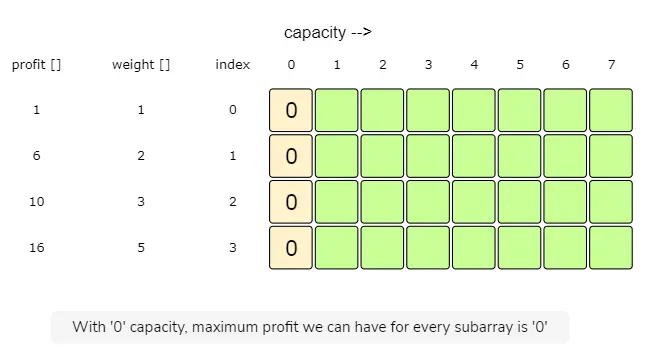
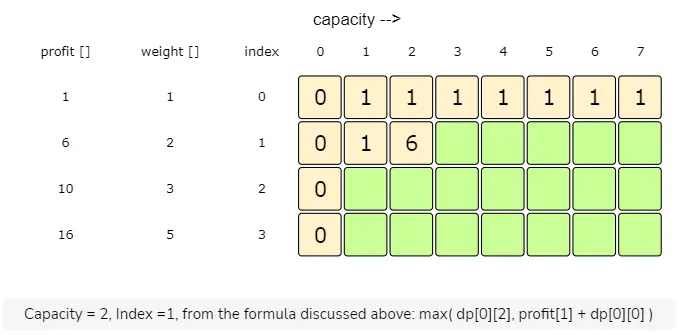
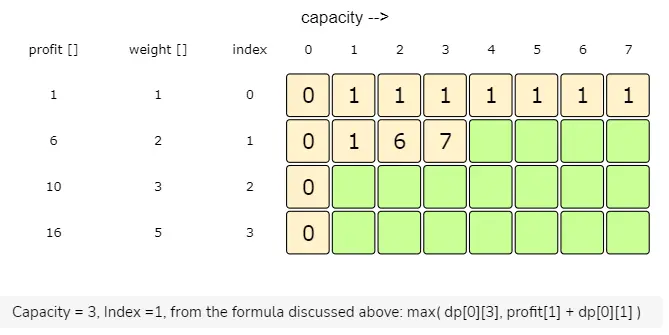
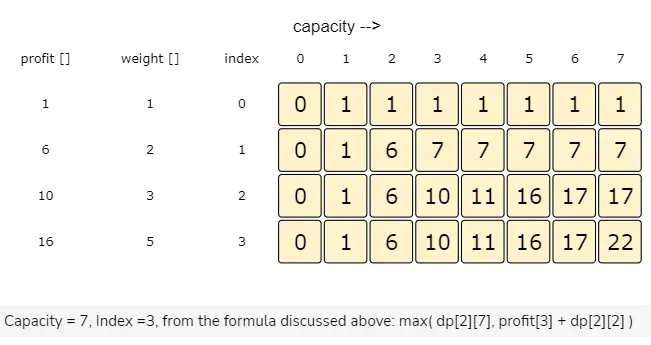
Let's try to populate our dp[][] array from the above solution, working in a bottom-up fashion. Essentially, we want to find the maximum profit for every sub-array and for every possible capacity. This means, dp[i][c] will represent the maximum knapsack profit for capacity 'c' calculated from the first 'i' items.
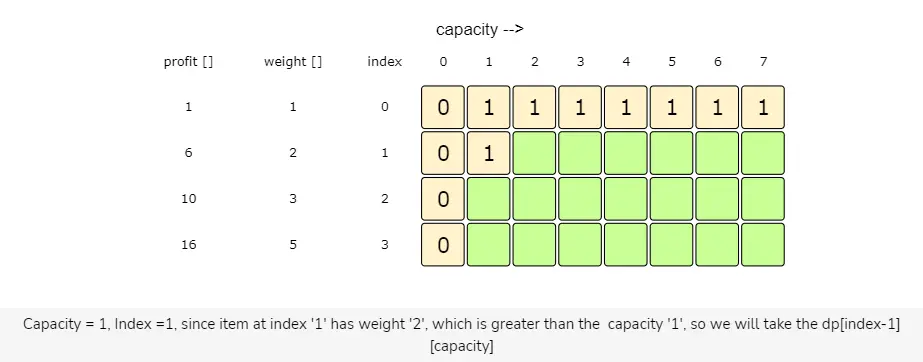
So, for each item at index 'i' (0 <= i < items.length) and capacity 'c' (0 <= c <= capacity), we have two options:
- Exclude the item at index 'i'. In this case, we will take whatever profit we get from the sub-array excluding this item =>
dp[i-1][c] - Include the item at index 'i' if its weight is not more than the capacity. In this case, we include its profit plus whatever profit we get from the remaining capacity and from remaining items =>
profits[i] + dp[i-1][c-weights[i]]
Finally, our optimal solution will be maximum of the above two values:
dp[i][c] = max (dp[i-1][c], profits[i] + dp[i-1][c-weights[i]])
Let's visually draw this and start with our base case of zero capacity:
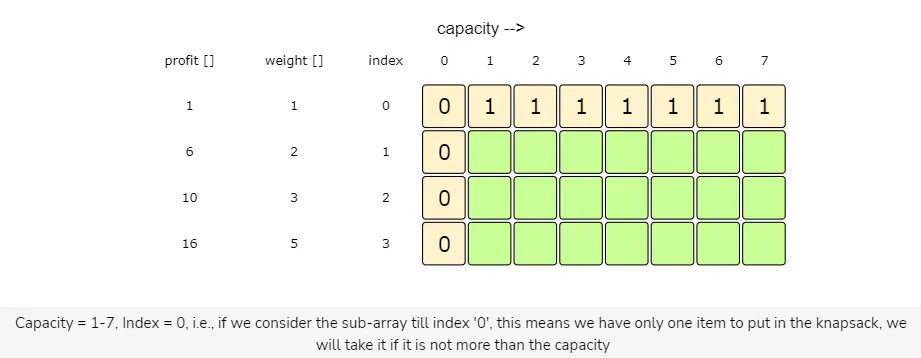
Code
Here is the code for our bottom-up dynamic programming approach:
public class Solution {

  public int solveKnapsack(int[] profits, int[] weights, int capacity) {
    // basic checks
    if (
      capacity <= 0 || profits.length == 0 || weights.length != profits.length
    ) return 0;

    int n = profits.length;
    int[][] dp = new int[n][capacity + 1];

    // populate the capacity=0 columns, with '0' capacity we have '0' profit
    for (int i = 0; i < n; i++) dp[i][0] = 0;

    // if we have only one weight, we will take it if it is not more than the capacity
    for (int c = 0; c <= capacity; c++) {
      if (weights[0] <= c) dp[0][c] = profits[0];
    }

    // process all sub-arrays for all the capacities
    for (int i = 1; i < n; i++) {
      for (int c = 1; c <= capacity; c++) {
        int profit1 = 0, profit2 = 0;
        // include the item, if it is not more than the capacity
        if (weights[i] <= c) profit1 = profits[i] + dp[i - 1][c - weights[i]];
        // exclude the item
        profit2 = dp[i - 1][c];
        // take maximum
        dp[i][c] = Math.max(profit1, profit2);
      }
    }

    // maximum profit will be at the bottom-right corner.
    return dp[n - 1][capacity];
  }
}
The above solution has a time and space complexity of
How to find the selected items?
As we know that the final profit is at the bottom-right corner; therefore, we will start from there to find the items that will be going in the knapsack.
As you remember, at every step, we had two options: include an item or skip it. If we skip an item, then we take the profit from the remaining items (i.e., from the cell right above it); if we include the item, then we jump to the remaining profit to find more items.
Let's understand this from the above example:
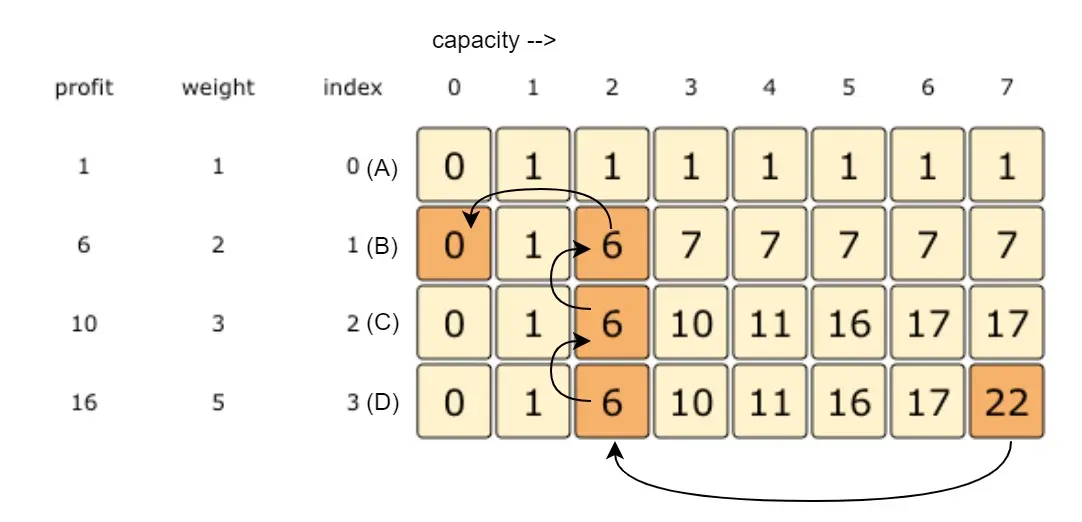
- '22' did not come from the top cell (which is 17); hence we must include the item at index '3' (which is the item 'D').
- Subtract the profit of item 'D' from '22' to get the remaining profit '6'. We then jump to profit '6' on the same row.
- '6' came from the top cell, so we jump to row '2'.
- Again, '6' came from the top cell, so we jump to row '1'.
- '6' is different than the top cell, so we must include this item (which is item 'B').
- Subtract the profit of 'B' from '6' to get the profit '0'. We then jump to profit '0' on the same row. As soon as we hit zero remaining profit, we can finish our item search.
- So items going into the knapsack are {B, D}.
Let's write a function to print the set of items included in the knapsack.
public class Solution {

  public int solveKnapsack(int[] profits, int[] weights, int capacity) {
    // base checks
    if (
      capacity <= 0 || profits.length == 0 || weights.length != profits.length
    ) return 0;

    int n = profits.length;
    int[][] dp = new int[n][capacity + 1];

    // populate the capacity=0 columns, with '0' capacity we have '0' profit
    for (int i = 0; i < n; i++) dp[i][0] = 0;

    // if we have only one weight, we will take it if it is not more than the capacity
    for (int c = 0; c <= capacity; c++) {
      if (weights[0] <= c) dp[0][c] = profits[0];
    }

    // process all sub-arrays for all the capacities
    for (int i = 1; i < n; i++) {
      for (int c = 1; c <= capacity; c++) {
        int profit1 = 0, profit2 = 0;
        // include the item, if it is not more than the capacity
        if (weights[i] <= c) profit1 = profits[i] + dp[i - 1][c - weights[i]];
        // exclude the item
        profit2 = dp[i - 1][c];
        // take maximum
        dp[i][c] = Math.max(profit1, profit2);
      }
    }

    printSelectedElements(dp, weights, profits, capacity);
    // maximum profit will be at the bottom-right corner.
    return dp[n - 1][capacity];
  }

  private void printSelectedElements(
    int dp[][],
    int[] weights,
    int[] profits,
    int capacity
  ) {
    System.out.print("Selected weights:");
    int totalProfit = dp[weights.length - 1][capacity];
    for (int i = weights.length - 1; i > 0; i--) {
      if (totalProfit != dp[i - 1][capacity]) {
        System.out.print(" " + weights[i]);
        capacity -= weights[i];
        totalProfit -= profits[i];
      }
    }

    if (totalProfit != 0) System.out.print(" " + weights[0]);
    System.out.println("");
  }
}
Challenge
Can we further improve our bottom-up DP solution? Can you find an algorithm that has
We only need one previous row to find the optimal solution!
Solution code
Here is the solution code.
public class Solution {

  public int solveKnapsack(int[] profits, int[] weights, int capacity) {
    // basic checks
    if (
      capacity <= 0 || profits.length == 0 || weights.length != profits.length
    ) return 0;

    int n = profits.length;
    // we only need one previous row to find the optimal solution, overall we need '2' rows
    // the above solution is similar to the previous solution, the only difference is that
    // we use `i%2` instead if `i` and `(i-1)%2` instead if `i-1`
    int[][] dp = new int[2][capacity + 1];

    // if we have only one weight, we will take it if it is not more than the capacity
    for (int c = 0; c <= capacity; c++) {
      if (weights[0] <= c) dp[0][c] = dp[1][c] = profits[0];
    }

    // process all sub-arrays for all the capacities
    for (int i = 1; i < n; i++) {
      for (int c = 0; c <= capacity; c++) {
        int profit1 = 0, profit2 = 0;
        // include the item, if it is not more than the capacity
        if (weights[i] <= c) profit1 =
          profits[i] + dp[(i - 1) % 2][c - weights[i]];
        // exclude the item
        profit2 = dp[(i - 1) % 2][c];
        // take maximum
        dp[i % 2][c] = Math.max(profit1, profit2);
      }
    }

    return dp[(n - 1) % 2][capacity];
  }
}
The above solution is similar to the previous solution; the only difference is that we use i%2 instead of i and (i-1)%2 instead of i-1. This solution has a space complexity of
This space optimization solution can also be implemented using a single array. It is a bit tricky though, but the intuition is to use the same array for the previous and the next iteration!
If you see closely, we need two values from the previous iteration: dp[c] and dp[c-weight[i]]
Since our inner loop is iterating over c:0-->capacity, let's see how this might affect our two required values:
- When we access
dp[c], it has not been overridden yet for the current iteration, so it should be fine. dp[c-weight[i]]might be overridden if "weight[i] > 0". Therefore we can't use this value for the current iteration.
To solve the second case, we can change our inner loop to process in the reverse direction: c:capacity-->0. This will ensure that whenever we change a value in dp[], we will not need it anymore in the current iteration.
Can you try writing this algorithm?
    // basic checks
    if (
      capacity <= 0 || profits.length == 0 || weights.length != profits.length
    ) return 0;

    int n = profits.length;
    int[] dp = new int[capacity + 1];

    // if we have only one weight, we will take it if it is not more than the
    // capacity
    for (int c = 0; c <= capacity; c++) {
      if (weights[0] <= c) dp[c] = profits[0];
    }

    // process all sub-arrays for all the capacities
    for (int i = 1; i < n; i++) {
      for (int c = capacity; c >= 0; c--) {
        int profit1 = 0, profit2 = 0;
        // include the item, if it is not more than the capacity
        if (weights[i] <= c) profit1 = profits[i] + dp[c - weights[i]];
        // exclude the item
        profit2 = dp[c];
        // take maximum
        dp[c] = Math.max(profit1, profit2);
      }
    }

    return dp[capacity];
  }
}
🤖 Don't fully get this? Learn it with Claude
Stuck on Solution 01 Knapsack? Open Claude, copy a block below, and it'll teach you this exact concept — visually and interactively.
Progressively stronger hints — you still solve it.
I'm working on the problem **Solution 01 Knapsack** (DSA). Give me a HINT LADDER: start with the tiniest nudge, then wait. Only reveal the next, stronger hint when I ask. Do NOT show the full solution unless I type 'show solution'. Keep me doing the thinking. If you're unsure or a claim isn't standard, say so and reason from first principles instead of guessing.
See the technique, not just code.
Explain the optimal approach to **Solution 01 Knapsack** with a VISUAL walkthrough: trace it on a small concrete example using ASCII art / a step-by-step diagram, narrate what changes each step, then give time & space complexity with a one-line derivation. If you're unsure or a claim isn't standard, say so and reason from first principles instead of guessing.
Catch bugs, edge cases, sub-optimality.
I'll paste my solution to **Solution 01 Knapsack**. Review it for correctness, missed edge cases, and time/space complexity, then coach me toward the optimal — don't just rewrite it. Ask me to paste my code now. If you're unsure or a claim isn't standard, say so and reason from first principles instead of guessing.
Lock in recognition with look-alikes.
Give me 2 problems that use the SAME underlying pattern as **Solution 01 Knapsack**. For each, let me attempt first, then review my answer and name the trigger signal that reveals the pattern. If you're unsure or a claim isn't standard, say so and reason from first principles instead of guessing.