Solution Coin Change
Introduction
Given an infinite supply of ‘n’ coin denominations and a total money amount, we are asked to find the total number of distinct ways to make up that amount.
Example:
Denominations: {1,2,3}
Total amount: 5
Output: 5
Explanation: There are five ways to make the change for '5', here are those ways:
  1. {1,1,1,1,1}
  2. {1,1,1,2}
  3. {1,2,2}
  4. {1,1,3}
  5. {2,3}
Problem Statement
Given a number array to represent different coin denominations and a total amount 'T', we need to find all the different ways to make a change for 'T' with the given coin denominations. We can assume an infinite supply of coins, therefore, each coin can be chosen multiple times.
Constraints:
1 <= coins.length <= 12- 1 <= coins[i] <= 231 - 1
- 0 <= amount <= 104
This problem follows the "Unbounded Knapsack" pattern.
Basic Solution
A basic brute-force solution could be to try all combinations of the given coins to select the ones that give a total sum of 'T'. This is what our algorithm will look like:
for each coin 'c'
  create a new set which includes one quantity of coin 'c' if it does not exceed 'T', and
     recursively call to process all coins
  create a new set without coin 'c', and recursively call to process the remaining coins
return the count of sets who have a sum equal to 'T'
This problem is quite similar to "Count of Subset Sum". The only difference here is that after including the item (i.e., coin), we recursively call to process all the items (including the current coin). In 'Count of Subset Sum', however, we were recursively calling to process only the remaining items.
Code
Here is the code for the brute-force solution:
class Solution {

  public int countChange(int[] denominations, int total) {
    return this.countChangeRecursive(denominations, total, 0);
  }

  private int countChangeRecursive(
    int[] denominations,
    int total,
    int currentIndex
  ) {
    // basic checks
    if (total == 0) return 1;

    if (
      denominations.length == 0 || currentIndex >= denominations.length
    ) return 0;

    // recursive call after selecting the coin at the currentIndex
    // if the coin at currentIndex exceeds the total, we shouldn't process this
    int sum1 = 0;
    if (denominations[currentIndex] <= total) sum1 = countChangeRecursive(
      denominations,
      total - denominations[currentIndex],
      currentIndex
    );

    // recursive call after excluding the coin at the currentIndex
    int sum2 = countChangeRecursive(denominations, total, currentIndex + 1);

    return sum1 + sum2;
  }

  public static void main(String[] args) {
    Solution cc = new Solution();
    int[] denominations = { 1, 2, 3 };
    System.out.println(cc.countChange(denominations, 5));
  }
}
The time complexity of the above algorithm is exponential
Let's try to find a better solution.
Top-down Dynamic Programming with Memoization
We can use memoization to overcome the overlapping sub-problems. We will be using a two-dimensional array to store the results of solved sub-problems. As mentioned above, we need to store results for every coin combination and for every possible sum:
class Solution {


  public int countChange(int[] denominations, int total)

  {
      Integer[][] dp = new Integer[denominations.length][total + 1];
      return this.countChangeRecursive(dp, denominations, total, 0);
  }


  private int countChangeRecursive(Integer[][] dp, int[] denominations, int
  total, int currentIndex)

  {
      // base checks
      if (total == 0)
      return 1;

      if(denominations.length == 0 || currentIndex >= denominations.length)
      return 0;

      // if we have already processed a similar sub-problem, return the result from memory
      if(dp[currentIndex][total] != null)
      return dp[currentIndex][total];

      // recursive call after selecting the coin at the currentIndex
      // if the number at currentIndex exceeds the total, we shouldn't process this
      int sum1 = 0;
      if( denominations[currentIndex] <= total )
      sum1 = countChangeRecursive(dp, denominations, total - denominations[currentIndex], currentIndex);

      // recursive call after excluding the number at the currentIndex
      int sum2 = countChangeRecursive(dp, denominations, total, currentIndex + 1);

      dp[currentIndex][total] = sum1 + sum2;
      return dp[currentIndex][total];
  }


  public static void main(String[] args) {
      Solution cc = new Solution();
      int[] denominations = {1, 2, 3};
      System.out.println(cc.countChange(denominations, 5));
  }
}
Bottom-up Dynamic Programming
We will try to find if we can make all possible sums, with every combination of coins, to populate the array dp[TotalDenominations][Total+1].
So for every possible total ‘t’ (0<= t <= Total) and for every possible coin index (0 <= index < denominations.length), we have two options:
- Exclude the coin. Count all the coin combinations without the given coin up to the total 't' =>
dp[index-1][t] - Include the coin if its value is not more than ‘t’. In this case, we will count all the coin combinations to get the remaining total:
dp[index][t-denominations[index]]
Finally, to find the total combinations, we will add both the above two values:
dp[index][t] = dp[index-1][t] + dp[index][t-denominations[index]]
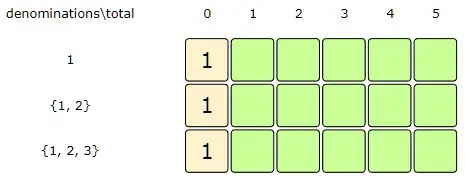
Let’s draw this visually with the following example:
    Denominations: [1, 2, 3]
    Total: 5
Let’s start with our base case of zero total:
![total: 1, index:0=> dp[index][total - denominations[index]], since index =0, we didn't consider dp[index-1][total]](/assets/6fed0d709c724784.webp)
![total: 2-5, index:0=> dp[index][total - denominations[index]], since index =0, we didn't consider dp[index-1][total]](/assets/ed579fcf98e56651.webp)
![total: 1, index:1=> dp[index-1][total] , we didn't consider dp[index][total - denominations[index]], since 'total < denominations[index]'](/assets/87ce76ccb7b69d8d.webp)
![total: 2, index:1=> dp[index-1][total] + dp[index][total - denominations[index]]](/assets/558fbabcc23ea1cf.webp)
![total: 3, index:1=> dp[index-1][total] + dp[index][total - denominations[index]]](/assets/68f3f9bff8b59640.webp)
![total: 4, index:1=> dp[index-1][total] + dp[index][total - denominations[index]]](/assets/ed30da1e46932c0a.webp)
![total: 5, index:1=> dp[index-1][total] + dp[index][total - denominations[index]]](/assets/7a17f0f0cc77ddfc.webp)
![total: 5, index:2=> dp[index-1][total] + dp[index][total - denominations[index]]](/assets/2e51b50fc45a13a2.webp)
Code
Here is the code for our bottom-up dynamic programming approach:
class Solution {

  public int countChange(int[] denominations, int total) {
    int n = denominations.length;
    int[][] dp = new int[n][total + 1];

    // populate the total=0 columns, as we will always have an empty set for zero total
    for (int i = 0; i < n; i++) dp[i][0] = 1;

    // process all sub-arrays for all capacities
    for (int i = 0; i < n; i++) {
      for (int t = 1; t <= total; t++) {
        if (i > 0) dp[i][t] = dp[i - 1][t];
        if (t >= denominations[i]) dp[i][t] += dp[i][t - denominations[i]];
      }
    }

    // total combinations will be at the bottom-right corner.
    return dp[n - 1][total];
  }

  public static void main(String[] args) {
    Solution cc = new Solution();
    int[] denominations = { 1, 2, 3 };
    System.out.println(cc.countChange(denominations, 5));
  }
}
The above solution has time and space complexity of
🤖 Don't fully get this? Learn it with Claude
Stuck on Solution Coin Change? Open Claude, copy a block below, and it'll teach you this exact concept — visually and interactively.
Progressively stronger hints — you still solve it.
I'm working on the problem **Solution Coin Change** (DSA). Give me a HINT LADDER: start with the tiniest nudge, then wait. Only reveal the next, stronger hint when I ask. Do NOT show the full solution unless I type 'show solution'. Keep me doing the thinking. If you're unsure or a claim isn't standard, say so and reason from first principles instead of guessing.
See the technique, not just code.
Explain the optimal approach to **Solution Coin Change** with a VISUAL walkthrough: trace it on a small concrete example using ASCII art / a step-by-step diagram, narrate what changes each step, then give time & space complexity with a one-line derivation. If you're unsure or a claim isn't standard, say so and reason from first principles instead of guessing.
Catch bugs, edge cases, sub-optimality.
I'll paste my solution to **Solution Coin Change**. Review it for correctness, missed edge cases, and time/space complexity, then coach me toward the optimal — don't just rewrite it. Ask me to paste my code now. If you're unsure or a claim isn't standard, say so and reason from first principles instead of guessing.
Lock in recognition with look-alikes.
Give me 2 problems that use the SAME underlying pattern as **Solution Coin Change**. For each, let me attempt first, then review my answer and name the trigger signal that reveals the pattern. If you're unsure or a claim isn't standard, say so and reason from first principles instead of guessing.