Introduction to Stack
A stack is a linear collection where every operation touches only one end — the top — which is what forces Last-In-First-Out (LIFO) order: an element can only be removed after every element pushed on top of it has already been removed, so history unwinds in exact reverse of how it was built.
Recognize the pattern
- The problem needs to undo or reverse a sequence of actions (undo/redo, backtracking, browser history).
- You must match nested/paired structures — brackets, tags, function calls — where the most recent unmatched thing must resolve first.
- You need the nearest unresolved item relative to current position (next greater element, monotonic stack, expression evaluation).
- Recursion needs to be simulated iteratively (call stack, DFS without recursion).
Brute force vs optimal
Brute force — use an array and always manipulate index 0 (insert/delete at front): each push/pop shifts every remaining element by one slot to keep indices dense, costing O(n) per operation because up to n elements move — Θ(n²) aggregated over n operations.
Optimal (real stack) — restrict all mutation to one fixed end (the top). A dynamic array (ArrayList) or a singly linked list both support insert/delete at one end without touching other elements, giving O(1) per push/pop.
Complexity, derived
Time. Push/pop/peek touch exactly the top pointer/index and, for an array-backed stack, occasionally trigger a resize. Amortized analysis: if capacity doubles on overflow, a sequence of n pushes causes resize copies of sizes 1, 2, 4, … n/2 (the size-n copy only happens on push n+1) — total copies = 1+2+4+…+n/2 = n−1 when n is a power of 2, < n in general. Spread over n pushes that's O(1) amortized per push; pop/peek/isEmpty are strictly O(1) — no scan is ever needed since only the top is examined.
Space. O(n) to hold n elements, plus O(1) extra for the top pointer — no auxiliary structure is proportional to input size.
Traced example
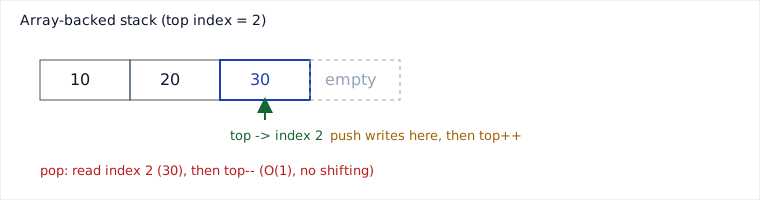
Sequence: push(10), push(20), push(30), peek(), pop(), push(40), pop()
| Op | Stack (bottom→top) | Returned |
|---|---|---|
| push(10) | [10] | - |
| push(20) | [10,20] | - |
| push(30) | [10,20,30] | - |
| peek() | [10,20,30] | 30 |
| pop() | [10,20] | 30 |
| push(40) | [10,20,40] | - |
| pop() | [10,20] | 40 |
Minimal Java implementation
class ArrayStack<T> {
    private Object[] data = new Object[4];
    private int top = -1; // index of top element, -1 = empty

    public void push(T val) {
        if (top + 1 == data.length) resize();
        data[++top] = val;
    }

    @SuppressWarnings("unchecked")
    public T pop() {
        if (isEmpty()) throw new RuntimeException("stack empty");
        T val = (T) data[top];
        data[top--] = null; // avoid memory leak
        return val;
    }

    @SuppressWarnings("unchecked")
    public T peek() {
        if (isEmpty()) throw new RuntimeException("stack empty");
        return (T) data[top];
    }

    public boolean isEmpty() { return top == -1; }

    private void resize() {
        Object[] bigger = new Object[data.length * 2];
        System.arraycopy(data, 0, bigger, 0, data.length);
        data = bigger;
    }
}
Pitfalls
- Popping/peeking an empty stack — always check
isEmpty()first; unchecked pop is the #1 source of runtime crashes in stack code. - Forgetting to null out a popped array slot in a garbage-collected language — the array still holds a reference, causing a memory leak in long-lived stacks.
- Fixed-capacity array without resizing silently overflows or throws on
isFull()in real workloads where input size isn't known ahead of time. - Using a stack when order doesn't matter or FIFO is needed — reaching for a stack out of habit instead of a queue.
When to use / when not — trade-offs
Use a stack when the most recently seen unresolved item is what you need next: parsing/matching brackets, undo history, DFS/backtracking, expression evaluation, monotonic-stack problems (next greater element).
Avoid it when you need FIFO order (task scheduling, BFS, print queues) — a Queue is the named alternative there, since it removes from the opposite end it inserts from, preserving arrival order instead of reversing it. Also avoid a plain stack when you need random access to arbitrary elements (use a dynamic array/list) or fast lookup by key (use a hash map) — a stack deliberately gives up both to guarantee O(1) LIFO access.
Takeaways
- LIFO is a direct consequence of restricting all operations to one end — that restriction is what makes O(1) amortized push/pop possible.
- Array-backed stacks need amortized-cost resizing; linked-list-backed stacks avoid resizing but pay per-node allocation overhead.
- Reach for a stack when the next-needed item is always the most recently added unresolved one; reach for a queue when it's the opposite.
Recall: Why is popping from the front of a plain array O(n) while popping from the back is O(1)?
L0 · A stack is a LIFO (Last-In, First-Out) data structure that restricts insertion and deletion to a single end.
L1 · ⑤ Adversary/Edge — “If you implement a stack using a dynamically resizing array, what is the worst-case time complexity of a single push operation?”
Trap: It is always O(1) because we append to the end of the array.
Bar: When the array reaches capacity, it must allocate a new array of double size and copy all N elements, taking O(N) worst-case time, though the amortized complexity remains O(1). Implementing Stack
L2 · ② Failure — “In recursive algorithms, when does a stack overflow occur, and how do you protect against it?”
Trap: When the system runs out of heap memory.
Bar: Stack overflow occurs when the thread's call stack frame limit (typically 1MB) is exceeded by deep recursion; convert recursive calls to an iterative loop using an explicit, heap-allocated Stack/Deque structure. Implementing Stack
L3 · ③ Scale — “You are designing an undo-redo stack for an editor. A user performs 1,000,000 edits. How do you prevent out-of-memory errors?”
Trap: Store the complete document state at each step on the stack.
Bar: Use the Command pattern to store only delta operations (e.g. insert/delete characters + indices) on the stack, and enforce a maximum capacity limit using a circular buffer. Applications of Stack
L4 · ① Concurrency — “How do you implement a thread-safe concurrent stack without bottlenecking threads on a single lock?”
Trap: Wrap the push and pop operations in a synchronized block or Mutex.
Bar: Under high contention, threads block; implement a lock-free stack using Treiber's algorithm, employing an atomic CAS (Compare-And-Swap) loop on the head pointer. Implementing Stack
L5 · ⑥ Cost/Simplicity — “Why would you choose a linked list-based stack implementation over an array-based stack?”
Trap: Linked list stack is always faster.
Bar: Choose a linked list stack only if you need a guaranteed O(1) worst-case push latency (avoiding array resize spikes) and memory allocation latency is acceptable; otherwise, array-based is superior. Implementing Stack
The floor keeps dropping: How does Treiber's lock-free stack protect against the ABA problem during concurrent pops?
Self-locate: died at L1 → you present mid-level; L4+ → staff signal.
Facing any new concept? Hit it with the six: concurrent? failing? at 100×? over time? adversarial? worth the cost? — that's the interviewer's whole playbook.
Synthesized for interview-prep study guide; grounded in standard DSA references (CLRS, GeeksforGeeks stack tutorials).
🤖 Don't fully get this? Learn it with Claude
Stuck on Introduction to Stack? Open Claude, copy a block below, and it'll teach you this exact concept — visually and interactively.
Build the mental picture, not memorization.
I just read a lesson on **Introduction to Stack** (DSA) and want to truly understand it. Explain Introduction to Stack from first principles using ONE vivid real-world analogy and a visual mental model — draw it as ASCII art or a clear step-by-step diagram — with a concrete example using real numbers. Then ask me one question to check I got the mental picture, and wait for my reply. If you're unsure or a claim isn't standard, say so and reason from first principles instead of guessing.
Socratic — adapts to where you're stuck.
Teach me **Introduction to Stack** interactively. Ask me ONE guiding question at a time, wait for my answer, and adapt to my confusion — build the idea with me step by step instead of explaining it all at once. If you're unsure or a claim isn't standard, say so and reason from first principles instead of guessing.
Active recall exposes what you missed.
Quiz me on **Introduction to Stack** with 5 questions, easy to tricky, ONE at a time. Tell me if each answer is right; at the end, explain clearly what I got wrong and why. If you're unsure or a claim isn't standard, say so and reason from first principles instead of guessing.
Intuition + hook + flashcards for long-term memory.
Help me remember **Introduction to Stack** for the long term: give the one-sentence intuition, a memorable hook/mnemonic, a tiny worked example, and 3 active-recall flashcards (Q -> A). If you're unsure or a claim isn't standard, say so and reason from first principles instead of guessing.