easy Valid Parentheses
Problem Statement
Determine if an input string containing only the characters '(', ')', '{', '}', '[', and ']' is valid. A string is considered valid if:
- Open brackets must be closed by the same type of brackets.
- Open brackets must be closed in the correct order.
- Each close bracket has a corresponding open bracket of the same type.
Examples
-
- Input:
"(]" - Expected Output:
false - Justification: The opening parenthesis '(' is not closed by its corresponding closing parenthesis.
- Input:
-
- Input:
"{[]}" - Expected Output:
true - Justification: The string contains pairs of opening and closing brackets in the correct order.
- Input:
-
- Input:
"[{]}" - Expected Output:
false - Justification: The opening square bracket '[' is closed by a curly brace '}', which is incorrect.
- Input:
Constraints:
- 1 <= s.length <= 104
sconsists of parentheses only '()[]{}'.
Try it yourself
Try solving this question here:
🎯 STRICT STANDOUT — Valid Parentheses (problem)
1. Why / judgment
LC-style valid parentheses — still the core parsing stack. Multi-type nesting ⇒ stack, not counts alone.
2. Worked complexity / trace (K11)
"(]" false; "{[]}" true; "[{]}" false. Θ(n) target.3. Pattern + when-NOT (K12)
Name: LIFO BRACKET MATCH
Recognition: only ()[]{}; order+type validity.
When-NOT: Queue cannot match nesting. Counter works only for one type. Not mono NGE.
4. Edge hand-run (K13)
"([)]": false. "{}": true. "(((" final non-empty false.5. Interviewer follow-ups
Q1. Equal counts enough?
A: No — order matters.
Q2. Space?
A: O(n) worst.
Q3. Follow-up min add to make valid?
A: Different problem — balance + stack variants.
✅ Solution Valid Parentheses
Problem Statement
Determine if an input string containing only the characters '(', ')', '{', '}', '[', and ']' is valid. A string is considered valid if:
- Open brackets must be closed by the same type of brackets.
- Open brackets must be closed in the correct order.
- Each close bracket has a corresponding open bracket of the same type.
Examples
-
- Input:
"(]" - Expected Output:
false - Justification: The opening parenthesis '(' is not closed by its corresponding closing parenthesis.
- Input:
-
- Input:
"{[]}" - Expected Output:
true - Justification: The string contains pairs of opening and closing brackets in the correct order.
- Input:
-
- Input:
"[{]}" - Expected Output:
false - Justification: The opening square bracket '[' is closed by a curly brace '}', which is incorrect.
- Input:
Constraints:
- 1 <= s.length <= 104
sconsists of parentheses only '()[]{}'.
Solution
- Initialization:
- Start with an empty stack.
- For every bracket in the input string:
- If the bracket is an opening bracket ('(', '{', '['), push it onto the stack.
- If the bracket is a closing bracket (')', '}', ']'):
- If the stack is empty, return false.
- Pop the top of the stack and check if it matches the corresponding opening bracket.
- Validation:
- If the current closing bracket doesn't match the top of the stack, return false.
- If the stack is not empty after processing all brackets in the string, return false.
- Final Output:
- If the stack is empty at the end, return true, indicating that the string has valid parentheses.
Algorithm Walkthrough
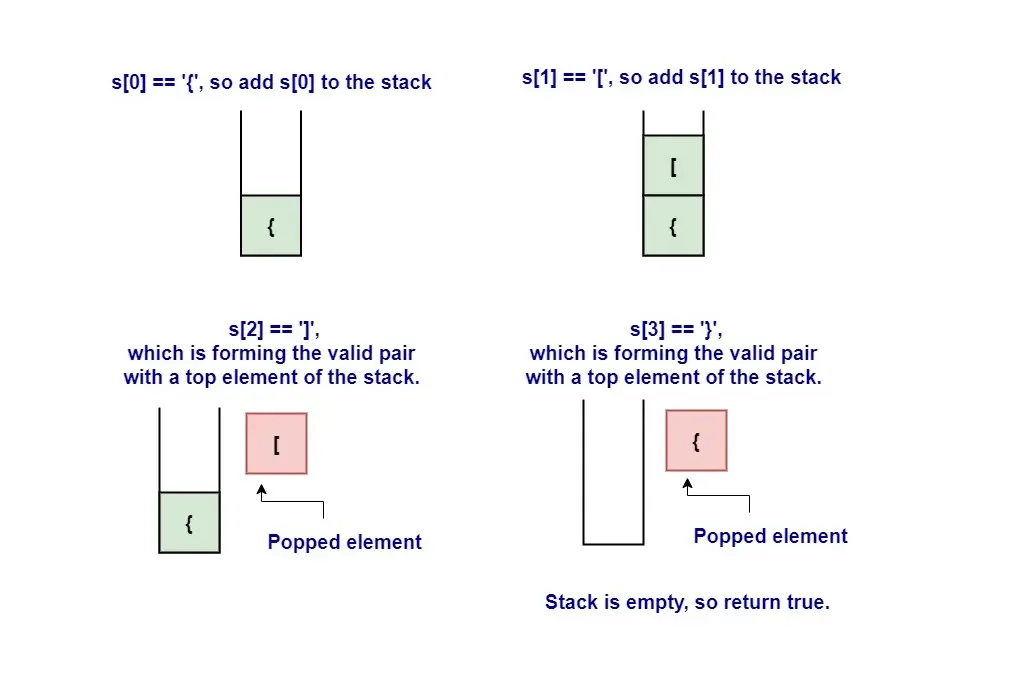
Using the input "{[]}":
- Start with an empty stack.
- Encounter '{', push onto the stack.
- Encounter '[', push onto the stack.
- Encounter ']', pop from the stack and check if the popped character is '['. It matches, so continue.
- Encounter '}', pop from the stack and check if the popped character is '{'. It matches.
- The string is processed and the stack is empty, so return true.
Code
import java.util.Stack;

public class Solution {

  public boolean isValid(String s) {
    Stack<Character> stack = new Stack<>();
    // Iterate through each character in the string
    for (char c : s.toCharArray()) {
      // If it's an opening bracket, push to stack
      if (c == '(' || c == '{' || c == '[') {
        stack.push(c);
      } else {
        // If stack is empty, it means no matching opening bracket
        if (stack.isEmpty()) return false;
        char top = stack.pop(); // Get the top element of the stack
        // Check if the current closing bracket matches the top of the stack
        if (c == ')' && top != '(') return false;
        if (c == '}' && top != '{') return false;
        if (c == ']' && top != '[') return false;
      }
    }
    // If stack is empty, all brackets were matched
    return stack.isEmpty();
  }

  public static void main(String[] args) {
    Solution solution = new Solution();
    System.out.println(solution.isValid("(]")); // false
    System.out.println(solution.isValid("{[]}")); // true
    System.out.println(solution.isValid("[{]}")); // false
  }
}
Complexity Analysis
- Time Complexity: O(n) where n is the length of the string. Each character is processed once.
- Space Complexity: O(n) in the worst case when all characters are opening brackets.
🎯 STRICT STANDOUT — Solution Valid Parentheses
1. Why / judgment
Push open, match close, final empty. Prefer Deque; map closer→opener. Same core as Balanced Parentheses.
2. Worked complexity / trace (K11)
"{[]}": push { [ ; pop ] matches [; pop } matches { → true.
"[{]}": push [ { ; ] mismatches { → false. Θ(n)/Θ(n).
3. Pattern + when-NOT (K12)
Name: OPENER STACK MATCH
Recognition: LC20 family.
When-NOT: Generate parentheses → backtracking. Score parentheses → DP/stack hybrid. ArrayDeque over Stack.
4. Edge hand-run (K13)
"(((": false final non-empty. "))": false empty pop. "()[]{}": true.5. Interviewer follow-ups
Q1. Map vs switch?
A: Both fine; map scales if more pair types.
Q2. Early exit?
A: On mismatch or empty pop — yes.
Q3. Production container?
A: ArrayDeque.
Recognize it: Matching / nesting, or “next greater / smaller” → LIFO, or a monotonic stack.
▶ Visualize this problem (step it, predict each fork)
🤖 Don't fully get this? Learn it with Claude
Stuck on Valid Parentheses? Open Claude, copy a block below, and it'll teach you this exact concept — visually and interactively.
Progressively stronger hints — you still solve it.
I'm working on the problem **Valid Parentheses** (DSA). Give me a HINT LADDER: start with the tiniest nudge, then wait. Only reveal the next, stronger hint when I ask. Do NOT show the full solution unless I type 'show solution'. Keep me doing the thinking. If you're unsure or a claim isn't standard, say so and reason from first principles instead of guessing.
See the technique, not just code.
Explain the optimal approach to **Valid Parentheses** with a VISUAL walkthrough: trace it on a small concrete example using ASCII art / a step-by-step diagram, narrate what changes each step, then give time & space complexity with a one-line derivation. If you're unsure or a claim isn't standard, say so and reason from first principles instead of guessing.
Catch bugs, edge cases, sub-optimality.
I'll paste my solution to **Valid Parentheses**. Review it for correctness, missed edge cases, and time/space complexity, then coach me toward the optimal — don't just rewrite it. Ask me to paste my code now. If you're unsure or a claim isn't standard, say so and reason from first principles instead of guessing.
Lock in recognition with look-alikes.
Give me 2 problems that use the SAME underlying pattern as **Valid Parentheses**. For each, let me attempt first, then review my answer and name the trigger signal that reveals the pattern. If you're unsure or a claim isn't standard, say so and reason from first principles instead of guessing.