Applications of Stack
A stack applies here whenever a process must suspend an unfinished unit of work, go deeper into a new one, and later resume exactly where it left off — the LIFO discipline guarantees the most recently suspended context is always the first one restored, which is precisely the order needed for nested/recursive structure (function calls, nested brackets, DFS branches, undo history).
Recognize the pattern
- The problem has nesting or reversal: brackets, tags, recursive calls, undo history, browser back button.
- You need to match the most recent unresolved item first (innermost bracket closes first, last action undone first).
- A traversal must fully exhaust one branch before trying a sibling (DFS) — as opposed to level-by-level (BFS, which needs a queue instead).
- You are converting a human-ordered (infix) sequence into a machine-ordered one by deferring operators until their operands are ready.
Brute force vs optimal
Take balanced-bracket validation as the running contrast. Brute force: repeatedly scan the string, find any adjacent matching pair like (), [], {}, delete it, and rescan from the start until no pair remains or the string is stuck. Each deletion costs an O(n) scan, and up to n/2 deletions happen, so this is O(n²) time, O(n) space for the mutable copy. Optimal (stack): scan once left to right; push every opener; on a closer, pop and check it matches. One pass, O(1) work per character → O(n) time, O(n) space worst case (all openers, e.g. (((().
Complexity, derived
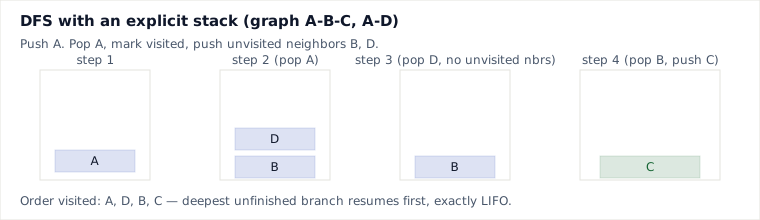
Each of the n characters triggers exactly one stack operation (a push or a pop), and push/pop on an array-backed stack are O(1) amortized (occasional resize doubles capacity, amortizing to O(1) per op). Total operations = n ⇒ time O(n). Space is bounded by how many openers can be simultaneously unmatched — worst case every character is an opener, so the stack holds up to n entries ⇒ space O(n). The same accounting applies to DFS-with-explicit-stack (each vertex pushed once, popped once ⇒ O(V+E) time, O(V) space for stack + visited set) and to the call stack during recursion (space O(depth), not O(n), because siblings don't coexist).
Worked example: evaluating postfix 3 4 2 * 1 5 - / +
This is the postfix form of 3 + (4*2)/(1-5), produced by exactly the deferred-operator idea above. Scan left to right; numbers push, operators pop two operands, compute, push the result.
| Token | Action | Stack after |
|---|---|---|
| 3 | push 3 | [3] |
| 4 | push 4 | [3, 4] |
| 2 | push 2 | [3, 4, 2] |
| * | pop 2,4 → 4*2=8, push | [3, 8] |
| 1 | push 1 | [3, 8, 1] |
| 5 | push 5 | [3, 8, 1, 5] |
| - | pop 5,1 → 1-5=-4, push | [3, 8, -4] |
| / | pop -4,8 → 8/-4=-2, push | [3, -2] |
| + | pop -2,3 → 3+(-2)=1, push | [1] |
Final pop gives 1, matching 3 + (4*2)/(1-5) = 3 + 8/(-4) = 3 - 2 = 1. 9 tokens → 9 O(1) operations → O(n) time confirmed.
Reference implementation (bracket matching)
boolean isBalanced(String s) {
    Deque<Character> stack = new ArrayDeque<>();
    Map<Character, Character> pairs = Map.of(')', '(', ']', '[', '}', '{');
    for (char c : s.toCharArray()) {
        if (c == '(' || c == '[' || c == '{') {
            stack.push(c);
        } else if (pairs.containsKey(c)) {
            if (stack.isEmpty() || stack.pop() != pairs.get(c)) return false;
        }
    }
    return stack.isEmpty();
}
Pitfalls
- Forgetting the final emptiness check —
"(()"never fails a pop, but the stack isn't empty at the end; skipping that check wrongly reports balanced. - Counting instead of stacking — per-type counters pass
"([)]"(every count balances) even though the nesting order is wrong; only a stack enforces that the most recent opener matches the current closer. - Popping an empty stack — an unmatched closer like
")("must be checked withisEmpty()before popping, or it throws / silently underflows. - Using recursion for arbitrarily deep nesting (e.g. DFS on a 100,000-node linear chain) — the call stack has a fixed OS-level size and overflows; an explicit heap-allocated stack does not.
- Confusing LIFO with priority — a stack always returns the most *recent* item, not the most important one; that needs a heap/priority queue instead.
When to use / when not — vs. Queue (BFS)
Use a stack when correctness depends on most-recent-first resolution: nested syntax, undo/redo, backtracking, DFS, call-frame management. Don't use a stack when you need shortest-path / level-order guarantees — a queue (FIFO) is the named alternative there, e.g. BFS finds the shortest unweighted path because it explores all distance-k nodes before any distance-(k+1) node, which a stack cannot guarantee (DFS may find *a* path but not the shortest one). Trade-off: DFS uses O(depth) space and is simple to implement recursively; BFS uses O(width) space, which can be far larger on wide shallow graphs, but is required whenever "first found = shortest" matters.
Takeaways
- Stacks solve problems whose structure is nested or reversible — the operator/bracket/call that opened last must close first.
- Converting an O(n²) rescan-and-delete approach into a single O(n) pass is the recurring stack win: one push/pop per element, no re-scanning.
- Recursion *is* an implicit stack; reach for an explicit one when recursion depth is unbounded or you need to inspect/modify the pending frames.
- Pick stack vs. queue by what "first" needs to mean: most recent (stack) or earliest discovered (queue).
Recall: Why does DFS with an explicit stack use O(depth) space in the best case but can use O(V) space in the worst case?
Synthesized from stack/DFS complexity analysis and postfix-evaluation mechanics; verify against your course's specific graph-representation assumptions (adjacency list vs matrix) when computing DFS space bounds.
🤖 Don't fully get this? Learn it with Claude
Stuck on Applications of Stack? Open Claude, copy a block below, and it'll teach you this exact concept — visually and interactively.
Build the mental picture, not memorization.
I just read a lesson on **Applications of Stack** (DSA) and want to truly understand it. Explain Applications of Stack from first principles using ONE vivid real-world analogy and a visual mental model — draw it as ASCII art or a clear step-by-step diagram — with a concrete example using real numbers. Then ask me one question to check I got the mental picture, and wait for my reply. If you're unsure or a claim isn't standard, say so and reason from first principles instead of guessing.
Socratic — adapts to where you're stuck.
Teach me **Applications of Stack** interactively. Ask me ONE guiding question at a time, wait for my answer, and adapt to my confusion — build the idea with me step by step instead of explaining it all at once. If you're unsure or a claim isn't standard, say so and reason from first principles instead of guessing.
Active recall exposes what you missed.
Quiz me on **Applications of Stack** with 5 questions, easy to tricky, ONE at a time. Tell me if each answer is right; at the end, explain clearly what I got wrong and why. If you're unsure or a claim isn't standard, say so and reason from first principles instead of guessing.
Intuition + hook + flashcards for long-term memory.
Help me remember **Applications of Stack** for the long term: give the one-sentence intuition, a memorable hook/mnemonic, a tiny worked example, and 3 active-recall flashcards (Q -> A). If you're unsure or a claim isn't standard, say so and reason from first principles instead of guessing.