Using Built-in Stack in Different Programming Languages
A stack's three operations — push, pop, peek — all touch only the one open end of the storage, so any structure that can append/remove at one end in O(1) amortized time can serve as a stack without writing a single node-linking line yourself; built-in stacks are just a thin, correctness-audited wrapper over an existing array-list or linked-list type that restricts access to that one end.
Recognize the pattern
- Problem needs LIFO order: "most recent first," "undo last action," "match the nearest unmatched opener."
- You need push/pop/peek and nothing else — no random access, no search by index.
- Keywords: balanced parentheses, backtracking history, expression evaluation, DFS via explicit stack, monotonic stack for next-greater-element.
Brute force vs. built-in / optimal
Brute force: hand-roll a stack with a singly linked list or write your own dynamic array with manual resize logic. Cost: correct but error-prone (off-by-one on resize, forgetting to null out popped references causing memory leaks in managed languages), and it re-derives well-tested code for no benefit.
Optimal (built-in): use the language's vetted stack-capable type. It gives the same O(1) amortized push/pop with none of the re-implementation risk, JIT/inlining benefits, and often iterator/utility support (contains, size, isEmpty) for free.
| Language | Recommended stack API | Underlying structure |
|---|---|---|
| Java | Deque<T> via ArrayDeque (push/pop/peek) | resizable circular array |
| Python | list (append/pop) or collections.deque | dynamic array / doubly linked block list |
| C++ | std::stack<T> (adapter, default std::deque) | deque or vector |
| JavaScript | Array (push/pop) | dynamic array |
| C# | Stack<T> (generic, prefer over legacy System.Collections.Stack) | resizable array |
| Go | slice (append, truncate via re-slicing) | dynamic array |
Note: Java's classic java.util.Stack extends Vector, is synchronized (pays a lock on every call) and legacy-designed — ArrayDeque used as a stack is the modern, faster, unsynchronized choice and is what interviewers expect you to know.
Complexity, derived
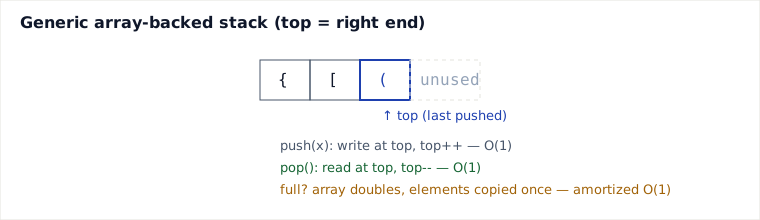
All these types are backed by a dynamic array (or an array-of-blocks deque). Push appends at the logical top:
- Amortized O(1) push: when capacity is full, the array doubles. A sequence of n pushes triggers resizes at sizes 1,2,4,8,...,n — total copy cost = 1+2+4+...+n ≈ 2n. Spread over n pushes, that's O(1) amortized per push (geometric series sums to less than 2× the final size).
- O(1) pop/peek: just decrement an index / remove the last block entry — no shifting, no traversal.
- Space: O(n) for n elements, plus up to 2× slack from the last doubling (worst case ~50% wasted capacity right after a resize).
Contrast with a naive stack built on an array with elements stored at index 0 (shifting on pop): pop becomes O(n) because every remaining element shifts left one slot — this is the bug brute-force implementations fall into.
Traced example — valid parentheses on "{[()]}"
| Step | Char | Action | Stack (top→right) |
|---|---|---|---|
| 1 | { | push | { |
| 2 | [ | push | { [ |
| 3 | ( | push | { [ ( |
| 4 | ) | pop, matches ( | { [ |
| 5 | ] | pop, matches [ | { |
| 6 | } | pop, matches { | (empty) |
Stack empty at the end ⇒ valid. Each char does one O(1) push or pop, so total work is O(n).
Pitfalls
- Using
java.util.Stackin Java: synchronized overhead and it exposesVector's index-based methods, breaking LIFO discipline if misused (e.g.insertElementAt). It also throws the legacyEmptyStackExceptionon an emptypop()/peek()— a type specific to this old class. - In Python, using
list.insert(0, x)/list.pop(0)to push/pop from the front is O(n) — always operate on the end of the list, or usecollections.dequeif you need front operations too. - Empty-stack behavior differs by API: legacy
java.util.StackthrowsEmptyStackExceptiononpop()/peek(); the recommendedArrayDeque(used viaDeque<T>) throwsNoSuchElementExceptiononpop()/remove()/element(), while itspeek()returnsnullon empty — a silent-null trap of its own; Python raisesIndexError. Always checkisEmpty()/length first, and handle the exact behavior of the type you actually chose. - In C++,
std::stackhas no iteration orclear()— treat that as a feature (it enforces LIFO-only access), not a bug to work around by digging into the underlying container.
When to use / when not — vs. a linked-list stack
Use the built-in array-backed stack (ArrayDeque, Python list, std::stack) by default: better cache locality, lower per-element memory overhead, amortized O(1) operations. Consider a hand-rolled linked-list stack only when you need guaranteed O(1) worst-case push with no resize pause (e.g. hard real-time constraints) or when elements are huge and you want to avoid copying during resize — trade-off is worse cache locality and extra pointer memory per node (typically 2-3x more memory per element than an array slot).
Takeaways
- A stack needs only single-end access — any dynamic array or deque gives you this for free with amortized O(1) push/pop.
- Prefer
ArrayDequeover legacyjava.util.Stack; prefer appending/popping at the list's end in Python, never the front. - Resizing doubles capacity, so the true cost of n pushes is O(n) total, i.e., O(1) amortized per push — not free, but cheap.
- Know your API's exact empty-stack behavior: legacy
java.util.Stack→EmptyStackException;ArrayDeque/Deque<T>→NoSuchElementExceptiononpop()/remove()/element()but a silentnullfrompeek(); Python →IndexError.
Recall: Why is list.pop(0) in Python O(n) while list.pop() is O(1), and which one should back a stack?
Synthesized from standard library documentation (java.util.ArrayDeque, java.util.Stack, Python collections, C++ std::stack, Go slices) and amortized analysis via the aggregate/accounting method for dynamic array doubling.
🤖 Don't fully get this? Learn it with Claude
Stuck on Using Built-in Stack in Different Programming Languages? Open Claude, copy a block below, and it'll teach you this exact concept — visually and interactively.
Build the mental picture, not memorization.
I just read a lesson on **Using Built-in Stack in Different Programming Languages** (DSA) and want to truly understand it. Explain Using Built-in Stack in Different Programming Languages from first principles using ONE vivid real-world analogy and a visual mental model — draw it as ASCII art or a clear step-by-step diagram — with a concrete example using real numbers. Then ask me one question to check I got the mental picture, and wait for my reply. If you're unsure or a claim isn't standard, say so and reason from first principles instead of guessing.
Socratic — adapts to where you're stuck.
Teach me **Using Built-in Stack in Different Programming Languages** interactively. Ask me ONE guiding question at a time, wait for my answer, and adapt to my confusion — build the idea with me step by step instead of explaining it all at once. If you're unsure or a claim isn't standard, say so and reason from first principles instead of guessing.
Active recall exposes what you missed.
Quiz me on **Using Built-in Stack in Different Programming Languages** with 5 questions, easy to tricky, ONE at a time. Tell me if each answer is right; at the end, explain clearly what I got wrong and why. If you're unsure or a claim isn't standard, say so and reason from first principles instead of guessing.
Intuition + hook + flashcards for long-term memory.
Help me remember **Using Built-in Stack in Different Programming Languages** for the long term: give the one-sentence intuition, a memorable hook/mnemonic, a tiny worked example, and 3 active-recall flashcards (Q -> A). If you're unsure or a claim isn't standard, say so and reason from first principles instead of guessing.