BST Operations
A binary search tree makes search, insert, and delete all run in time proportional to the tree's height — not its size — because at every node the BST invariant (left subtree < node < right subtree) lets you discard one entire subtree with a single comparison, the same halving idea as binary search but on a linked structure instead of an array.
Recognize the pattern
- Data has a total order and you need repeated search / insert / delete / range queries, not just build-once-and-scan.
- You need the sorted order to fall out of a traversal (inorder) rather than re-sorting after every mutation.
- Interview phrasing: "find/insert/delete in a BST", "kth smallest", "validate BST", "closest value", "floor/ceiling".
- Tell that rules it OUT: keys aren't comparable, or you only ever need O(1) min/max (use a heap instead).
Brute force vs optimal
Brute force — keep values in an unsorted array/list. Search is O(n) linear scan, insert is O(1) append but breaks sortedness, delete is O(n) to find plus O(n) to shift. No structure to exploit.
BST — each comparison prunes an entire subtree. Search/insert/delete all become O(h), where h is tree height. The cost you pay: h can degrade from O(log n) to O(n) if insertions arrive in sorted order and you never rebalance (that's what AVL/Red-Black trees fix, at the cost of extra rotation bookkeeping on every insert/delete).
Complexity from first principles
Let h = height of the tree, n = number of nodes. Each recursive step does O(1) work (one comparison) and moves one level down, so the recurrence is T(h) = T(h-1) + O(1), which unrolls to O(h) for search, insert, and the find-node part of delete.
- Balanced tree: each level roughly halves the remaining candidates, so h = O(log n) → operations are O(log n).
- Skewed tree (e.g. inserting 1,2,3,4,5 in order): every node has exactly one child, h = n → operations degrade to O(n).
- Space: recursive implementations use the call stack, O(h) — O(log n) balanced, O(n) skewed. Iterative implementations use O(1) auxiliary space.
Traced example: insert then delete
Start empty, insert in this order: 50, 30, 70, 20, 40, 60.
| Insert | Path taken | Result |
|---|---|---|
| 50 | empty → becomes root | root=50 |
| 30 | 50→left (30<50) | 50.left=30 |
| 70 | 50→right (70>50) | 50.right=70 |
| 20 | 50→30→left | 30.left=20 |
| 40 | 50→30→right | 30.right=40 |
| 60 | 50→70→left | 70.left=60 |
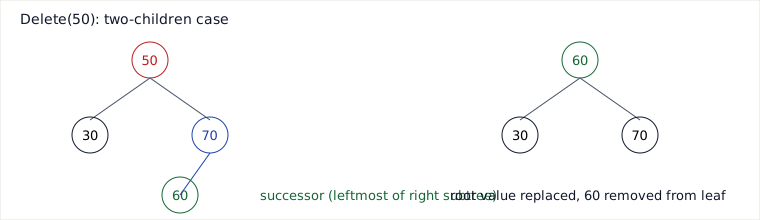
Now delete(50) — the root, a two-children case. Find the inorder successor = smallest value in right subtree (70's subtree): walk left from 70 → 60 (no left child) → successor = 60. Copy 60 into the root, then delete 60 from the right subtree (60 is a leaf there, so remove it directly). Final tree: root=60, left=30(20,40), right=70(null,null).
Java implementation
class Node {
    int val;
    Node left, right;
    Node(int v) { val = v; }
}

class BST {
    Node insert(Node node, int val) {
        if (node == null) return new Node(val);
        if (val < node.val) node.left = insert(node.left, val);
        else if (val > node.val) node.right = insert(node.right, val);
        return node; // duplicate: no-op
    }

    boolean search(Node node, int key) {
        if (node == null) return false;
        if (key == node.val) return true;
        return key < node.val ? search(node.left, key) : search(node.right, key);
    }

    Node delete(Node node, int key) {
        if (node == null) return null;
        if (key < node.val) { node.left = delete(node.left, key); return node; }
        if (key > node.val) { node.right = delete(node.right, key); return node; }
        // key == node.val: found the node to delete
        if (node.left == null) return node.right;
        if (node.right == null) return node.left;
        Node successor = node.right;
        while (successor.left != null) successor = successor.left;
        node.val = successor.val;
        node.right = delete(node.right, successor.val);
        return node;
    }
}
Pitfalls
- Forgetting to reassign the return value (
node.left = insert(node.left, val)) — a common bug that silently drops the insertion because Java passes references by value. - Using the predecessor and successor inconsistently, or deleting the wrong copy after promoting a successor value (must delete from the right subtree, not just detach a node).
- Assuming O(log n) without checking insertion order — sorted or reverse-sorted input degenerates any unbalanced BST to a linked list.
- Not handling duplicate keys explicitly (decide up front: reject, allow in right subtree, or store a count).
When to use / when not — trade-offs
Use a plain BST when keys are comparable, you need ordered traversal plus reasonably balanced insert patterns, and implementation simplicity matters more than worst-case guarantees.
vs. Balanced BST (AVL/Red-Black): guarantees O(log n) always by rotating on insert/delete, at the cost of extra rotation logic and slightly higher constant factors — pick this when adversarial or sorted input is possible.
vs. Hash Table: hashing gives O(1) average search/insert/delete but no ordering — pick a BST (or balanced variant) when you need range queries, kth-smallest, or sorted iteration; pick a hash table when you only need existence/lookup.
vs. Sorted Array + Binary Search: O(log n) search but O(n) insert/delete due to shifting — pick this only when the data is mostly static (build once, query many times).
Takeaways
- Every BST operation is a walk of length h; the whole game is keeping h close to log n.
- Deletion's two-children case is just "copy the successor's value up, then delete the successor," which is always a leaf-or-one-child case by construction.
- Recursive implementations trade O(h) stack space for clarity; iterative versions get the same time bound in O(1) space.
Recall: Why is deleting a two-children node's inorder successor always a simple leaf-or-one-child deletion, never itself a two-children case?
Play with it
Step through BST search yourself — press Play and predict each fork:
Synthesized from CLRS (Introduction to Algorithms) Ch. 12, and standard BST treatments (GeeksforGeeks, Princeton COS226).
🤖 Don't fully get this? Learn it with Claude
Stuck on BST Operations? Open Claude, copy a block below, and it'll teach you this exact concept — visually and interactively.
Build the mental picture, not memorization.
I just read a lesson on **BST Operations** (DSA) and want to truly understand it. Explain BST Operations from first principles using ONE vivid real-world analogy and a visual mental model — draw it as ASCII art or a clear step-by-step diagram — with a concrete example using real numbers. Then ask me one question to check I got the mental picture, and wait for my reply. If you're unsure or a claim isn't standard, say so and reason from first principles instead of guessing.
Socratic — adapts to where you're stuck.
Teach me **BST Operations** interactively. Ask me ONE guiding question at a time, wait for my answer, and adapt to my confusion — build the idea with me step by step instead of explaining it all at once. If you're unsure or a claim isn't standard, say so and reason from first principles instead of guessing.
Active recall exposes what you missed.
Quiz me on **BST Operations** with 5 questions, easy to tricky, ONE at a time. Tell me if each answer is right; at the end, explain clearly what I got wrong and why. If you're unsure or a claim isn't standard, say so and reason from first principles instead of guessing.
Intuition + hook + flashcards for long-term memory.
Help me remember **BST Operations** for the long term: give the one-sentence intuition, a memorable hook/mnemonic, a tiny worked example, and 3 active-recall flashcards (Q -> A). If you're unsure or a claim isn't standard, say so and reason from first principles instead of guessing.