Introduction to Tree View Pattern
A tree "view" pattern asks: if you stood to one side of a binary tree (or looked straight down at it), which nodes would be visible? Solving it means picking, for every level (left/right view) or every horizontal position (top/bottom view), the single node that "wins" — because level-order traversal visits nodes left-to-right inside each level, the first or last node dequeued at a level is exactly the boundary node a viewer standing to that side would see.
Recognize the pattern
- The problem literally says "view of a binary tree": left view, right view, top view, bottom view.
- You need one representative node per level (left/right view) or per horizontal distance from root (top/bottom view) — not all nodes.
- Output order is tied to level number or horizontal position, not to arbitrary traversal order.
- Restated as "for each level, report the leftmost/rightmost node" — a giveaway for level-order BFS with a per-level size snapshot.
Brute force to optimal
Brute force: traverse the whole tree in any order, tag every node with (level, column), then group by level and pick the min/max column per group. Correct, but needs a second grouping/sorting pass and stores columns for every node even though only the extreme one per level survives.
Optimal: BFS level-by-level, snapshotting queue.size() before dequeuing each level's nodes. Inside that fixed-size inner loop, the first node dequeued is the left-view node and the last is the right-view node — one pass, no grouping step, no per-node bookkeeping beyond the queue itself.
Complexity, derived
Every node is enqueued once and dequeued once: 2n queue operations at O(1) each → O(n) time. Space is the queue's peak size, which is bounded by the widest level of the tree, plus O(k) for the k-length result — so O(w + k) space, where w ≤ n (worst case a complete tree's last level holds ⌈n/2⌉ nodes, so w = O(n) in the worst case, but O(h) ≈ O(log n) for a balanced tree if you instead do DFS by level-index, since recursion depth bounds space there instead of level width).
Traced example — left view
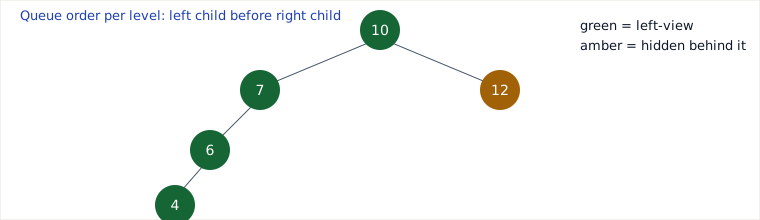
Tree: root = [10, 7, 12, 6, null, null, null, 4] (node 6 is left child of 7; node 4 is left child of 6).
| Level | Queue before processing | First dequeued (left-view pick) |
|---|---|---|
| 0 | [10] | 10 |
| 1 | [7, 12] | 7 |
| 2 | [6] | 6 |
| 3 | [4] | 4 |
Result: [10, 7, 6, 4] — matches the expected output because at every level the child-enqueue order is always left-then-right, so the queue's front at the start of a level is always the leftmost node of that level.
Java — left view (BFS) and top view (HD + TreeMap)
class TreeNode {
    int val; TreeNode left, right;
    TreeNode(int v) { val = v; }
}

List<Integer> leftView(TreeNode root) {
    List<Integer> result = new ArrayList<>();
    if (root == null) return result;
    Deque<TreeNode> queue = new ArrayDeque<>();
    queue.add(root);
    while (!queue.isEmpty()) {
        int size = queue.size();
        for (int i = 0; i < size; i++) {
            TreeNode node = queue.poll();
            if (i == 0) result.add(node.val);
            if (node.left != null) queue.add(node.left);
            if (node.right != null) queue.add(node.right);
        }
    }
    return result;
}

// Top view: first node seen at each horizontal distance (HD) from root,
// BFS order guarantees the first arrival at an HD is the topmost node there.
List<Integer> topView(TreeNode root) {
    TreeMap<Integer, Integer> hdToVal = new TreeMap<>();
    Deque<TreeNode> queue = new ArrayDeque<>();
    Deque<Integer> hds = new ArrayDeque<>();
    queue.add(root); hds.add(0);
    while (!queue.isEmpty()) {
        TreeNode node = queue.poll();
        int hd = hds.poll();
        hdToVal.putIfAbsent(hd, node.val);
        if (node.left != null) { queue.add(node.left); hds.add(hd - 1); }
        if (node.right != null) { queue.add(node.right); hds.add(hd + 1); }
    }
    return new ArrayList<>(hdToVal.values());
}
Pitfalls
- Enqueuing right child before left child silently turns "left view" into "right view".
- For top/bottom view, using DFS without tracking (level, HD) together breaks ties wrong — bottom view needs the last node seen at an HD (deeper overrides shallower), so DFS must compare levels, not just overwrite blindly.
- Confusing "left view" with "left boundary": left view is one node per level; left boundary (root-to-leaf boundary traversal) includes the entire left edge plus leaves, a different problem.
- Forgetting the null check for an empty tree crashes on
queue.poll()of an empty queue. - Degenerate shapes collapse the views: for a single-child chain (e.g. a right-only spine), every level has exactly one node, so the left view and the right view are identical — both return the entire spine. A test that only exercises bushy trees will miss a left/right mix-up that this input exposes immediately.
When to use / when not — trade-offs
Use BFS-with-size-snapshot when you need per-level extremes (left/right view) — it's a single linear pass with O(1) extra work per node.
Use HD-tracking (BFS or DFS) when the view is defined by horizontal position (top/bottom view) rather than level.
Alternative — DFS by level index: recurse with a level counter and a result list sized lazily; write into result.get(level) only the first time that level is reached. Same O(n) time, but O(h) space instead of O(w) — better for wide, shallow trees (e.g., a nearly-complete tree) where BFS's queue would balloon to O(n) while DFS recursion depth stays O(log n). Trade-off: DFS is trickier to get right for bottom/right view (must track and update by level, not just "first hit").
Takeaways
- Level-order BFS with a size-snapshot turns "view" problems into a one-line pick (first or last) per level.
- Top/bottom view swap the axis: track horizontal distance instead of level, using first-seen (top) or last-seen (bottom) at each HD.
- Choose BFS (O(w) space) vs. level-tracked DFS (O(h) space) based on whether the tree is wide or deep.
Recall: Why does enqueuing the left child before the right child guarantee correctness for left view, and what single change gives you the right view instead?
Pattern derived from standard level-order traversal (Cormen et al., BFS) applied to binary tree view problems as popularized in interview-prep references (e.g., LeetCode 199/1302, GeeksforGeeks tree-view series).
🤖 Don't fully get this? Learn it with Claude
Stuck on Introduction to Tree View Pattern? Open Claude, copy a block below, and it'll teach you this exact concept — visually and interactively.
Build the mental picture, not memorization.
I just read a lesson on **Introduction to Tree View Pattern** (DSA) and want to truly understand it. Explain Introduction to Tree View Pattern from first principles using ONE vivid real-world analogy and a visual mental model — draw it as ASCII art or a clear step-by-step diagram — with a concrete example using real numbers. Then ask me one question to check I got the mental picture, and wait for my reply. If you're unsure or a claim isn't standard, say so and reason from first principles instead of guessing.
Socratic — adapts to where you're stuck.
Teach me **Introduction to Tree View Pattern** interactively. Ask me ONE guiding question at a time, wait for my answer, and adapt to my confusion — build the idea with me step by step instead of explaining it all at once. If you're unsure or a claim isn't standard, say so and reason from first principles instead of guessing.
Active recall exposes what you missed.
Quiz me on **Introduction to Tree View Pattern** with 5 questions, easy to tricky, ONE at a time. Tell me if each answer is right; at the end, explain clearly what I got wrong and why. If you're unsure or a claim isn't standard, say so and reason from first principles instead of guessing.
Intuition + hook + flashcards for long-term memory.
Help me remember **Introduction to Tree View Pattern** for the long term: give the one-sentence intuition, a memorable hook/mnemonic, a tiny worked example, and 3 active-recall flashcards (Q -> A). If you're unsure or a claim isn't standard, say so and reason from first principles instead of guessing.