medium Sum of Path Numbers
Problem Statement
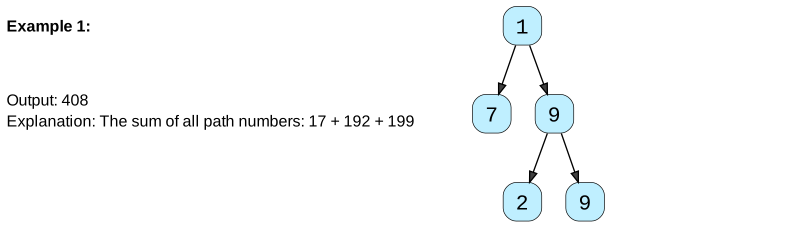
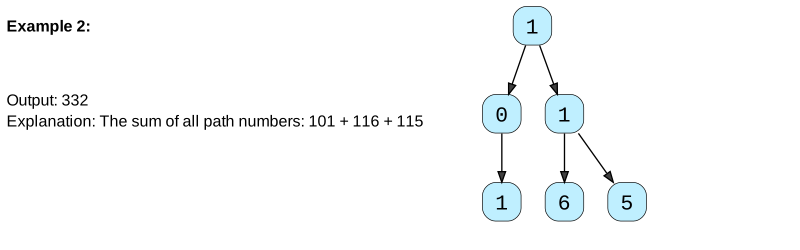
Given a binary tree where each node can only have a digit (0-9) value, each root-to-leaf path will represent a number. Find the total sum of all the numbers represented by all paths.
Constraints:
- The number of nodes in the tree is in the range
[1, 1000]. 0 <= Node.val <= 9- The depth of the tree will not exceed
10.
Try it yourself
Try solving this question here:
🎯 STRICT STANDOUT — Sum of Path Numbers
1. Why
Root→leaf as decimals; num=num*10+val; sum at leaves.
2. K11
Θ(n)/O(h). long if needed.3. K12
DECIMAL PATH FOLD. When-NOT: binary *2; path sum target.
4. K13
single digit; multi-digit paths.5. Panel
Q1. Formula? A: 10*num+val. Q2. Time Θ(n). Q3. Space O(h).
✅ Solution Sum of Path Numbers
Problem Statement
Given a binary tree where each node can only have a digit (0-9) value, each root-to-leaf path will represent a number. Find the total sum of all the numbers represented by all paths.
Constraints:
- The number of nodes in the tree is in the range
[1, 1000]. 0 <= Node.val <= 9- The depth of the tree will not exceed
10.
Solution
This problem follows the Binary Tree Path Sum pattern. We can follow the same DFS approach. The additional thing we need to do is to keep track of the number representing the current path.
How do we calculate the path number for a node? Taking the first example mentioned above, say we are at node ‘7’. As we know, the path number for this node is ‘17’, which was calculated by: 1 * 10 + 7 => 17. We will follow the same approach to calculate the path number of each node.
Here is the visual representation of the algorithm:

Code
Here is the code for this algorithm:
// class TreeNode {
//   int val;
//   TreeNode left;
//   TreeNode right;

//   TreeNode(int x) {
//     val = x;
//   }
// };

class Solution {

  public int findSumOfPathNumbers(TreeNode root) {
    return findRootToLeafPathNumbers(root, 0);
  }

  private static int findRootToLeafPathNumbers(
    TreeNode currentNode,
    int pathSum
  ) {
    if (currentNode == null) return 0;

    // calculate the path number of the current node
    pathSum = 10 * pathSum + currentNode.val;

    // if the current node is a leaf, return the current path sum.
    if (currentNode.left == null && currentNode.right == null) {
      return pathSum;
    }

    // traverse the left and the right sub-tree
    return (
      findRootToLeafPathNumbers(currentNode.left, pathSum) +
      findRootToLeafPathNumbers(currentNode.right, pathSum)
    );
  }

  public static void main(String[] args) {
    Solution sol = new Solution();
    TreeNode root = new TreeNode(1);
    root.left = new TreeNode(0);
    root.right = new TreeNode(1);
    root.left.left = new TreeNode(1);
    root.right.left = new TreeNode(6);
    root.right.right = new TreeNode(5);
    System.out.println(
      "Total Sum of Path Numbers: " + sol.findSumOfPathNumbers(root)
    );
  }
}
Time Complexity
The time complexity of the above algorithm is O(N), where ‘N’ is the total number of nodes in the tree. This is due to the fact that we traverse each node once.
Space Complexity
The space complexity of the above algorithm will be O(N) in the worst case. This space will be used to store the recursion stack. The worst case will happen when the given tree is a linked list (i.e., every node has only one child).
🎯 STRICT STANDOUT — Solution Sum of Path Numbers
1. Why
DFS carry num; leaf ans+=num.
2. K11
Θ(n)/O(h). Example path 12+13 style offline.3. K12
*10 FOLD. When-NOT: string parse each path.
4. K13
null 0; single.5. Panel
Q1. Overflow? A: long. Q2. Time Θ(n). Q3. Space O(h).
Recognize it: Hierarchical data → recurse on children; BFS (queue) for level-order, DFS (recursion) for paths.
▶ Visualize this problem (step it, predict each fork)
🤖 Don't fully get this? Learn it with Claude
Stuck on Sum of Path Numbers? Open Claude, copy a block below, and it'll teach you this exact concept — visually and interactively.
Progressively stronger hints — you still solve it.
I'm working on the problem **Sum of Path Numbers** (DSA). Give me a HINT LADDER: start with the tiniest nudge, then wait. Only reveal the next, stronger hint when I ask. Do NOT show the full solution unless I type 'show solution'. Keep me doing the thinking. If you're unsure or a claim isn't standard, say so and reason from first principles instead of guessing.
See the technique, not just code.
Explain the optimal approach to **Sum of Path Numbers** with a VISUAL walkthrough: trace it on a small concrete example using ASCII art / a step-by-step diagram, narrate what changes each step, then give time & space complexity with a one-line derivation. If you're unsure or a claim isn't standard, say so and reason from first principles instead of guessing.
Catch bugs, edge cases, sub-optimality.
I'll paste my solution to **Sum of Path Numbers**. Review it for correctness, missed edge cases, and time/space complexity, then coach me toward the optimal — don't just rewrite it. Ask me to paste my code now. If you're unsure or a claim isn't standard, say so and reason from first principles instead of guessing.
Lock in recognition with look-alikes.
Give me 2 problems that use the SAME underlying pattern as **Sum of Path Numbers**. For each, let me attempt first, then review my answer and name the trigger signal that reveals the pattern. If you're unsure or a claim isn't standard, say so and reason from first principles instead of guessing.