Introduction to Serialize and Deserialize Tree Pattern
Serialize/deserialize works because a tree's shape is fully recoverable from a single traversal as long as null children are recorded explicitly — the null markers act as delimiters telling the reconstruction algorithm exactly where each subtree ends, so one linear string can be walked once, in the same order it was written, to rebuild the identical tree with no ambiguity.
Recognize the pattern
- Problem says "design an algorithm to serialize and deserialize a binary tree" — LeetCode 297 is the canonical form.
- You need to turn a tree into a string/array (for storage, caching, or sending over a network) and later reconstruct the exact same structure, including shape, not just values.
- Values may repeat or be negative, so structure cannot be inferred from values alone — you need explicit null markers, or two traversal orders (e.g. preorder + inorder), which only disambiguates when values are unique.
Brute force → optimal
Brute force: record only the preorder values, skipping nulls. This is ambiguous: [1,2] could be "1 with left child 2" or "1 with right child 2" — many distinct shapes share the same value sequence. Deserialization cannot recover the tree without extra context.
Optimal: preorder (or level-order) traversal that also emits a sentinel for every null child. This makes the encoding a bijection — one tree maps to exactly one string and back. Both directions are a single linear pass.
| Approach | Time | Space | Correct for arbitrary trees? |
|---|---|---|---|
| Preorder, nulls omitted | O(n) | O(n) | No — ambiguous |
| Preorder + inorder (two arrays) | O(n) | O(n) | Only if all values distinct |
| Preorder with null sentinels | O(n) | O(n) | Yes, always |
Complexity from first principles
Serialize: the recursive call visits every real node exactly once (n calls) and every null child exactly once. A binary tree with n real nodes has at most n+1 null children (count leaves/missing edges: each of the n nodes contributes up to 2 child slots, n−1 of which are filled by other real nodes, leaving n+1 empty slots). So total emitted tokens = n + (n+1) = 2n+1 → O(n) time. The output string and the recursion stack (worst case a skewed tree of height n) both cost O(n) space.
Deserialize: we consume the token list once, left to right, one token per recursive call — again n + (n+1) = O(n) calls → O(n) time. Space is O(n) for the queue/list of tokens plus O(h) recursion stack, dominated by O(n) in the worst (skewed) case.
Traced example
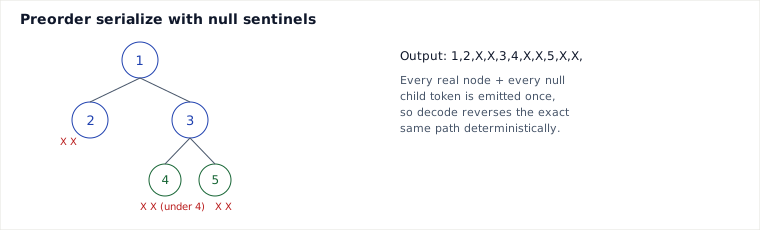
Tree: [1,2,3,null,null,4,5] — node 1 has children 2 and 3; node 2 is a leaf; node 3 has children 4 and 5 (both leaves).
| Step | Visit | Action | String so far |
|---|---|---|---|
| 1 | 1 | emit value | 1, |
| 2 | 2 (left of 1) | emit value | 1,2, |
| 3 | null (left of 2) | emit X | 1,2,X, |
| 4 | null (right of 2) | emit X | 1,2,X,X, |
| 5 | 3 (right of 1) | emit value | 1,2,X,X,3, |
| 6 | 4 (left of 3) | emit value + 2×X | 1,2,X,X,3,4,X,X, |
| 7 | 5 (right of 3) | emit value + 2×X | 1,2,X,X,3,4,X,X,5,X,X, |
Deserialize reads this same list front-to-back with an index/queue: pop "1" → make node(1); recurse left → pop "2" → make node(2); recurse left → pop "X" → return null; recurse right → pop "X" → return null (node 2 done); back up, recurse right of 1 → pop "3" → make node(3); … and so on, exactly retracing the serialize order.
Java implementation
class Codec {
    public String serialize(TreeNode root) {
        StringBuilder sb = new StringBuilder();
        buildString(root, sb);
        return sb.toString();
    }

    private void buildString(TreeNode node, StringBuilder sb) {
        if (node == null) {
            sb.append("X,");
            return;
        }
        sb.append(node.val).append(",");
        buildString(node.left, sb);
        buildString(node.right, sb);
    }

    public TreeNode deserialize(String data) {
        Deque<String> tokens = new ArrayDeque<>(Arrays.asList(data.split(",")));
        return buildTree(tokens);
    }

    private TreeNode buildTree(Deque<String> tokens) {
        String val = tokens.poll();
        if (val.equals("X")) return null;
        TreeNode node = new TreeNode(Integer.parseInt(val));
        node.left = buildTree(tokens);
        node.right = buildTree(tokens);
        return node;
    }
}
Pitfalls
- Forgetting the trailing delimiter/using a separator that also appears in values (e.g. comma with negative-number formatting like "-1") — pick a delimiter that cannot collide, or length-prefix each token.
- Using an iterator/index that isn't shared by reference across recursive calls — in Java, a plain
intindex won't advance across calls; use aDeque/queue or a mutable wrapper (int[1]). - Choosing inorder alone: inorder traversal without nulls cannot even be decoded uniquely with a companion array unless values are distinct, and preorder+inorder still costs an extra O(n) lookup structure — never use inorder as the sole encoding.
- Level-order (BFS) encodings need care with sentinel placement per level; missing a null between two real values shifts every subsequent index.
When to use / when not
Use preorder-with-nulls when you need a simple, general, always-correct codec for arbitrary binary trees (interview default, or a real string/blob format for persistence).
Alternative — level-order (BFS) with nulls: mirrors how LeetCode displays trees and is more intuitive for humans reading the array, and it naturally supports early-exit optimizations (e.g. trimming trailing nulls) for sparse/complete trees like heaps; but it needs a queue and slightly more bookkeeping than the recursive preorder version. Prefer BFS when the tree is close to complete (fewer null tokens) or when you want a format matching a UI/visualizer; prefer DFS preorder for simplicity and lowest code complexity.
Don't use a nulls-free encoding for anything except a known-BST with distinct values, since only there can inorder-implicit ordering resolve ambiguity — and even then it costs more code for no asymptotic gain.
Takeaways
- Null sentinels turn traversal into a bijection between trees and strings — that's the entire trick.
- Serialize and deserialize are mirror-image single passes: O(n) time, O(n) space, both dominated by tree size not shape (except stack depth, which is O(h)).
- Preorder is simplest to code; level-order matches visual/array tree formats and can be more compact for complete trees.
Recall: Why does a pure preorder traversal without null markers fail to uniquely reconstruct an arbitrary binary tree, and what's the minimal fix?
Compiled from the extracted source page on the Serialize/Deserialize Tree pattern (LeetCode 297-style problem), cross-checked against standard preorder-with-sentinels and BFS-codec approaches used in mainstream interview-prep references.
🤖 Don't fully get this? Learn it with Claude
Stuck on Introduction to Serialize and Deserialize Tree Pattern? Open Claude, copy a block below, and it'll teach you this exact concept — visually and interactively.
Build the mental picture, not memorization.
I just read a lesson on **Introduction to Serialize and Deserialize Tree Pattern** (DSA) and want to truly understand it. Explain Introduction to Serialize and Deserialize Tree Pattern from first principles using ONE vivid real-world analogy and a visual mental model — draw it as ASCII art or a clear step-by-step diagram — with a concrete example using real numbers. Then ask me one question to check I got the mental picture, and wait for my reply. If you're unsure or a claim isn't standard, say so and reason from first principles instead of guessing.
Socratic — adapts to where you're stuck.
Teach me **Introduction to Serialize and Deserialize Tree Pattern** interactively. Ask me ONE guiding question at a time, wait for my answer, and adapt to my confusion — build the idea with me step by step instead of explaining it all at once. If you're unsure or a claim isn't standard, say so and reason from first principles instead of guessing.
Active recall exposes what you missed.
Quiz me on **Introduction to Serialize and Deserialize Tree Pattern** with 5 questions, easy to tricky, ONE at a time. Tell me if each answer is right; at the end, explain clearly what I got wrong and why. If you're unsure or a claim isn't standard, say so and reason from first principles instead of guessing.
Intuition + hook + flashcards for long-term memory.
Help me remember **Introduction to Serialize and Deserialize Tree Pattern** for the long term: give the one-sentence intuition, a memorable hook/mnemonic, a tiny worked example, and 3 active-recall flashcards (Q -> A). If you're unsure or a claim isn't standard, say so and reason from first principles instead of guessing.